
Ontario’s deficit has grown by more than $3 billion in the past few months, and as Siobhan Morris reports, the province’s opposition is pulling no punches.
Ontario’s deficit has grown by more than $3 billion in the past few months as the province continues to face economic headwinds blowing up from the U.S.
In an economic update delivered on Thursday, the Ford government said the deficit for 2026-27 is now projected to be $16.9 billion, up from the $13.8 billion that was projected in the budget tabled back in March.
“The impact of U.S. tariffs – which affect, among others, our steel, our auto and our manufacturing sectors – and global unrest impacting the price of gas has risen the cost of goods and has driven a sea of uncertainty,” Finance Minister Peter Bethlenfalvy said after delivering his fall economic statement. “As a result, Ontario families and businesses are feeling the impacts.”
However, he said the province has a plan “to protect workers, businesses and communities while building a stronger economy for the future,” despite the turbulence.
Most of the measures to do so have previously been announced. They include the joint $8.7 billion Canada-Ontario action plan with the federal government to bolster the steel, automotive and critical mineral sectors, as well as a recently announced plan to provide $8 billion in provincial tax relief to businesses by allowing them to write off a wide arrange of assets, another joint venture with the feds.
Some of the higher deficit owes to boosted funding to the government’s contingency and reserve funds, so-called rainy day funds.
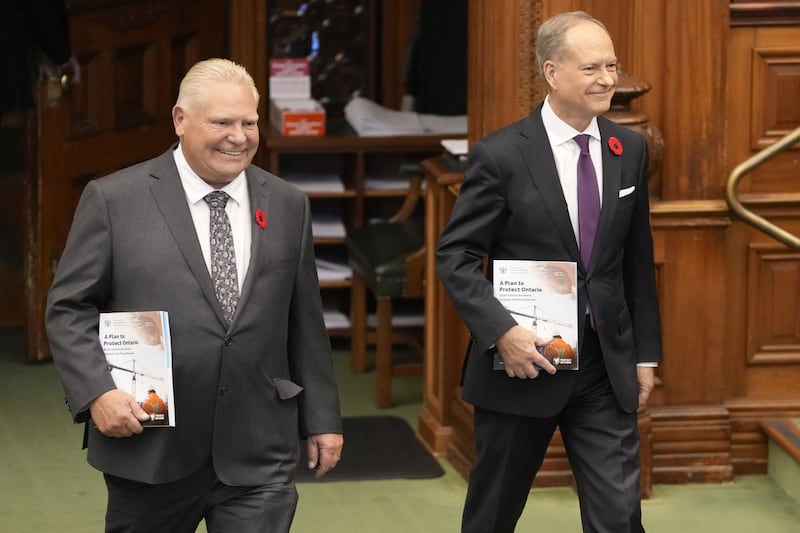 Le premier ministre de l’Ontario, Doug Ford, à gauche, et le ministre des Finances de la province, Peter Bethlenfalvy, arrivent à une présentation de l’exposé économique d’automne, à Toronto, le 29 octobre 2026. LA PRESSE CANADIENNE/Frank Gunn Le premier ministre de l’Ontario, Doug Ford, à gauche, et le ministre des Finances de la province, Peter Bethlenfalvy, arrivent à une présentation de l’exposé économique d’automne, à Toronto, le 29 octobre 2026. LA PRESSE CANADIENNE/Frank Gunn
Ontario has increased funding in its fiscal reserve fund from $1.5 billion to $2.2 billion. The province says the increase reflects “ongoing extraordinary circumstances, including significant trade-related risks to Ontario’s economic outlook.”
The province also topped up its contingency fund by an additional $3.8 billion in order to be prepared for further economic uncertainty, bringing the total in that fund to $4.9 billion.
Bethlenfalvy called the move “prudent” despite questions about whether it is worth going deeper into debt to add to those accounts.
“When we tabled the plan in March, we didn’t have Section 338 tariffs in place. These are the new tariffs that the president put on Canada. We didn’t have bans of certain products,” Bethlenfalvy told reporters.
“We had, based on best estimates from private sector economists, an economy that was growing at one per cent in Ontario. It’s (now) growing at 0.5 per cent because these tariffs are having an impact. We didn’t have a war in Iran. So, these are the types of things that are impacting our expenses. We don’t know exactly how they’re going to land in the next five months.”
Smaller deficits of $12.7 billion and $6.7 billion are expected over the next two fiscal years, with a small surplus of $200 million projected for 2029-30. The government had projected in the spring budget that it hoped to return to balance in 2028-29 with a surplus of $600 million.
The government says that, despite the economic uncertainty, the province’s economy is expected to continue growing. Real GDP is projected to increase by just 0.5 per cent in 2026 and 1.5 per cent in 2027.
Corporate tax up, personal income tax down
The higher deficit comes even as overall government revenue is actually up, now projected at $2 billion higher than the $232.6 billion forecast in the spring budget. The government says this is due to higher-than-expected federal transfers, as well as $878 million more in sales tax and around $1.5 billion more in corporate tax revenue.
At the same time, the province has seen revenue drop in other areas. Revenue from personal income tax is $1.7 billion less than previously forecast, due to less-than-expected revenue from the CRA for 2025. Government officials say this mainly reflects less capital gains tax revenue than expected and also stems from difficulties in projecting personal income revenue.
The province is also now projecting $3.28 billion in Land Transfer Tax revenue, $497 million less than forecasted in the budget. That’s mainly owing to the sluggish housing market, the government says.
Bethlenfalvy said he’s not concerned the province’s revenue are overly exposed to the slumping housing market.
To help make up the shortfall, the government is borrowing $3.9 billion more, bringing long-term borrowing to $51.1 billion.
U.S. tariffs impacting economy
The budget also lays out some details in terms of how the trade war has started to impact Ontario’s economy.
For example, steel exports to the U.S. totalled $4.1 billion in the first eight months of 2026. That compares to $8.4 billion over the same period in 2024, a drop of more than 50 per cent.
Auto exports to the U.S. over the same period declined 13.7 per cent from $39.9 billion to $34.5 billion.
 Peter Bethlenfalvy Ontario Finance Minister Peter Bethlenfalvy delivers the government’s fall economic statement in the legislature in Toronto, on Thursday, Oct. 29, 2026. THE CANADIAN PRESS/Frank Gunn
While the government is projecting a return to balance in three years, a slower-growth scenario contemplates more large deficits over the next few years if, for example, the trade war drags on. A faster-growth scenario could see the province return to balance as soon as 2028-29 if it is resolved sooner.
Unemployment in the province sits at 7.2 per cent for 2026, but the government says it expects that to decrease to 6.1 per cent in 2029 with strengthening economic growth.
Opposition slams update
Responding to the government’s fall economic statement, opposition parties at Queen’s Park did not hold back.
“People simply cannot afford to live in this province,” Ontario Green Party Leader Mike Schreiner said.
He said the government should be looking at a wealth tax on the richest Ontarians in order to help balance the books.
Ontario NDP finance critic Jessica Bell also took aim at the update for failing to introduce any measures to help bring down the cost of living.
“Never have I seen a fall economic statement this mediocre,” Bell said. “I was shocked to see this fall economic statement does not do anything significant to address affordability. There are no significant measures in here to make it easier for people to pay for food at the grocery store or pay for rent at the end of the month.”
Interim Ontario Liberal Leader John Fraser said the update represents poor fiscal management more than economic conditions.
“The premier can’t keep blaming Trump. At some point, he’s got to look at his choices,” Fraser said.
Bethlenfalvy defended the update though, saying the government is already spending on a number of programs aimed at affordability, including a temporary break on HST off the purchase of a new home, as well as purpose-built rental buildings.
“These are a range of measures that are stimulating affordability for individuals, building for down the road, and keeping our construction sector jobs employed,” he said.
Other highlightsThe province says it is increasing the penalty for people who fraudulently claim the first-time homebuyers’ creditOntario is capping the monthly credit for the Ontario Electricity Rebate at 1,200 KWh for residential customers as of May 1, 2027. The government says this will maintain affordability and ensure stability. The average residential customer uses 700KWh. The $4 billion Protect Ontario Investment Fund announced in the spring budget has now been paused as the government explores possible better uses for the funds in the wake of further instability The province is proposing narrowing the Ontario Computer Animation and Special Effects Tax Credit so that just TV and film producers will be eligible, a move asked for by the industry to help support it.Related Stories