
In June, 20 Tao people squeezed into a narrow, 12-metre-long wooden boat, painted white and red, and set off on a journey that hadn’t been made in 300 years. Rowing nearly 200 kilometres, the members of the indigenous group made the crossing from Taiwan’s Orchid Island to Batanes, the northernmost province of the Philippines, across the Luzon Strait, which connects the Pacific Ocean to the South China Sea.
Intended to honour ancestral links between indigenous peoples on both sides of the strait, the trip became caught up in a very modern geopolitical dispute, inadvertently underlining the historic links between Batanes and Taiwan – which Beijing claims sovereignty over – that some in China are using to suggest Batanes’s three populated islands and smaller islets and atolls should also be under Chinese control.
“We just wanted to respect the historical relationship,” said Proto Galarion, a cultural worker in Mahatao, on the main island of Batan, where the Taiwanese boat is now being displayed. “But here you have a bigger power trying to manipulate the story, trying to change history. We know in our hearts that we are Filipinos, that Batanes is part of the Philippines.”

After its journey from Taiwan this past June, a traditional wooden ship now rests at a hall in Mahatao, in the northernmost province of the Philippines. Indigenous people once used such boats to travel among the islands of the Luzon Strait.
Lushly forested, rugged and storm-swept − looking more like Scotland than the rest of the Philippines − Batanes’s location in the middle of the Luzon Strait has given it a historical role far greater than its 200 square kilometres, about a third the size of the Greater Toronto Area.
Ancient Austronesians are believed to have spread south from Taiwan through Batanes en route to the Philippines and beyond. During the Second World War, the Japanese followed suit, seizing Batanes from their Taiwanese colonial outpost and using it as a staging ground for the invasion of the Philippines.
Were China to follow through on threats to invade or blockade Taiwan, Batanes’s location would likely again come into play. While the islands do not have a large permanent garrison, owing to their environmentally protected status and propensity for being struck by super typhoons, Manila is thinking of changing that.
“We need to increase our access by air and sea,” said Gilbert Teodoro, the Philippine Secretary of National Defence, adding that there will be a “multidomain deployment” of military assets to the islands.
“We realize that in the case of any Taiwan contingency, our waters and Batanes may be affected,” Mr. Teodoro told The Globe and Mail. “We include that in our defence calculations.”
These windswept volcanic islands lie south of Taiwan, which Beijing seeks to control. The Communist state has also grown bolder in asserting its maritime claims across the South China Sea.
While discussion of Batanes has so far been limited to Chinese academia and state media, with the government remaining silent on the issue, any suggestion that Beijing may have a claim to the islands is particularly sensitive in the Philippines. In recent decades, China has systematically encroached upon and seized territory across the South China Sea, much of it within Manila’s exclusive economic zone, an internationally recognized border extending as much as 200 nautical miles (370 kilometres) off a country’s coast.
In 2016, an international tribunal ruled much of China’s claims unlawful, but Beijing has refused to budge, and clashes between Chinese and Philippine coast guard and fishing vessels are becoming more common around hotly disputed Scarborough Shoal and the Spratly Islands. Many analysts see the South China Sea as one of the world’s most dangerous potential flashpoints for a future conflict, especially since the Philippines is a U.S. treaty ally, with Washington required to come to Manila’s aid if it is attacked.
Open this photo in gallery:Open this photo in gallery:
On a June tour of Scarborough Shoal, a Philippine fisheries plane spots a Chinese warship. The shoal, far to the southwest of Batanes islands, is another point of friction between the countries in the South China Sea.Ezra Acayan/Getty Images
Mr. Teodoro said the recent noise about Batanes is concerning because it echoes Beijing’s approach in the South China Sea, which also began with dubious historical claims before escalating to seizing territory and pushing Filipino fishermen out of their traditional waters.
“The Philippine government takes this issue very seriously because of that pattern,” Mr. Teodoro told The Globe. “We do not think this is a spur-of-the-moment action, but a carefully laid-out narrative.”
China’s Foreign Affairs Ministry did not respond to a faxed request for comment. The country’s ambassador to the Philippines, Jing Quan, said this month that the Philippines was fortunate to “have a neighbour like China in this region.”
“If we want to use force, we may easily win,” he said regarding territorial disputes with Manila. “But no, we will not choose force, and we love peace.”
Just as in the South China Sea, Chinese fishing and research vessels are becoming a regular sight in the waters around Batanes, where the presence of the Philippine Coast Guard is far smaller than in the disputed waters to the country’s west.
This is making fishermen on the islands nervous. Evaristo Come, who spoke with The Globe while whitewashing a church in Mahatao ahead of an upcoming festival, said he and his fellow fishermen fear being outclassed in their traditional waters. “We see them every day off Itbayat,” he said, referring to the island north of Batan. “They’re stealing our catch. We take photos of them and post them online, but what can we do? Chinese boats have better technology, they’re bigger.”
Basco, the main town on Batan, has a Coast Guard base to keep an eye on disputed waters.
At a port in Basco, the main town on Batan, Cesar Alcoy and his adult son, Renward, were loading a small red craft with coolers, nets and water as they prepared to head out on a three-day journey to the rich fishing grounds off Mavulis, the country’s northernmost island.
Mr. Alcoy, who has been fishing since he was a small child alongside his own father, said he makes the trip as many as four times a month. On some occasions, there can be 10 foreign vessels for every Philippine one, he said. “We’ve been here forever,” he said. “It should just be fishermen from Batanes.”
Father Cesar Alcoy and son Renward are used to seeing foreign vessels in the waters where they fish.
The suggestion of a Chinese claim to Batanes was first made at an academic conference in June, convened in part to respond to increased co-operation between the Philippines and Japan, which has been locked in a year-long diplomatic spat with Beijing over comments by Japanese Prime Minister Sanae Takaichi about the dangers posed by a war over Taiwan.
In May, Japanese, U.S. and Philippine naval vessels took part in the annual Balikatan exercises off the coast of Luzon, the main island south of Batanes.
That same month, during a visit by Philippine President Ferdinand Marcos Jr. to Japan, Tokyo and Manila also began formal negotiations to delimit their maritime borders east of Taiwan. Beijing vociferously objected, claiming it has territorial rights in the same waters.
China’s reaction, Mr. Teodoro said, was evidence “not only of their intent to control the South China Sea,” but also parts of the Pacific around Taiwan that could be used for an invasion of the self-ruled island.

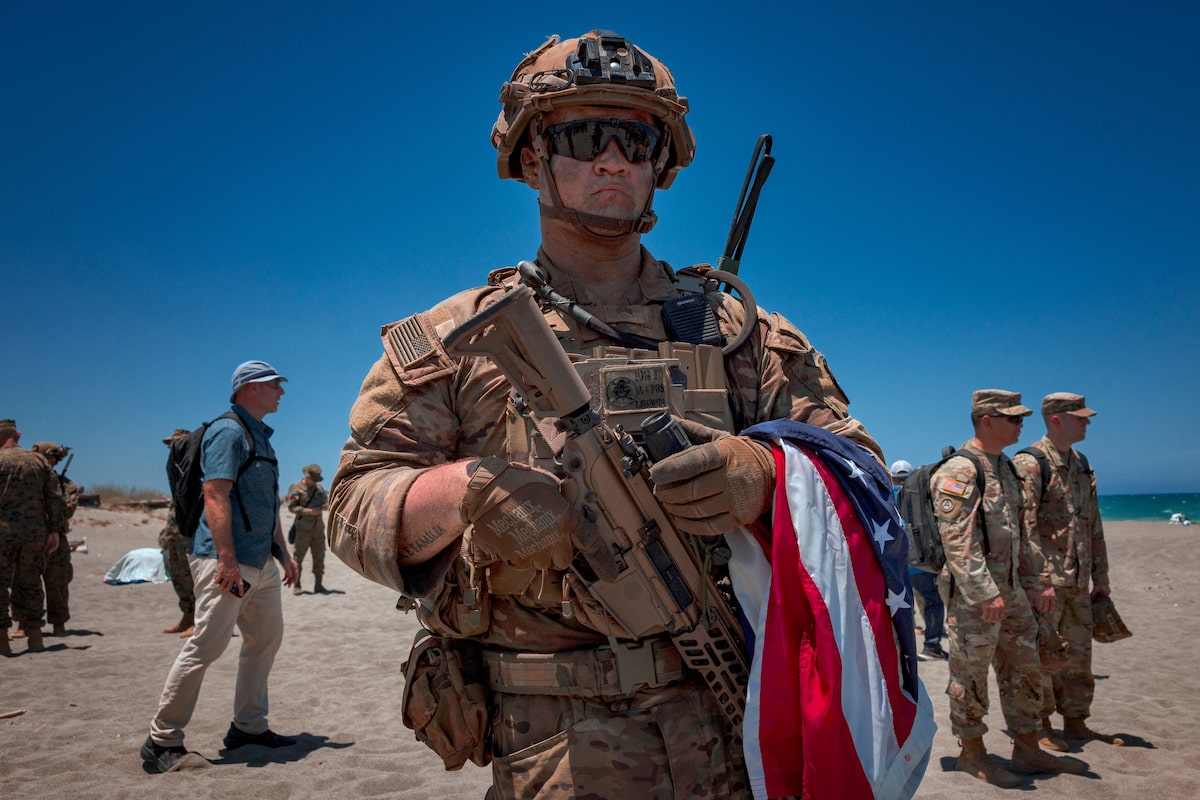
May’s Balikatan drills brought together U.S., Japanese and Philippine troops for live-fire exercises to combat a simulated landing on Luzon, the largest island in the Philippines. The exercise happened at a time of mounting tensions with Beijing.
Ezra Acayan/Getty Images

Before touring Balikatan together, Philippine defence chief Gilbert Teodoro, right, and his Japanese counterpart, Shinjiro Koizumi, were in Manila for bilateral talks. The countries have taken steps to more clearly define their maritime claims around Taiwan.
Mark Cristino/AFP via Getty Images
There are deep ancestral and historical links between Batanes and Taiwan, but the islands have been part of the Philippines since the Spanish colonial era, said Vincent Parada, a former defence analyst for the Philippine Navy who is now with research agency FACTS Asia.
“In the case of Batanes and areas east of Taiwan, you make a fabricated claim or misrepresent an existing claim and try to weave an air of legitimacy over it to justify actions that otherwise would be pretty clearly unlawful under international law.”
The U.S. has long sought to limit China’s military presence beyond what is known as the first island chain, which spans from Japan in the north to Taiwan and the Philippines in the south, a line of U.S. allies blocking Chinese access to the wider Western Pacific.
“Batanes is an integral link in the first island chain,” Mr. Parada said, which is why the Tokyo-Manila talks raised such alarm in Beijing.
“China feels like a noose is tightening around their neck and they want to break free. Part of the byproduct of spoiling the talks and delegitimizing them is that it legitimizes China’s patrols east of Taiwan,” he said.
“When we talk about either a Chinese amphibious invasion or blockade, they need to surround Taiwan to make that happen. They need freedom to manoeuvre in the eastern Taiwan seaboard, while the U.S., Taiwan and its other allies have a vested interest in restraining China’s forces to Taiwan’s west, where most of its defences are.”
Open this photo in gallery:Open this photo in gallery:
Taiwan, which celebrated its National Day on Oct. 10, is one of several states with competing claims over the South China Sea.Cheng Yu-chen/AFP via Getty Images; Ann Wang/Reuters/Reuters
While both the Philippine and U.S. militaries have deployed assets to Batanes as part of exercises in the past, there is little permanent presence there. “Frankly speaking, Filipinos never saw any need to armour the area except for the past few years, with China becoming more aggressive under Xi Jinping,” said Mr. Teodoro, who was sanctioned by Beijing in June after he called out China’s territorial ambitions in the South China Sea as the biggest obstacle to setting a code of conduct for the disputed waters.
With the U.S. overstretched militarily in the Middle East and reducing its footprint in Asia, some doubt whether the current administration would intervene to aid Taiwan − or even defend its treaty allies such as the Philippines, Japan and South Korea. Mr. Teodoro said he had “no doubt about the commitments of the United States toward Philippine resilience.” He pointed to remarks this month by his U.S. counterpart, Pete Hegseth, in which he said a US$1.5-trillion defence budget was necessary to match China, which is undergoing “the most historic military buildup potentially in world history.”
Batan locals such as George Geron, a retired seafarer, are worried about being caught in the middle of a South China Sea conflict.
Canada, too, plays a role in pushing back against Chinese territorial claims in the Pacific, with naval vessels carrying out “freedom of navigation” operations in both the South China Sea and the Taiwan Strait. Mr. Teodoro said such a show of solidarity was vital − “it’s important for the world to enforce the status quo against a unilateral alternative” that would see Taiwan annexed and the South China Sea turned into a “Chinese lake.”
“What we are doing is firmly moored on solid legal ground and solid political and moral grounds,” he said. “We are asserting ourselves against a much more powerful country, so we expect this to be a long, drawn-out struggle.”
On Batan, everyone The Globe spoke with endorsed the government’s tough stand when it comes to the South China Sea, even as they worried their islands could soon be caught up in a similar conflict. “We’re worried that the same thing will happen to us eventually,” said George Geron, a retired seafarer and chief engineer. “You know how the Chinese are − they want to claim everything, from Japan to the Scarborough Shoal.”
With reporting by Yasmin Coles in Batan and Manila
A world on guard: More from The Globe and MailGlobal defence in focus
Taiwan wants peace but prepares for war
Prepping for disaster, Finland-style
In Kramatorsk, drones rule the skies and everything below
Commentary
Charles Burton: As Xi and Trump do their dance, Canada is left to wonder about its place
Philippe Legrain: Europe must stand with Canada against Trump