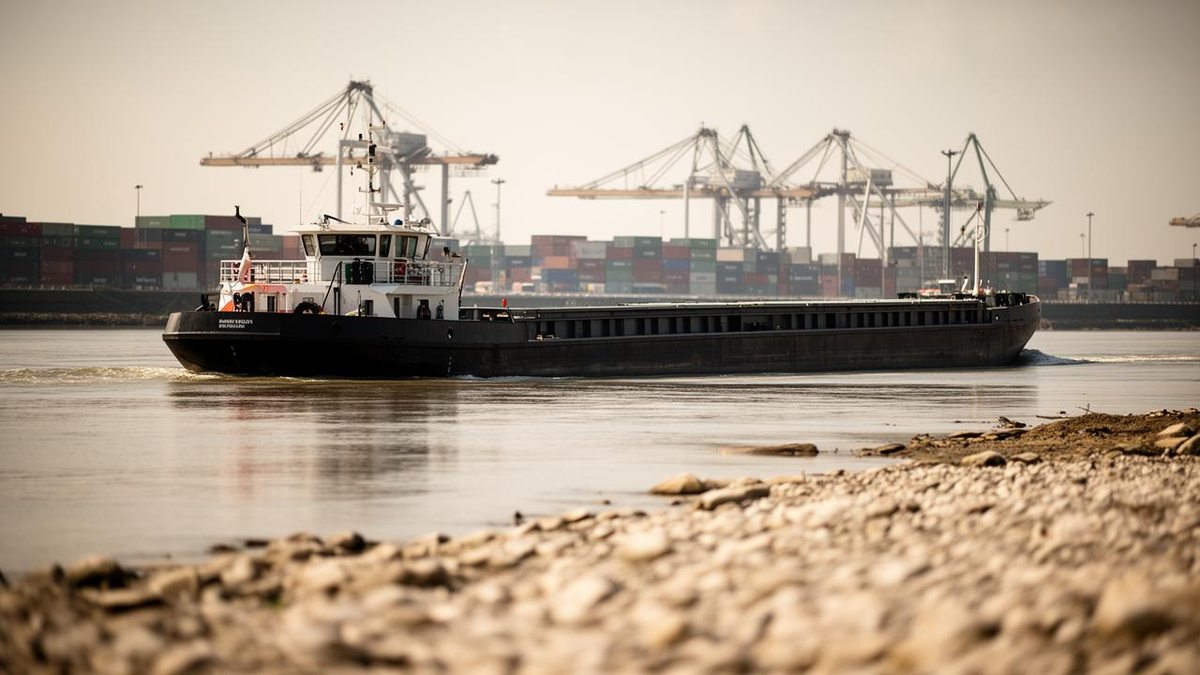
Germany’s economy grew in the third quarter of 2026 despite low water levels on the Rhine and high energy prices. According to preliminary calculations by the Federal Statistical Office, gross domestic product (GDP) rose 0.2 percent in price-adjusted terms compared with the previous quarter. Economists and Deutsche Bundesbank had expected stagnation; the feared setback therefore failed to materialize.
The economic recovery is thus losing momentum but is not coming to a halt. In the first half, economic output had grown much more strongly, with quarterly rates of 0.4 and 0.3 percent, driven above all by exports and debt-financed government spending on defense and infrastructure. In the summer, export momentum slowed noticeably, the statisticians found. Investment declined, while consumer spending picked up slightly – an increase that observers believe likely also reflects government spending, since consumer sentiment recently remained at a low level.
Compared with the same quarter a year earlier, German GDP was 1.3 percent higher. For the full year, the German government expects growth of 1.3 percent and the Ifo Institute 1.4 percent. After years of stagnation and contraction, this would mark a turning point: in 2025, growth was only 0.2 percent.
A look at the currency union reveals a growing gap between the two largest economies. While Germany expanded, France shrank 0.1 percent, after economic output had already stagnated or declined in the two previous quarters. Italy reported stagnation, while Spain grew strongly again, by 0.6 percent. Overall, GDP in the eurozone rose 0.4 percent, after 0.6 percent in the second quarter.
CountryGDP change in Q3 2026 vs. previous quarterGermany+0.2%France−0.1%Italy0.0%Spain+0.6%Eurozone total+0.4%
Behind the weaker summer growth are also special effects from the first half that had overstated the upswing. The chemical industry, for example, had benefited after the outbreak of the Iran war from the fact that East Asian competitors suffered more from higher energy prices than German companies. These effects have recently faded.
For the final quarter, economists expect a noticeable pickup. The Ifo business climate index, Germany’s most important leading indicator, has now risen for the sixth consecutive month. Expectations for export business reached their highest level since the start of Russia’s attack on Ukraine in February 2022, according to the Munich-based survey. “The economy is working its way out of the valley,” said Klaus Wohlrabe, head of the Ifo survey. Persistently high inflation, however, is dampening consumers’ willingness to spend.
For the markets, the figure signals that the eurozone’s largest economy is not sliding into recession, even if the pace lags behind the first half. France’s continued weakness is likely to fuel the debate over growth divergence in the eurozone and the European Central Bank’s monetary policy course. Momentum for the final quarter is expected above all from a recovery in exports and further rising business confidence.