
Drinking a Labatt and cheering on the Red Wings — it doesn’t get more Michigan than that, proclaims Mike Rogers, acknowledging the symbolic ties between the cross-border neighbours.
Then the ad quickly turns to the issue that has come to dominate the state’s tight political race.
Here in Michigan, we know Canada is not our enemy, Rogers says, before stressing we need to end this tariff war now.
WATCH | Mike Rogers’ tariff war ad:
By doing so, Rogers did what few Republicans have: directly repudiated Donald Trump’s trade war. It’s an act that would have been unthinkable just months ago.
Tariffs are felt across Michigan’s economy, particularly its signature industry. Many auto parts and vehicles made north of the border face a 25 per cent levy when they enter the United States. In the new year, that number will jump to 50 per cent, unless the two countries can strike a new trade deal.
Michigan’s auto manufacturers have been hammered, causing Detroit’s biggest firms to hemorrhage money — and increase the price of a new car. By one estimate, Trump’s tariffs have added $5,700 US to cars built in the highly integrated cross-border sector.
Even for those not in the market for a new car, the National Taxpayers Union finds tariffs have cost the average American family $6,000 each year.
At the start, President Trump claimed other countries would pay those extra costs. But Americans increasingly don’t believe that. Polling conducted (new window) by the libertarian CATO Institute finds 75 per cent of respondents say tariffs will be important to how they vote in the midterms.
We want more manufacturing, said Glenn Stevens of the automotive industry lobby group MichAuto. But we do not want that at the expense of our partnership and our trade relationship with Canada.
While his organization seeks to be non-partisan, he knows the Senate race in Michigan is so close that it is going to swing probably on 10,000 votes. And politicians are trying to get to that undecided voter.
Michigan trades heavily with Ontario
Poll after poll shows the top issue for Michigan voters is the cost of living.
A lot of people still don’t understand tariffs, said longtime Michigan pollster Ed Saropolus. But now they’ll say, ‘I know they’re not good for my bottom line.’
Trump’s problem has become the problem of every Republican candidate — especially those in states that are highly reliant on trade with Canada.
Michigan does more business with Ontario than it does with virtually every other U.S. state.
We probably feel the effects of the trade fight with Canada more than any other state, Republican strategist Jason Roe told CBC News on a visit to the state this month. There is no question the president has hurt himself politically in Michigan.
Control of Congress and control of the Senate could very well be decided right here in Michigan. We have three competitive congressional seats. Democrats only need four [nationally].
It’s a tight race between Rogers and Democratic candidate Abdul El-Sayed, with both parties and associated political action groups spending hundreds of millions of dollars in the campaign in Michigan alone.
With the president’s national approval rating at a dismal 36 per cent, Republican candidates like Rogers are looking to create distance from Trump’s less-popular policies and actions.
That works its way into the message Rogers’ supporters deliver when door-knocking across the state.
Mike Rogers is working to look at the Canadian tariffs and see which ones are costing Michiganders and reduce those, Aiden Haas of the Michigan College Republicans told his team in mid-October as they set out to rally support while going door to door in Lansing.
El-Sayed: Trump tariffs are ‘dumb’
Despite the tariff-related tension, the Trump-friendly network Fox News has been focusing on the Democratic candidate’s religion.
There are near-daily segments pushing fears about El-Sayed, a charismatic physician who could become the first Muslim U.S. senator, should he win the state.
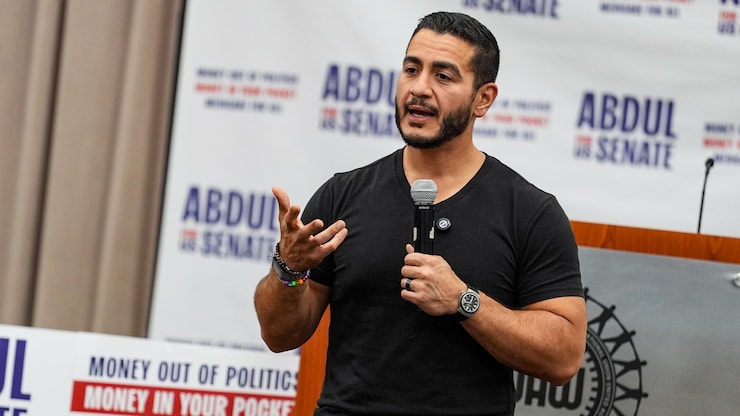
Democrat Senate candidate Abdul El-Sayed is putting U.S. President Donald Trump’s trade war with Canada on the ballot in Michigan in the midterms.
Photo: Associated Press / Julia Demaree Nikhinson
Republicans accuse him of being a socialist and radical Islamist. He rejects both claims regularly.
In television ads, El-Sayed has called Trump’s tariffs dumb. He has said he supports targeted tariffs to restore Michigan manufacturing, but calls the action against Canada a vanity trade war that Donald Trump has decided to inflict upon all of us for no clear, observable reason.
Amid this trade tension, the personal attacks on El-Sayed have kept the race competitive, with polling suggesting a near-even split in support between the two candidates.
Michigan has only elected Democratic senators in the last 26 years. But it did vote for Trump by a 1.5 per cent margin in 2024. Where goes Michigan, often so goes the United States, in its politics.
Strategist Roe, no fan of the president, says he’s tried to stay optimistic about the chances for Republican congressional candidates in Michigan.
But he says it’s hard when one of the focal points of our messaging in 2024 was we were going to lower the cost of living, to now be in a situation in which the cost of living is obviously very difficult for most Michiganders to navigate.