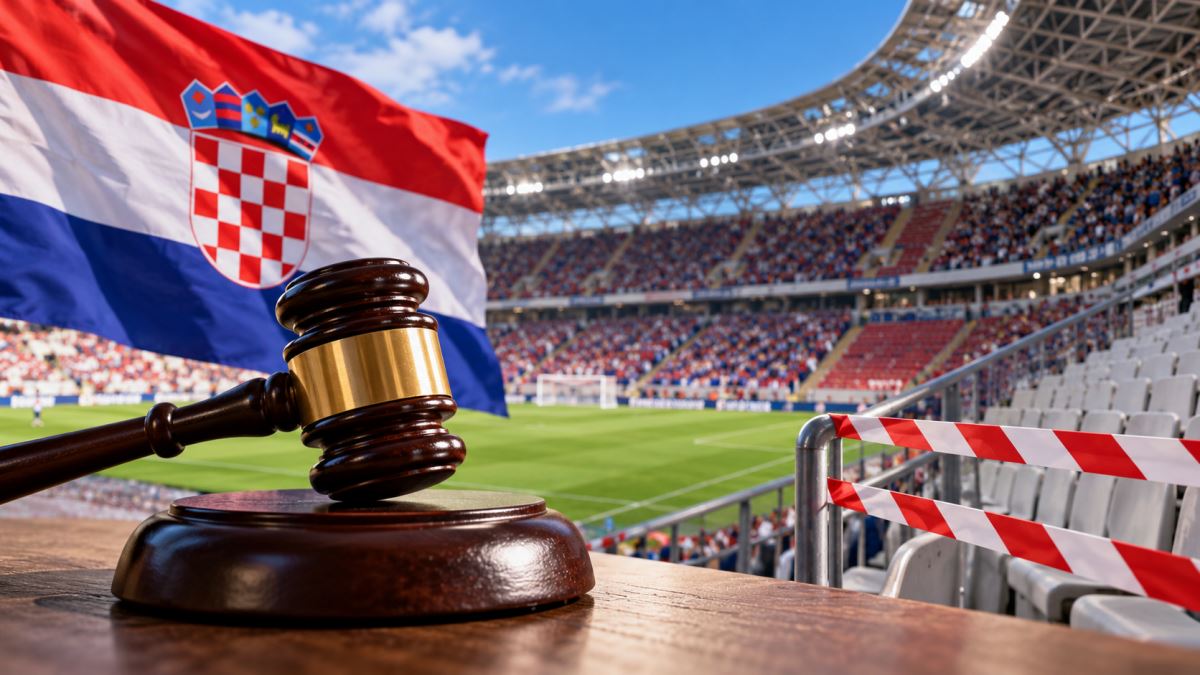
UEFA rejects HNS appeal: €57,000 fine and suspended partial stadium closure remain in place
The Croatian Football Federation (HNS) has failed to overturn the disciplinary decision of the Union of European Football Associations (UEFA) following the Nations League match between Croatia and Spain, played on 6 October 2026 at Poljud Stadium in Split. According to a report published by the Spanish sports newspaper Mundo Deportivo on 30 October, UEFA rejected the Croatian federation’s arguments, meaning that the €57,000 fine remains unchanged. The suspended sanction requiring the closure of 20 percent of stadium capacity for one future home match of the national team in a UEFA competition also remains in force. This measure will not be implemented immediately but is subject to a two-year probationary period and the possible recurrence of a similar offence. This is a new development in the disciplinary proceedings, not a new penalty for the match played at the beginning of the month.
The rejection of the appeal comes after HNS publicly confirmed on 14 October that it had received the original decision, which identified three categories of offences: discriminatory behaviour by some supporters, the use of pyrotechnics and the blocking of passageways in the stands. UEFA’s official disciplinary records confirm the breakdown of the sanctions and the suspended measure concerning stadium capacity, while Mundo Deportivo reports that the Croatian side’s attempt to challenge the imposed amount was unsuccessful. The financial component of the sanction is binding on the federation regardless of whether another incident occurs in the future. The deferred measure, by contrast, is particularly important for the organisation of upcoming home matches and for spectators who would be denied access to part of the stands if it were activated. The decision therefore has consequences extending beyond the amount of the financial penalty itself.
How the €57,000 fine is divided
According to the official HNS statement and UEFA’s published disciplinary decision, the largest portion of the sanction, €30,000, was imposed for racist or other discriminatory behaviour by some supporters. This offence is also associated with the partial stadium closure measure, covering 20 percent of its capacity. A separate fine of €23,000 was imposed for the use of pyrotechnic devices. The remaining €4,000 relates to the blocking of public passageways in the stands, which UEFA treats as a match safety issue. These three amounts add up to €57,000, and following the rejection of the appeal, none of the individual penalties has been reduced, according to available reports.
This breakdown is important because the total amount covers several different violations of the rules. Discriminatory behaviour is governed by Article 14 of the UEFA Disciplinary Regulations, while the use of pyrotechnics falls under Article 16, which regulates order and safety at matches. Regarding obstructed passageways, UEFA refers in its published decision to Article 38 of its safety and security regulations. However, the publicly available summary of the decision does not provide a detailed description of the individual discriminatory chants or actions examined during the proceedings. It would therefore be inappropriate to attribute specific words, banners or gestures to particular supporters without additional officially confirmed information.
What preceded the disciplinary proceedings at Poljud
The match between Croatia and Spain took place on 6 October in Group A3 of the Nations League, with 32,690 spectators attending at Poljud, according to the official HNS match report. Croatia took the lead through Ivan Perišić in the 17th minute, but Spain overturned the result in the second half. Mikel Merino equalised in the 61st minute before scoring the winning goal for a 2-1 victory towards the end of the match. Croatia played the closing stages with ten men after Perišić was sent off in the 79th minute following a second yellow card. The sporting result and the disciplinary offences in the stands are two separate matters: UEFA did not penalise HNS because of the defeat, the refereeing or the national team’s performance, but because of conduct established by its disciplinary body in connection with the organisation of the match.
Poljud hosted one of the more significant fixtures of the autumn Nations League schedule. Under Slaven Bilić, Croatia were seeking points against the Spanish national team coached by Luis de la Fuente, but events on the pitch ultimately favoured the visitors. UEFA’s match report and official HNS data confirm the sequence of goals and the attendance figure, but football statistics alone cannot explain what happened in every section of the stands. The disciplinary proceedings were conducted under separate rules governing the responsibility of federations and spectator conduct. That is precisely why sporting success or failure does not affect the obligation of organisers and national federations to comply with safety and disciplinary requirements.
Suspended closure of 20 percent of stadium capacity is not an immediate ban
The most important distinction compared with some previous stadium closure cases is that the measure against HNS is suspended for two years. According to UEFA’s decision, it concerns 20 percent of stadium capacity at one subsequent home match played by the Croatian national team in a competition under UEFA’s authority, should the conditions for enforcement be met. This does not mean that 20 percent of the stands at Poljud or any other stadium must already be closed for the next match. Nor is the measure restricted exclusively to Poljud: the wording of the decision refers to the stadium at which the Croatian federation would be playing as the home team. The location of any eventual enforcement therefore depends on when the sanction might be activated and where the relevant match would then be played.
Article 26(3) of the 2026 UEFA Disciplinary Regulations provides that the competent disciplinary body will, as a rule, order the enforcement of a previously suspended measure if another offence of a similar nature is committed during the probationary period. A separate penalty may also be imposed for the new offence, meaning the consequences need not be limited to the previously suspended closure. It is important to emphasise that the regulations refer to action taken by the competent body, not to the automatic closure of a stadium following any incident whatsoever. The decisive factors are the nature of the new offence and the decision reached in the corresponding disciplinary proceedings. The two-year probationary period is therefore a time during which any new case of discriminatory behaviour would carry additional significance because of the existing sanction.
For matchgoers, this distinction has practical implications. The financial penalty affects HNS finances immediately, while a partial stadium closure could directly affect ticket availability and spectator seating arrangements, but only if it is enforced. The actual number of unavailable seats would depend on the capacity of the stadium selected for the match to which the measure would apply. At present, there is no basis for claiming that particular sections of the next home match have already been closed as a result of this decision. According to the published information, the deferred part of the penalty remains a warning of possible future consequences rather than an already implemented restriction on spectator capacity.
Why the national federation is responsible for supporter behaviour
The UEFA Disciplinary Regulations establish a broader responsibility for federations than simply determining whether an organiser personally caused an incident. Article 8 stipulates that a national federation or club may be held disciplinarily responsible for the conduct of its members, officials, players or supporters even when it can demonstrate that it was not at fault or negligent. Article 14 further regulates discriminatory behaviour and provides for at least a financial penalty combined with a partial stadium closure or a restriction on the sale of away tickets when the offence is committed by supporters of a federation or club. These rules apply to UEFA competitions generally, not only to the Croatian national team. Consequently, disciplinary decisions are normally directed at the federation participating in the competition, even though the specific actions were committed by individuals in the stands.
The regulations also clearly distinguish pyrotechnic offences from discrimination. The use of flares and similar devices is covered by provisions concerning order and safety in stadiums, while the blocking of passageways is assessed separately because it restricts spectator movement and may obstruct evacuation in an emergency. UEFA can therefore impose several penalties for a single match, each based on the corresponding offence. In the case of the match at Poljud, three different penalties were combined into one financial obligation for HNS. According to Mundo Deportivo, the rejection of the appeal means that the attempt to change the total amount did not alter this allocation of responsibility.
Earlier penalty following the away match in Seville
The proceedings following the Poljud match are not the only disciplinary consequence of Croatia’s encounters with Spain in the autumn edition of the Nations League. The two national teams also met on 29 September in Seville, at Ramón Sánchez-Pizjuán Stadium, where Spain won 4-1. According to an N1 report published on 10 October, UEFA fined HNS €20,000 for racist or discriminatory behaviour by some Croatian supporters at that match. At the same time, it imposed a suspended ban on ticket sales to Croatian supporters for one subsequent away match of the national team in a UEFA competition. A two-year probationary period was also established for this measure, meaning the ban did not take effect immediately.
Adding together the two separate financial decisions relating to the matches against Spain, HNS faces a total of €77,000 in fines: €20,000 for the incidents in Seville and €57,000 for those in Split. It is equally important that these are two different suspended measures. One concerns ticket sales to Croatian supporters at an away match, while the other concerns part of the capacity of a stadium where the national team plays at home. They are not interchangeable and should not be presented as a single, unified ban on supporters attending matches. Both, however, demonstrate that repeated conduct of a similar nature can have consequences for different groups of spectators and for match organisation during the probationary period.
The disciplinary sanctions following the match in Seville did not concern only the Croatian side. Mundo Deportivo reported on 30 October that the Spanish Football Federation had been fined €7,500 because supporters entered the pitch after the match on 29 September. This is a separate offence and a separate procedure, not part of the amount HNS must pay. Including this decision in the wider context demonstrates that UEFA assesses spectator behaviour on both sides, regardless of which national team won. The type of offence and the corresponding measure are determined according to the circumstances of each individual case, and the penalty imposed on one federation should not be interpreted as reducing the responsibility of the other.
What the rejected appeal means for the remainder of the Nations League
According to the official HNS schedule, Croatia’s next match is against England at Wembley on 12 November 2026, followed by a home match against Czechia on 15 November in the final stage of the group competition. The trip to London is relevant because of the earlier suspended measure concerning ticket sales to Croatian away supporters, while the home match against Czechia is considered in the context of the deferred sanction requiring a partial stadium closure. However, neither measure means an immediate ticket sales ban or an automatic reduction in capacity simply because the appeal has been rejected. Any enforcement would require an appropriate disciplinary basis and a decision by the competent authority. Supporters should therefore rely on specific official announcements concerning each match rather than conclusions drawn solely from the existence of a suspended penalty.
After four rounds in Group A3, HNS data show that Spain had 12 points, England nine, Croatia three and Czechia none. This gives the two remaining matches additional competitive importance but does not change the federation’s separate disciplinary obligations. The Croatian Football Federation must simultaneously address the national team’s sporting objectives and the organisational requirements arising from UEFA regulations. A possible partial stadium closure would affect the number of spectators allowed to enter, while activation of the away ticket ban would affect how supporters could follow the national team outside Croatia. According to the decisions currently published, these are possible consequences over the next two years, not changes already confirmed for the November fixtures.
Rejection of the appeal ends this attempt to reduce the penalty
The Mundo Deportivo report does not provide a detailed account of the arguments HNS presented in its appeal, nor is there sufficient information in the publicly available material to assess why any particular argument from the Croatian side was rejected. The outcome is known: the €57,000 fine has not been reduced, and the suspended closure of 20 percent of stadium capacity remains part of the disciplinary decision. UEFA regulations provide for proceedings before disciplinary and appeals bodies, but the media report itself does not justify predicting further legal action by HNS. Without an official statement from the federation concerning any continuation of the proceedings, such predictions would be speculation. For readers, it is therefore essential to distinguish the confirmed failure of the appeal from assumptions about future steps.
The outcome of the proceedings also sends a clear organisational warning: disciplinary responsibility for the behaviour of some spectators can have consequences long after the final whistle. In this case, the financial penalty has already been determined, while two separate suspended measures arising from the matches against Spain remain linked to possible future offences. The fact that the match at Poljud ended on 6 October does not mean that its administrative consequences for the federation ended on that date. Following the news published on 30 October, the main outstanding question is whether new disciplinary violations will occur during the probationary period that could lead to enforcement of the deferred measures. Until such decisions are made, HNS is obliged to pay the imposed financial penalties, while the partial stadium closure and the ban on away ticket sales remain suspended sanctions.
Sources:
– Mundo Deportivo – report from 30 October on the rejection of the HNS appeal and the penalty imposed on the Spanish Football Federation (link)
– UEFA – published disciplinary decisions concerning the Croatia-Spain match and the suspended partial stadium closure (link)
– Croatian Football Federation – official statement of 14 October concerning the €57,000 fine (link)
– UEFA – Disciplinary Regulations, 2026 edition, articles concerning federation responsibility, discrimination, safety and suspended penalties (link)
– Croatian Football Federation – official Croatia-Spain match report and attendance figure (link)
– Croatian Football Federation – Nations League match schedule and group standings (link)
– N1 – report from 10 October on the separate penalty following the match in Seville (link)
Tags
UEFA
Croatia
Spain
Croatian Football Federation
Nations League
disciplinary ruling
stadium closure
supporters