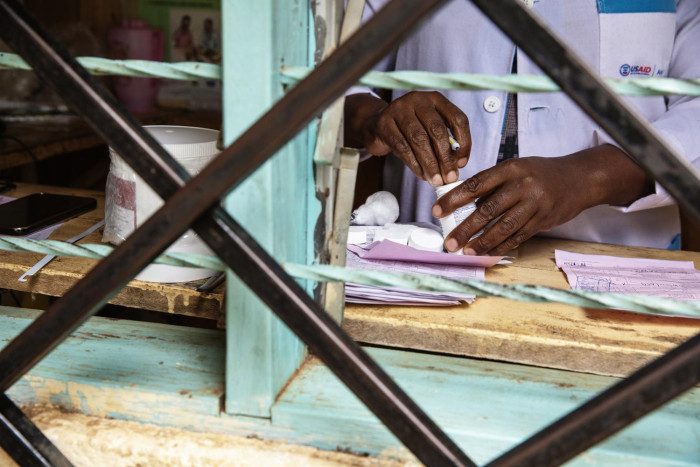

A pharmacist packs a bottle of antiviral pills at the pharmacy at the Ogwedhi Health Centre in Migori, Kenya. (Photo: Malin Fezehai/The New York Times)
Imagine a government forced to choose between building a hospital or a school and paying off a wealthy foreign bondholder. This isn’t a hypothetical dilemma. It is a harsh, everyday reality that affects nearly half the world’s population — 3.4 billion people in 46 countries, many of whom still struggle to make ends meet.
Global debt is currently close to 311% of world GDP. Developing nations, in particular, are suffocating from a sovereign debt crisis. This is not merely a story of economic mismanagement. It is the result of a global financial system that is fundamentally rigged, operating more like a mechanism for extraction than an engine for development.
This crisis is why AIDS Healthcare Foundation’s Freedom from Debt campaign is calling for a fundamental overhaul of the global financial system, where sovereign debt has become a barrier to health, education, and economic development for billions of people in developing countries.
This loan architecture has created a perverse reverse flow of wealth. Instead of spending adequately on programs that improve and save lives, poorer nations are subsidising richer ones to the tune of $3 trillion annually through exorbitant debt servicing, tax loopholes and illicit financial flows.
The math is staggeringly unjust. Developing countries, frequently penalised with “high-risk” credit labels, are forced to borrow at predatory rates. Consequently, they pay two to four times more in interest than the United States, and up to 12 times more than Germany. In 2024 alone, net interest payments on public debt for developing nations skyrocketed to a record $921 billion — a 10% jump from the previous year.
The human cost of this crisis is devastating. Behind every debt statistic is a child without a classroom, a community without a doctor and a family vulnerable to climate disasters. In many low- and middle-income countries, including those across the Asia-Pacific and Africa, debt payments now eclipse investments in health and education. Two out of three African countries, for example, spend more on debt interest than on healthcare for their citizens.
A significant part of the problem lies with private lenders. Commercial banks and bondholders now hold over 50% of the public external debt of many developing nations. When countries struggle to pay, these private creditors often exploit Western legal systems to force payouts, prioritising profit over the right to human survival.
This has been seen in Zambia, Sri Lanka and elsewhere, where private lenders have stalled negotiations or sued vulnerable nations for millions in UK and US courts.
Many Asean countries are no exception. Despite its upper-middle-income status, Thailand’s public debt-to-GDP ratio stood at 65.2% in October 2025 and was expected to rise to 68.2% in 2026, forcing the country to raise its public debt ceiling to 70% of GDP. While its 2026 budget for the Ministry of Education is 355 billion baht, the country allocates roughly 300–350 billion baht to service public debt. Had public debt been managed more effectively, many of the approximately 680,000 out-of-school children would have had access to education.
Though Laos has reduced its public debt from 112% of GDP in 2022 to 88% in 2025, the existing burden forces the government to cut public health spending, reduce essential medicine supplies, and limit its ability to address infrastructure deficiencies. Due to debt stress, the country faces a severe workforce shortage resulting from a drastic cut in the civil servant quota from 4,000 in 2014 to 230 in recent years.
In March 2026, the Philippines’ public debt reached a 21-year high at 65.2% of GDP. According to a report, 64% of Filipino families cannot pay a PHP10,000 (5,367.55 baht) hospital bill without going into debt. This has forced many Filipino workers to seek better income opportunities abroad just to afford access to basic healthcare.
And the list goes on.
It is immoral to allow this long-standing inequity to persist in the Asia-Pacific and globally. As such, the Freedom from Debt campaign is sounding the alarm: no nation should have to sacrifice its citizens to satisfy an unfair global financial system. A bold, structural reform is urgently needed.
First, implementation of the “Borrowers’ Forum” established by the Seville Financing for Development summit and the G20 in South Africa must be accelerated. Currently, developing nations negotiate alone against powerful creditor blocs. A functional, unified forum would allow them to share expertise, amplify their bargaining power and secure fairer terms.
Second, mandatory debt service pauses must be implemented during public health and climate emergencies. Countries hit by devastating disasters should not be forced to bleed their treasuries to pay foreign creditors. Immediate payment suspensions would allow governments to redirect their already limited funds to save lives and aid in recovery.
Finally, as artificial intelligence drives unprecedented global wealth, a 1% “AI Solidarity Levy” on AI-generated capital should be earmarked to fund debt relief and safeguard social protection for developing countries.
Achieving true progress and prosperity is impossible under the crushing weight of sovereign debt. It is time for global leaders to treat this debt crisis with the same urgency as a pandemic. The world needs a financial architecture rooted in justice and human dignity, not extraction.