
The New Geography of Globalization: How AI, Geopolitics, and Supply Chains Are Redrawing the Global Economic Map
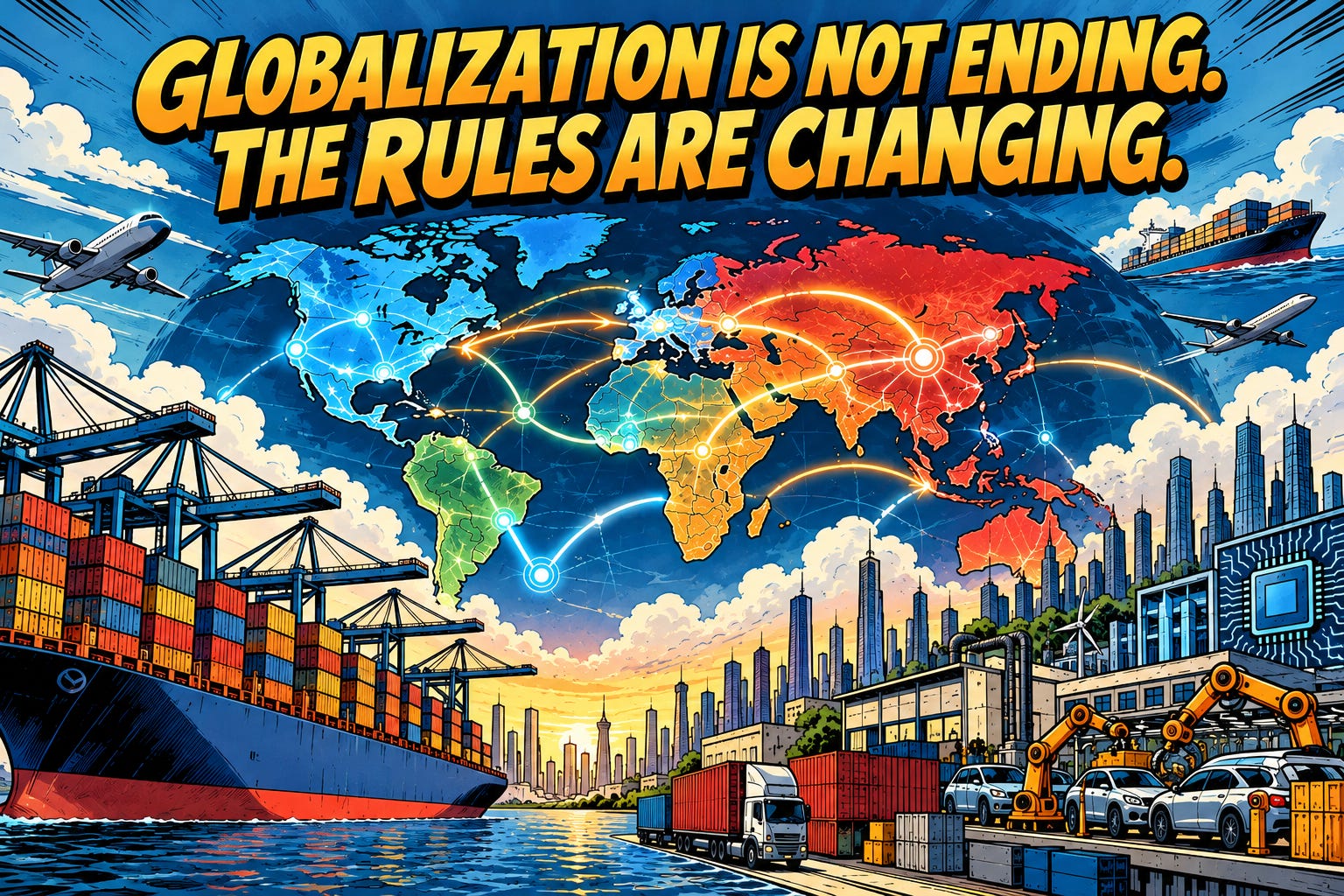
For the past three decades, multinational corporations have followed a relatively simple principle: manufacture wherever production costs are lowest.
China became the world’s factory. Southeast Asia absorbed labor-intensive manufacturing. Taiwan and South Korea established their dominance in semiconductors, while the United States retained leadership in software, chip design, and global capital markets.
This division of labor generated extraordinary economic efficiency. It also created an interconnected global supply chain in which disruptions in one region could quickly spread across entire industries.
Yet by 2026, the economic landscape has fundamentally changed.
At the 2026 Cathay Asset Management Summit, Chief Economist of Cathay United Bank, addressed the topic of regional economic growth and supply chain restructuring, highlighting a broader transformation in global investment and industrial development.
The implications extend far beyond relocating factories from one country to another.
The world is moving from globalization built primarily around cost efficiency toward a new model shaped by economic security, technological capabilities, industrial policy, and supply chain resilience.
For investors, this shift suggests that future capital flows may increasingly depend not simply on which economies grow fastest, but on which regions control technologies and industrial capabilities that are difficult to replace.
If the old globalization model resembled a single production line stretching across continents, the emerging model looks more like a network of interconnected regional manufacturing centers.
The United States is seeking to rebuild domestic capabilities in strategic technologies and advanced manufacturing. Europe is emphasizing strategic autonomy and energy security. Japan is investing heavily in semiconductor manufacturing, while India and Southeast Asia are competing to attract the next generation of industrial investment.
This does not necessarily mean global trade is collapsing.
According to the World Trade Organization’s World Trade Report 2026, the share of global merchandise trade accounted for by low- and middle-income economies increased from approximately 23% in 1995 to 45% in 2024.
The broader lesson is that global economic activity is becoming more geographically distributed rather than concentrated in a single manufacturing powerhouse.
Companies are consequently moving away from optimizing supply chains around one preferred production location.
A technology company might design chips in California, manufacture advanced semiconductors in Taiwan, conduct portions of assembly and testing in Malaysia, and complete system integration across several regional markets.
Such arrangements may increase operational complexity and costs, but they can also reduce exposure to geopolitical disruptions, export restrictions, and excessive supplier concentration.
The next generation of globalization may not be cheaper, but it will need to be more resilient.
 The Global Imbalance Triangle: How European Savings, American Capital and Chinese Manufacturing Are Reshaping the World Economy
If geopolitics is pushing supply chains toward regional diversification, artificial intelligence is accelerating the process.
Unlike previous digital revolutions, AI is not simply a software story.
Every large AI data center requires sophisticated GPUs, advanced semiconductor manufacturing, high-bandwidth memory, optical communication systems, electrical infrastructure, and increasingly complex cooling technologies.
This makes AI one of the few technological transformations capable of simultaneously stimulating digital innovation and large-scale physical industrial investment.
During the internet era, technology companies generated much of their value through software, digital platforms, and network effects.
Today, access to computing capacity has become an increasingly important competitive advantage.
Companies such as NVIDIA, AMD, Google, Amazon, Microsoft, and Meta are therefore competing not only to develop more powerful AI systems, but also to secure the infrastructure required to operate them.
This transformation is exposing bottlenecks across the semiconductor supply chain.
Advanced wafer fabrication is only one part of the equation. HBM availability, advanced packaging capacity, ABF substrates, high-speed optical transceivers, power infrastructure, and liquid-cooling systems can all influence how quickly AI infrastructure is deployed.
A semiconductor may be ready for production, but the final AI system can still be delayed by limitations elsewhere in the supply chain.
For investors, this is an important distinction.
The AI investment opportunity extends well beyond GPU designers.
Specialty materials, packaging technologies, optical interconnects, power equipment, and thermal management may capture a growing share of the value created by AI infrastructure expansion.
 SpaceX and xAI’s Push Toward 10 GW: The Supply Chains and Geopolitics Behind AI Infrastructure
Southeast Asia has emerged as one of the principal beneficiaries of global supply chain diversification.
Vietnam continues to attract electronics manufacturing and semiconductor-related investments. Malaysia has established a strong position in semiconductor assembly, packaging, and testing. Singapore remains a significant center for advanced manufacturing, research, and regional corporate operations.
These economies, however, are following different development paths.
Vietnam’s opportunities are closely linked to electronics manufacturing clusters and the gradual upgrading of local industrial capabilities.
Malaysia may have opportunities to expand beyond conventional outsourced semiconductor assembly and testing into higher-value packaging technologies, equipment, and materials.
Singapore’s competitive advantage lies more heavily in its established infrastructure, engineering ecosystem, research capabilities, and ability to coordinate regional operations.
Yet relocating manufacturing is rarely as straightforward as announcing a new factory.
New production facilities require reliable electricity, water, engineering talent, transportation networks, and local supplier ecosystems.
Government subsidies and tax incentives can reduce initial investment costs, but they cannot instantly create a sophisticated industrial cluster.
This is particularly relevant to semiconductor manufacturing.
From equipment installation to process qualification, customer validation, yield improvement, and stable volume production, a new semiconductor facility must overcome considerable technical and operational challenges.
Capital can build a factory relatively quickly. Manufacturing expertise, supplier relationships, and customer confidence take much longer to develop.
As a result, the winners of supply chain diversification will not necessarily be the countries offering the cheapest land or labor.
They will be the economies capable of creating reliable industrial ecosystems that companies can operate profitably over the long term.
 VSMC: Singapore’s New 300mm Fab Is a Bet on the Chips AI Cannot Ignore
Taiwan occupies a unique position in the global semiconductor industry.
TSMC’s advanced process technologies, the packaging capabilities of companies such as ASE, and the island’s extensive network of semiconductor equipment, materials, and electronics suppliers have created one of the world’s most sophisticated manufacturing ecosystems.
As the United States, Japan, and Europe increase semiconductor investment, Taiwanese companies are also expanding their international operations.
This development is sometimes interpreted as evidence that semiconductor manufacturing is gradually leaving Taiwan.
But that framing overlooks an essential distinction.
The more important question is which manufacturing activities can be geographically replicated, and which technological capabilities remain highly concentrated.
Mature-node manufacturing, certain packaging and testing operations, and electronics assembly can be redistributed according to market conditions and customer requirements.
Advanced process technologies, heterogeneous integration, sophisticated process engineering, and complex supplier coordination are considerably harder to reproduce.
Advanced packaging provides a useful example.
A high-performance AI accelerator is no longer simply a collection of individual chips. Its performance and reliability depend on signal integrity, power delivery, thermal management, package warpage, and mechanical reliability.
Solving these problems requires extensive research, manufacturing experience, customer qualification, and cooperation across multiple suppliers.
The competitive advantage therefore lies not merely in owning production facilities, but in coordinating the underlying technologies that make advanced semiconductor systems commercially viable.
For Taiwan, the strategic challenge is to maintain leadership in these difficult-to-replicate capabilities while participating in the international expansion of semiconductor manufacturing.
Similar considerations apply to critical technology suppliers in South Korea, Japan, the United States, and Europe.
In the next phase of global industrial competition, the number of factories a company operates may matter less than the technological bottlenecks it can solve.
 Manufacturing at Scale in the Photonics Era: Taiwan’s AI Supply Chain Through the Lens of ficonTEC Expert Seminar ASIA
SemiVision believes that global supply chain restructuring is fundamentally changing how value is distributed across the technology industry.
The companies best positioned for the next decade may not necessarily be those with the greatest production capacity.
Instead, competitive advantage will increasingly depend on three capabilities.
First: Control over difficult-to-replace technologies.
Advanced semiconductor manufacturing, HBM, hybrid bonding, co-packaged optics, and specialized electronic materials share an important characteristic: they are technically demanding and require lengthy qualification cycles.
As global supply chains diversify, companies controlling these capabilities may enjoy stronger competitive positions than manufacturers offering relatively standardized services. Technology scarcity can become a source of pricing power, although its durability will depend on competition, customer relationships, and the pace of technological substitution.
Second: The ability to manufacture and deliver across multiple regions.
Future semiconductor suppliers will need to navigate trade regulations, export restrictions, tariffs, customer localization requirements, and increasingly complex geopolitical relationships.
Companies capable of transferring production processes, maintaining quality standards, and supporting customers across different regions may gain a meaningful competitive advantage.
However, geographical diversification does not automatically translate into greater profitability.
New factories bring higher fixed costs, execution risks, and potential underutilization. Investors must distinguish between strategic manufacturing announcements and facilities that can generate sustainable returns.
Third: The ability to solve the actual bottlenecks in AI infrastructure.
As AI computing expands, the industry’s constraints are spreading beyond transistor performance.
Memory bandwidth, packaging interconnect density, optical communication, electrical power, and thermal management are becoming critical determinants of system-level performance.
SemiVision is particularly focused on advanced packaging materials, ABF substrates, high-speed PCBs, optical interconnects, and next-generation thermal management technologies.
Historically, many of these technologies were treated as supporting components within the semiconductor industry.
Today, they can influence the deployment schedule, energy efficiency, reliability, and economics of entire AI computing systems.
Consider advanced packaging substrates. Even when GPU manufacturing capacity is available, insufficient substrate supply or packaging yield can limit final accelerator shipments.
Similarly, improvements in optical connectivity and thermal management can determine whether increasingly powerful AI systems remain economically practical at the rack and data-center levels.
This suggests that some of the most important beneficiaries of AI infrastructure expansion may operate outside the most visible segments of the semiconductor industry.
Nevertheless, demand growth alone does not guarantee shareholder returns. Capital intensity, supplier concentration, technical substitution, and the timing of capacity expansion will remain central considerations.
 Nvidia Is Not Looking for the Next OpenAI. It Wants to Challenge China’s Open AI Models.
Globalization is not coming to an end.
It is evolving from a system optimized primarily for efficiency into one where efficiency, resilience, technological capabilities, and national industrial policies must coexist.
The United States is rebuilding strategic manufacturing capabilities. Japan and Europe are expanding semiconductor investment. Southeast Asia is moving toward higher-value industrial activities. India is working to develop a more comprehensive electronics ecosystem, while Taiwan and South Korea continue to occupy essential positions in advanced semiconductor technologies.
But supply chain diversification is not free insurance.
Duplicated manufacturing investment, higher operating costs, and additional coordination requirements could undermine some of the efficiency gains achieved through decades of globalization.
The challenge for both governments and corporations will be finding an economically sustainable balance between security and efficiency.
SemiVision believes the next decade’s technology winners will not simply be the companies serving the largest markets. They will be those controlling essential technologies, delivering reliably across regions, and solving the industry’s most difficult infrastructure bottlenecks.
Global capital may consequently shift from pursuing low-cost manufacturing capacity toward businesses characterized by technological scarcity, system integration expertise, and difficult-to-replicate industrial capabilities.
The geography of the world economy is being redrawn.
Yet the fundamental question determining corporate value remains remarkably simple:
What can a company do that its competitors cannot easily replicate?
Thanks for reading SEMIVISION @_@! This post is public so feel free to share it.
 The AI Paradox: Why Cheaper Tokens Could Make Computing Power More Valuable