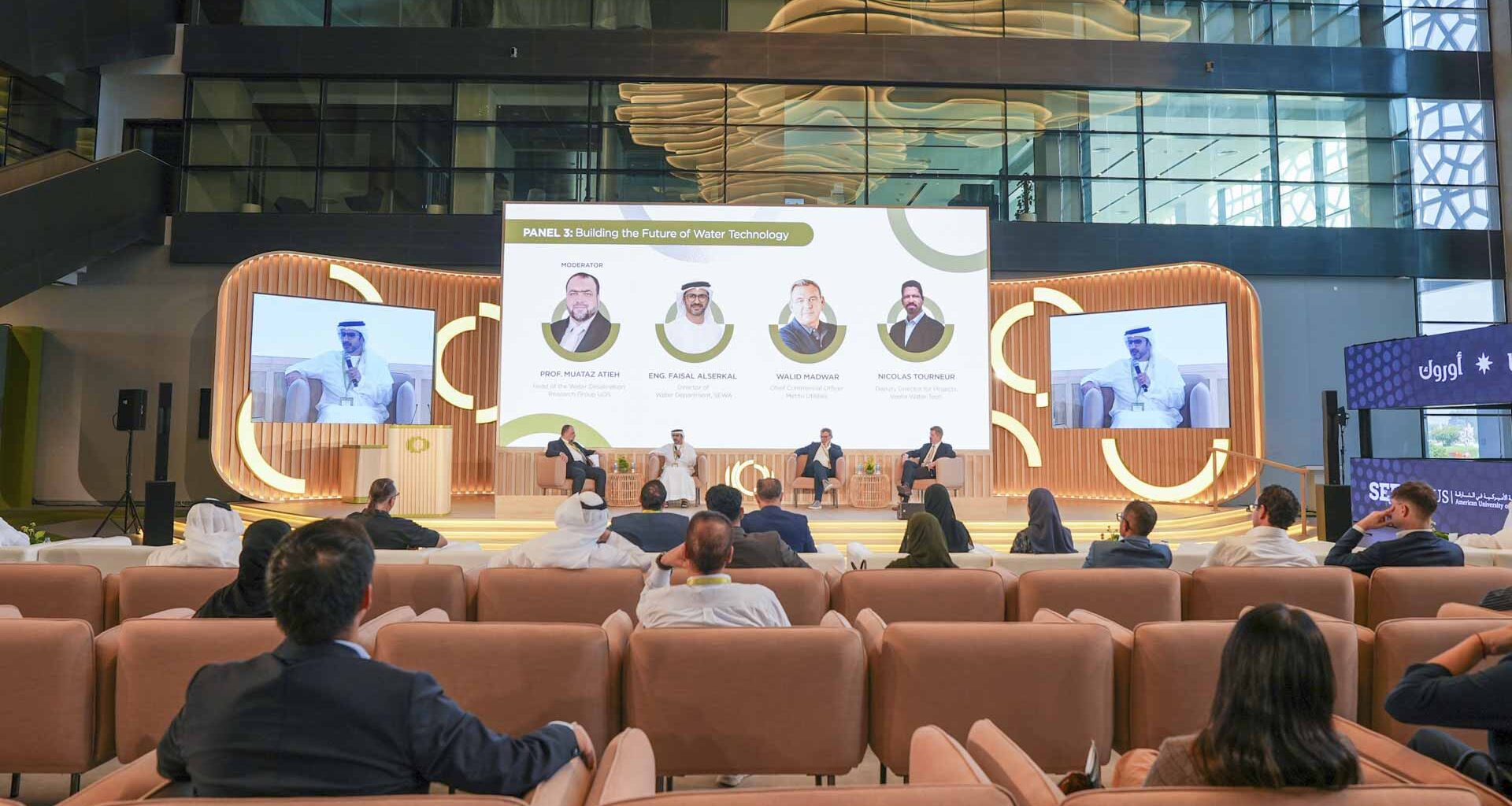
The Authority hosted a prominent exhibition stand showcasing its latest projects and cutting-edge technologies. Furthermore, SEWA took part in two panel discussions; the first focused on building the future of water technology.
Investing AED 5.2 billion in strategic water projects
During this session, Engineer Faisal Al Sarkal, Director of the Water Department at SEWA, outlined key aspects of the Authority’s strategy to address rising water demand, in alignment with the goals of the “UAE Water Security Strategy 2036.” These objectives include reducing demand for water resources by 21%, increasing the water productivity index to $110 per cubic meter, lowering the water scarcity index by 3 points, and raising the reuse rate of treated water to 95%. The strategy also addresses emergency storage—ensuring a two-day supply capacity under normal conditions—along with the allocation of emergency reserves and a commitment to reducing carbon dioxide emissions by approximately 100 million tons. During the session, he highlighted key strategic projects being implemented by SEWA, with a total investment exceeding AED 5.2 billion. These projects include a new water desalination plant, transmission networks, pumping stations, and water storage facilities, which will add 270 million gallons to the existing storage capacity.
New desalination plant to serve 1.4 million people
Al Sarkal explained that the first independent water desalination plant in the Emirate of Sharjah is currently under construction. Utilising reverse osmosis technology, the plant is designed to meet the Emirate’s water requirements. Once fully operational in the fourth quarter of 2028, it will reach its full production capacity of approximately 410,000 cubic meters of desalinated water per day, providing potable water for 1.4 million people.
AI-powered systems to improve water network efficiency
Al Sarkal further noted that the pumping stations being developed by the Authority, along with an AI-powered water distribution network monitoring system—managed via a state-of-the-art control room and supported by smart meters and Geographic Information Systems (GIS)—are instrumental in gathering and analyzing data. These initiatives enhance the efficiency of water production and distribution systems, minimise waste by detecting network leaks, and include a strategic underground water storage project, among other ventures.
Al Sarkal added that the Authority is actively fostering collaboration with researchers, scientific institutions, industrial sectors, and investors to accelerate the transition of innovations from research and development to practical application, while effectively addressing any emerging challenges.
Smart electricity grids to support clean energy transition
During a panel discussion on the second day of the conference, Eng. Hamad Al Tunaiji, Director of the Power Transmission Department at SEWA, outlined the Authority’s efforts to prepare the electrical grids in the Emirate of Sharjah to accommodate clean energy and enhance grid efficiency, thereby contributing to sustainable development. Four key areas were highlighted during the event: first, the implementation of innovative scientific solutions to manage reactive power; second, the operation of smart high-voltage grids and substations using advanced technology—achieving optimal efficiency regardless of energy source or load, and without the need for manual technical intervention—which has resulted in a 25% reduction in grid losses and a 40% decrease in faults; third, the transition of high-voltage grids from a ring configuration to a mesh (network) configuration, which improves the interconnection of grids and substations, ensures more seamless electricity transmission and distribution, enhances safety and security, and enables efficient and rapid responses to challenges; and fourth, the implementation of a smart substation system that streamlines the stages of energy transmission and distribution.
Al Tunaiji emphasised that the Authority is committed to leveraging advanced technology and artificial intelligence, as well as applying innovative ideas—in collaboration with all relevant stakeholders—to further develop its operations.