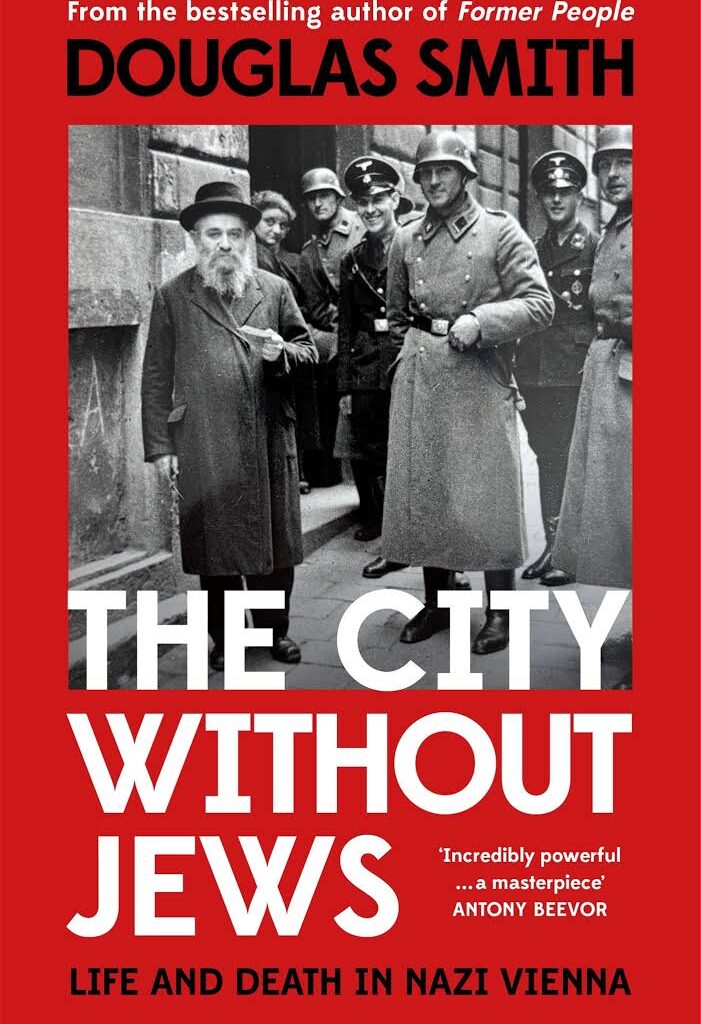
Between world wars Vienna was the second-largest Jewish city in Europe after Warsaw and the largest in the German-speaking world. The Jews’ presence had been part of the fabric of the Austrian capital since the early Middle Ages. But after Germany’s annexation of the country, the Anschluss in March 1938, it took just seven years of Nazi rule until the end of World War II in 1945 to almost decimate them, from nearly 200,000 to a mere few thousand.
Most of Austria’s Jews fled abroad and survived, American historian Douglas Smith writes, but as many as 66,000 were murdered in the Holocaust. The author chronicles this destruction of Jewish Vienna under the occupiers as a tragedy of immeasurable proportions. He assesses the city’s extraordinary influence in the spheres of art, culture, science, economics and politics as being unthinkable without acknowledging the Jews’ huge role.
Had Vienna been – particularly in the 70 years straddling 1900 – a city without them, it would never have been worthy of such grand claims, Smith states. His new book tells the dramatic story of 1938-45 from hundreds of sources, many said to be untouched for decades. One voice is prominent among those who present the intertwined lives of the victims of this horrific time: Mignon Langnas, a Jewish woman and middle-aged nurse who would see all her friends and family, and her entire world, consumed under the Germans.
She was the only Jew who spent the entire period in Vienna and she alone left behind a detailed record of her suffering in hundreds of pages of letters and diaries. Hers is described as an account of a woman of exceptional strength, compassion and dignity, seeking to make sense of the once-vibrant city that had now turned against her and her like.
Smith recounts how Langnas managed to find work as a nurse in a Jewish hospital, a position that provided only a little income but also, more importantly, offered some protection from deportation to the east. Three times she was on the verge of expulsion but somehow managed to avoid this fate. It is, we read, a story that seems almost impossible.
Langnas lived openly during the occupation, and while it was decided that her husband Leon and their children Manuela and Georg should escape soon after the Anschluss, she remained to care for her aging parents, Moses and Charlotte, sure that they, too, might eventually be allowed to emigrate. The Germans wanted Jews out, though made the paperwork difficult.
Manuela and Georg were sent to the United States to be cared for by relatives and friends.
Leon was one of some 930 Jewish refugees aboard the German-built ocean liner M.S. (Motor Ship) St. Louis, bound for Cuba in May 1939, where he hoped to bring over the rest of the family. But Cuba denied the ship entry and its passengers spent an agonising month at sea being rejected also by the United States and Canada before Belgium took them in.
Langnas worked first in a nursing home then at a Jewish children’s hospital as every Jewish life hung in the balance, and Smith traces her increasingly desperate yet futile efforts to secure visas for herself and her parents. Meanwhile, nearly every Jew she knew disappeared into camps or managed to emigrate, as institutions collapsed and hope faded daily.
“Her world shrank in upon itself. The loneliness came close to consuming her. As the tide of war shifted, Mignon faced new threats. Twice she was almost killed by Allied bombs. After liberation in 1945, she barely avoided being raped by a band of drunken Soviet soldiers.”
Austria already had a strong vein of antisemitism before the Third Reich’s troops poured in, and Vienna was often out ahead of Germany in leading the assault on Jewish life and property, for instance establishing what amounted to semi-ghettos before Berlin. Vienna, and other Austrian cities, experienced murder and suicides, beatings and torture, sexual abuse, forced emigration, deportation to concentration camps, expropriated and plundered shops and apartments with the occupants given only minutes to pack a few things before being thrown out and set upon by mobs, destruction of synagogues and prayer houses, sackings from jobs and restricted licences for professions, prohibitions from entertainment venues, closed publications, humiliations such as forced scrubbing of streets and further dread.
By being forced into overcrowded houses and barred from public baths, Jews became dirty, smelly and often infested with vermin, thus reducing them to the stereotypes of unclean and infectious, a plague on Aryan society, dehumanised and thus not worth human compassion or consideration. This latter, Smith tells, was a crucial step on the path to genocide.
Langnas recorded the horrors in vivid and intimate writing. Smith says her accounts reveal a woman whose resilience wavered as she went through cycles of crushing despair, exhaustion and moments of remarkable tenderness toward the youngsters under her care. She told a cousin: “… I have been so worn down by hoping that it has become torture. I no longer want to live on eternal ‘miracles’ + ‘mercies’! I want peace at last … I want to have my children again + a home + I long ardently for the warm feeling of security. Will I experience it?”
But the war would drag on for years and survival seemed increasingly unlikely: both the children’s hospital where she worked and her apartment suffered direct hits during Allied bombing raids as the Nazis ramped up deportations of the city’s remaining Jews.
Smith’s book lists a useful who’s who of the many Jews and Nazis involved, with photographs of some. A map of Vienna circa 1930 offers further help in bringing the catastrophic events into focus. His title comes from another book, “The City Without Jews: A Novel from the Day After Tomorrow”, written by Hugo Bettauer, an Austrian Jewish journalist, and published in 1922. This was a satirical critique of Austrian antisemitism in which the country’s Jews are expelled but then the Viennese come to their senses and welcome them back.
The novel was popular and was filmed, but in March 1925 Bettauer was shot five times by a Nazi, Otto Rothstock, who believed him to be a traitor to their compatriots. Bettauer died 12 months later, thus becoming, Smith writes, the first Jew killed by the Nazis in Vienna.
The novel was prophetic, opines Smith, “with a level of specificity that might have surprised Bettauer himself. Not merely the expulsion of Austria’s Jews would come to pass in little over a decade after his murder, but the targeting of Jewish wealth, the obsessions with Jewish ancestry, the calculating of Jewish blood, the categorizing of half and quarter Jews, and the expropriation of Jewish homes as social policy, along with the jubilation that greeted these antisemitic measures, became reality following German’s Anschluss of Austria in 1938.”
However, Bettauer had got one thing wrong – his happy ending in which the anti-Jew law was overturned, the disgraced former chancellor committed suicide and the first returnee was hoisted aloft by a joyous throng and carried to city hall in triumph and glory.
In reality, Smith writes, come World War Two, the Jews of Berlin were shocked by the joyful brutality with which Nazis from Vienna exercised their power when switched to the German capital. It was something the Jews had never seen from the Berlin SS.
Nor did the Langnas family of four have a happy ending. Leon had finally reached New York and the children, but what the couple thought in Vienna might be a six-month separation proved to be seven years. When a changed, broken, Mignon arrived in June 1946 the children did not recognise her at first and their parents were strangers until she died in 1949.