
Application development intelligence startup LinearB Inc. said today it’s trying to ease the growing congestion in organization’s software delivery pipelines that has arisen with the widespread adoption of artificial intelligence coding tools.
It’s doing so with Agentic Studio, a new offering announced today that’s focused on providing more actionable context for human engineers and autonomous coding agents alike.
The startup says the emergence of generative AI coding tools such as Claude Code and Codex has led to new headaches for enterprise software development teams. Though writing software code now can be basically effortless, shipping that code into production is still as painful as it has always been, and now they have much more of it to ship.
In its recent Software Engineering Benchmarks report, the company analyzed more than 2.7 million pull requests across 250 organizations and found that those who rely on AI coding tools have almost doubled their merged code changes year-over-year. But the problem is that AI-assisted pull requests are nearly 2.6-times larger, and consequently they’re waiting more than five-times longer to be reviewed. This has led to significant backlogs and it’s compounded by the fact that AI agent’s proposed code changes are merged just 79% of the time at “elite organizations,” compared with 92% for human-authored code.
LinearB says that human software engineers struggle to clear this backlog because the traditional dashboards they’re forced to work with only provide metrics, rather than the context needed to resolve those pull requests. With Agentic Studio, it’s trying to address this by normalizing the data and insights generated by Git repositories and project tracking tools into a unified context layer. It means that instead of muddling through various charts to try and understand why release velocity has stalled, software engineers can ask questions in plain language to understand the root cause and receive recommendations on how to speed things up.
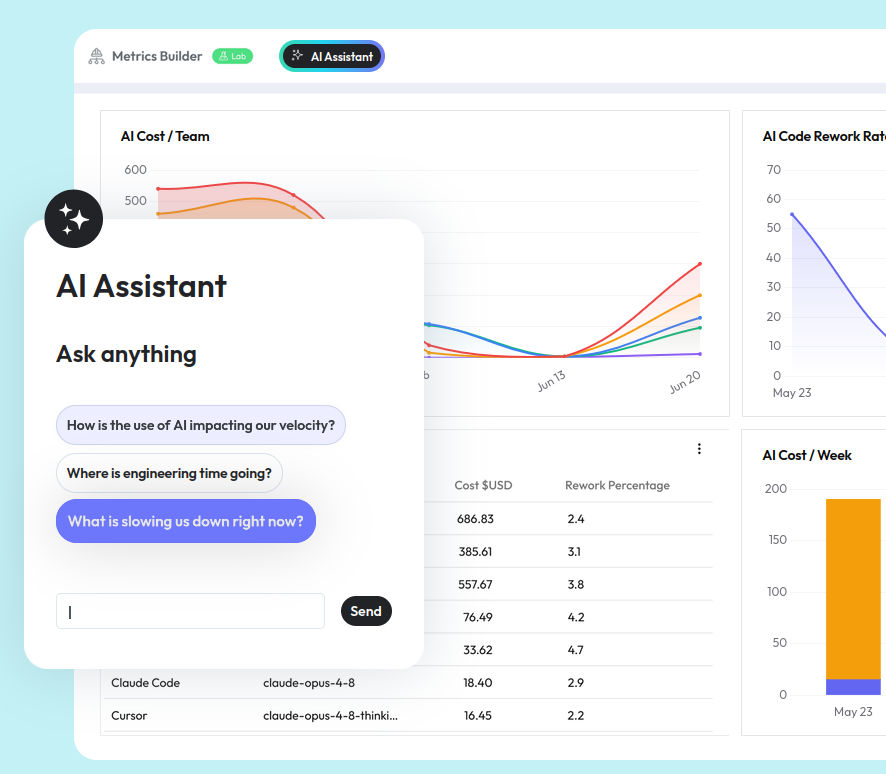
Co-founder and Chief Executive Ori Keren said context has become the new king, not only for AI tools but also for humans. “We realized we hold a knowledge graph that nobody else has of everything that is happening across the software delivery lifecycle,” he said. “That’s exactly what agents and teams need to deliver high quality software faster, so we rebuilt LinearB around it.”
What’s different about Agentic Studio is that it’s designed to help autonomous coding agents just as much as human software engineers, Keren said. By integrating through protocols such as the Model Context Protocol, it feeds historical context such as rework rates, past production incidents and code ownership to AI agents, preventing them from making blind modifications to pull requests.
Early adopters have benefited from dramatically increased productivity with Agentic Studio. A case in point is the cryptocurrency exchange Kraken, which used LinearB’s MCP integration to pinpoint why its code reviews were lagging. It discovered that timezone misalignments were the main culprit rather than pull request sizes, and subsequently reorganized its workflows to cut its review times by more than half within just four months.
“For years, engineering leaders told us the same thing: metrics are useful, but they don’t tell you what to do,” said LinearB’s chief operating officer Dan Lines. “A dashboard says your cycle time is two days, but so what? Now [with Agentic Studio] a leader can ask what to improve in their engineering organization and get a clear answer. When that same context goes to coding agents, the platform is not just reporting, it’s acting.”
To help AI agents operationalize the context it provides, LinearB is developing a bunch of new agent skills. The first one, an “effort skill,” is available in early access now and analyzes the complexity of a pull request and its proposed code changes, its rework history and risk to calibrate dynamically how much computational effort a coding agent needs to expend as it works on it.
Simple, low-risk changes are done faster with minimal tokens. More sensitive, high-priority modifications will be implemented with deeper reasoning and more exhaustive testing to ensure nothing goes wrong.
LinearB said it’s planning to expand its agent skills library in the coming months with additional skills focused on automated code review, merge governance and token cost optimization.
Image: LinearB
Support our mission to keep content open and free by engaging with theCUBE community. Join theCUBE’s Alumni Trust Network, where technology leaders connect, share intelligence and create opportunities.
15M+ viewers of theCUBE videos, powering conversations across AI, cloud, cybersecurity and more
11.4k+ theCUBE alumni — Connect with more than 11,400 tech and business leaders shaping the future through a unique trusted-based network
SiliconANGLE Media is a recognized leader in digital media innovation, uniting breakthrough technology, strategic insights and real-time audience engagement. As the parent company of SiliconANGLE, theCUBE Network, theCUBE Research, CUBE365, theCUBE AI and theCUBE SuperStudios — with flagship locations in Silicon Valley and the New York Stock Exchange — SiliconANGLE Media operates at the intersection of media, technology and AI.
Founded by tech visionaries John Furrier and Dave Vellante, SiliconANGLE Media has built a dynamic ecosystem of industry-leading digital media brands that reach 15+ million elite tech professionals. Our new proprietary theCUBE AI Video Cloud is breaking ground in audience interaction, leveraging theCUBEai.com neural network to help technology companies make data-driven decisions and stay at the forefront of industry conversations.