
 A Team USA Ski Jumper. | Image: Team USA
A Nordic combined athlete was airlifted to hospital after a serious crash at Planica, Slovenia, on Friday, October 30. Initial reports did not reveal the athlete’s identity or nationality but the Polish Ski Association (PZN) has since confirmed that the athlete is one of their national athletes and that he is in stable condition and his life is not in danger.
The incident happened at approximately 9:57 a.m., when emergency services received a call reporting that an athlete had crash-landed at the Planica ski-flying venue and required urgent medical assistance. A rescue helicopter transported him to a hospital in Ljubljana.
The athlete’s identity and the nature of his injuries have not been disclosed.
PZN sports director Kamil Fundanicz confirmed the situation to Polish outlet Sportsinwinter.pl, saying the athlete had arrived at the hospital in Ljubljana after the fall. “His condition is stable, and his life is not in danger,” Fundanicz said. The athlete is expected to remain under medical observation until Monday, with doctors and the association set to decide on the next steps at the beginning of the week.
Coach Szczepan Kupczak accompanied the athlete’s team and remained in contact with medical staff and PZN officials. Kupczak said he had never before experienced one of his athletes being flown to hospital by helicopter. He travelled to the hospital by car to handle organizational matters. The coach was cautious about drawing conclusions about what caused the fall. “The conditions were good all week,” Kupczak said. “I am far from being rash that it was due to a technical error. I would rather describe the whole incident as a chain of unfortunate circumstances.” He added that the most important thing was that the accident had not resulted in something worse.
How Dangerous Is Ski Jumping?
Ski jumping involves athletes reaching high speeds before launching from a steep ramp and travelling through the air for distances that can exceed 200 meters (650 feet). While serious accidents attract attention, published research shows that injuries are not uncommon, although fatalities are rare.
A study following elite women ski jumpers across three FIS World Cup seasons from 2017-18 to 2019-20 recorded 54 injuries among 205 athlete-seasons, equivalent to 26.3 injuries per 100 athletes per season. Most were acute injuries, and 78% occurred on the ski jumping hill. Crash landings accounted for 70% of injury events. One-third of the recorded injuries were classified as severe, with the knee involved in 78% of those cases.
An earlier study of World Cup athletes across several Nordic disciplines found 13.6 injuries per 100 ski jumpers per season, including 5.6 severe injuries per 100 athletes per season. The researchers recorded a lower injury rate in ski jumping than in alpine skiing, freestyle skiing, or snowboarding during the seasons examined.
Planica is one of the most famous venues in the sport, known for its enormous ski-flying distances. The venue will host the FIS Ski Jumping World Cup Finals for the 2026-27 season which are scheduled for March 18–21, 2027, and will host the 2028 FIS Ski Flying World Championships.
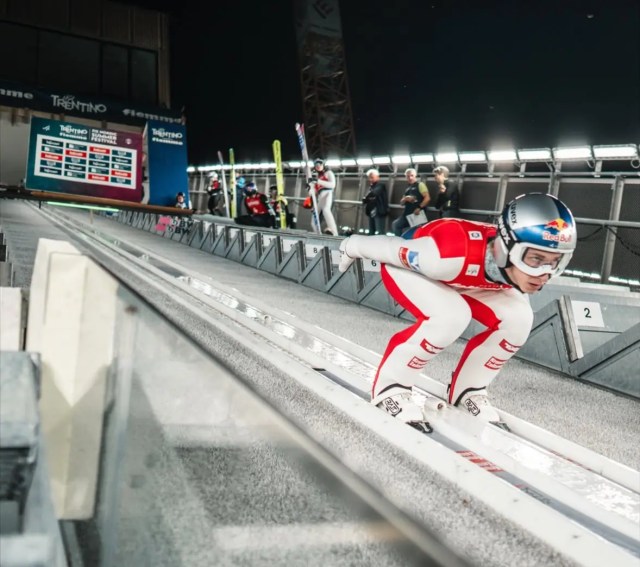 The men’s normal hill event. | Image: FIS Ski Jumping IG