
U.S. Marines conduct drone training. (Koji Sonoda)
Drones are rapidly being deployed and becoming the dominant weapon on battlefields around the world.
Reflecting these changes, Japan’s revised three national security documents, due out later this year, are expected to embrace a “new way of warfare.”
What innovations are emerging from modern conflict, and how is Japan adapting? This series of articles examines the front lines of that transformation.
MARINES IN OKINAWA TRAIN WITH DRONES
In mid-May, at a training area inside Camp Schwab, a U.S. military base in Nago, Okinawa Prefecture, about 20 young Marines in camouflage uniforms were practicing drone operations in the sweltering heat.
The drones were small, measuring roughly 40 centimeters on each side. Operators wearing goggles could view real-time video transmitted by cameras mounted on the front of the drones.
Flying the drones along a roughly 1-kilometer course through rugged mountainous terrain, the Marines maneuvered them through narrow openings measuring approximately one square meter and performed circling maneuvers around designated points.
At first glance, the drones appeared almost homemade, with strips of tape haphazardly attached to their frames. In fact, the drones had been assembled by Marines themselves, who soldered together the components. Each drone costs less than $1,000 (158,000 yen).
Yet, their battlefield potential is immense.
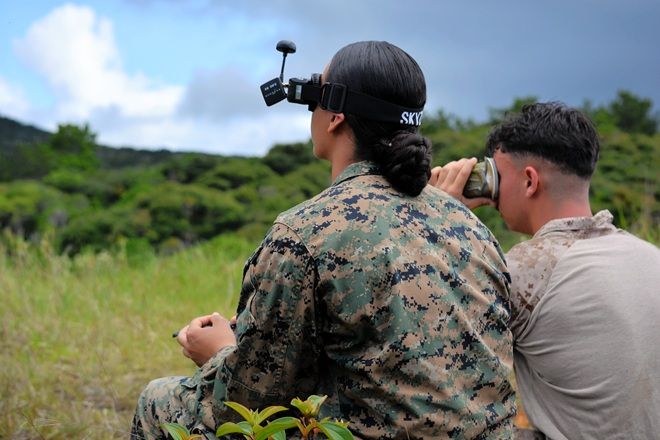 U.S. Marines operate drones at Camp Schwab in Nago, Okinawa Prefecture, on May 20. (Kazuyuki Ito)
According to Maj. Brant Wayson, who leads the III MEF Expeditionary Operations Training Group’s Unmanned Systems Branch, the small drones can carry a bomb weighing roughly 5 pounds (2.3 kilograms), enough to destroy an armored vehicle.
They are the similar type of one-way attack drones widely being deployed in the war in Ukraine.
DRONES EXTEND STRIKE RANGE
Wayson said the drones offer the Marine Corps two major advantages. The first is the ability to conduct long-range attacks.
Marines can engage targets at distances of roughly 2 km using rifles, artillery and other weapons. Drones, however, allow them to extend their strike range dramatically to targets as far as 20 km away.
The second advantage is cost-effectiveness compared with missiles.
An attack drone used in combat can cost as little as $2,000, while a single missile can cost anywhere from tens of thousands to hundreds of thousands of dollars.
“If there is a single enemy armored vehicle in the battlespace, all you need to do is send one drone,” Wayson said. “You can conserve firepower while also increasing both range and precision.”
Drones are also easy to maintain.
The drones used in the training were built from simple components commonly used in commercially available electronics. Marines also received training in producing replacement parts with 3-D printers in the event of equipment failures.
The exercise was conducted as part of the Basic Drone Operator Course, which began last October.
Upon completion of the course, participants can construct drones from individual components and perform a full range of operational tasks.
HEGSETH CALLS FOR DRONE REFORM
The training program was launched following a memorandum issued last July by U.S. Defense Secretary Pete Hegseth titled “Unleashing U.S. Military Drone Dominance,” which directed the armed services, including the Marine Corps, to dramatically accelerate the adoption and operational use of small drones.
In the opening of the memo, Hegseth wrote that “drones are the biggest battlefield innovation in a generation” and that they are responsible for the majority of casualties in Ukraine this year.
He argued that while America’s adversaries are producing millions of low-cost drones annually, the U.S. military does not possess sufficient numbers of the small attack drones it needs.
He then called for the achievement of three major objectives: expanding America’s drone industrial base; fielding large numbers of affordable drones across all combat units; and fundamentally reforming training systems, including preparation for drone-on-drone combat.
Perhaps the most significant aspect of the memo is its assertion that small drones should be viewed not as “aircraft” but as “munitions.”
The memo advances the concept that small drones are inexpensive expendable assets.
In that sense, Hegseth’s memorandum can be viewed as a strategic document that seeks to fundamentally transform the way the U.S. military fights, shifting from a force centered on highly sophisticated and expensive weapons toward one equipped with large numbers of low-cost expendable systems.
 A small drone flies during a training exercise by U.S. Marines based in Okinawa at Camp Schwab in Nago, Okinawa Prefecture, on May 20. (Kazuyuki Ito)
The Marine Corps is reportedly proceeding with plans to field approximately 10,000 drones by the end of this year in line with that policy.
U.S. SHARES UKRAINE DRONE LESSONS WITH SDF
The expertise behind the drone training conducted by U.S. Marines in Okinawa is itself closely linked to lessons learned from the war in Ukraine.
Wayson, who serves as an instructor in the training program, is a robotics engineer by background.
Before helping establish the course in Okinawa, he completed drone training in Europe, including through the Joint Multinational Training Group-Ukraine (JMTG-U), and studied lessons learned from personnel involved in drone operations and training.
He later brought those lessons back to Okinawa, where he helped develop the curriculum and now trains Marines to operate drones.
Members of the Self-Defense Forces also participated in the Okinawa-based Marine Corps Basic Drone Operator Course in January.
According to the GSDF Staff Office’s public affairs division, seven SDF personnel attended the course, enabling them to deepen their understanding of Marine Corps training methods while improving their own drone piloting skills.
“We expect to continue growing and evolving alongside Japan’s forces,” Wayson said. “Our doors are always open, and we welcome SDF personnel to participate in our courses.”
The U.S. military is increasingly focused on drones as a form of “battlefield innovation” demonstrated in the war in Ukraine and is seeking to incorporate the latest drone technologies and operational concepts across its combat forces.
That expertise is now beginning to reach the Self-Defense Forces through cooperation with the U.S. military.