
Taking another step toward harnessing artificial intelligence to optimize rare earth separation, Aclara Resources Inc. and the U.S. Department of Energy’s Argonne National Laboratory have completed the first stage of developing a digital twin for the company’s planned Project Dynamo facility in Louisiana.
Under a cooperative research and development agreement (CRADA) signed in January, Aclara and Argonne developed and validated a computer model capable of simulating the complex solvent extraction process used to separate individual rare earth elements.
The steady-state model, calibrated against operating data and chemical assays from Aclara’s rare earth demonstration plant at Virginia Tech, provides the foundation for developing an AI-enabled digital twin that can help operators manage the interconnected chemical processes involved in rare earth separation.
The achievement marks the completion of the initial research agreement and sets the stage for the next phase of development under DOE’s Genesis Mission, a federal initiative to leverage artificial intelligence and advanced computing to accelerate scientific discovery and strengthen American energy and critical mineral supply chains.
In July, Aclara’s U.S. subsidiary, Aclara Technologies Inc., Argonne, and Virginia Tech were selected for phase one of the Genesis Mission’s critical minerals extraction and processing challenge.
Further Reading: Genesis Mission backs rare earth tech
With the initial model validated, the partners are now preparing to extend the AI-enabled twin’s capabilities from simulating stable operating conditions to predicting how changes ripple through hundreds of interconnected separation stages.
Modeling a complex process
Separating rare earth elements into the individual high-purity products needed for aerospace, automotive, clean energy, robotics, and other advanced technologies is one of the most technically demanding steps in the critical minerals supply chain.
Due to nearly identical chemical properties, individual rare earths must be separated through carefully controlled processes that exploit subtle differences in their behavior.
For Project Dynamo, Aclara is designing a solvent extraction system consisting of 478 interconnected mixer-settler stages, each contributing to the gradual separation and purification of individual rare earths.
Because the chemical equilibrium in each stage is linked to surrounding stages, even minor adjustments to acid or base flows can affect conditions throughout the circuit.
Traditionally, operators have relied heavily on experience to manage these complex interactions, making incremental adjustments to avoid disrupting the delicate chemical balance needed to achieve target purity and recovery.
That approach can prolong the time required to bring a new separation plant into stable operation.
The model developed by Aclara and Argonne is designed to address this challenge by predicting the concentration of individual rare earth elements at every stage of the separation circuit.
Validated against operating data from Aclara’s demonstration facility at Virginia Tech, the model allows engineers to virtually evaluate how adjustments to process conditions could affect rare earth recovery and purity before making those changes in the plant.
“This technology has the potential to accelerate Project Dynamo’s ramp-up, improve efficiency and substantially reduce operating risk,” said Aclara CEO Ramón Barúa.
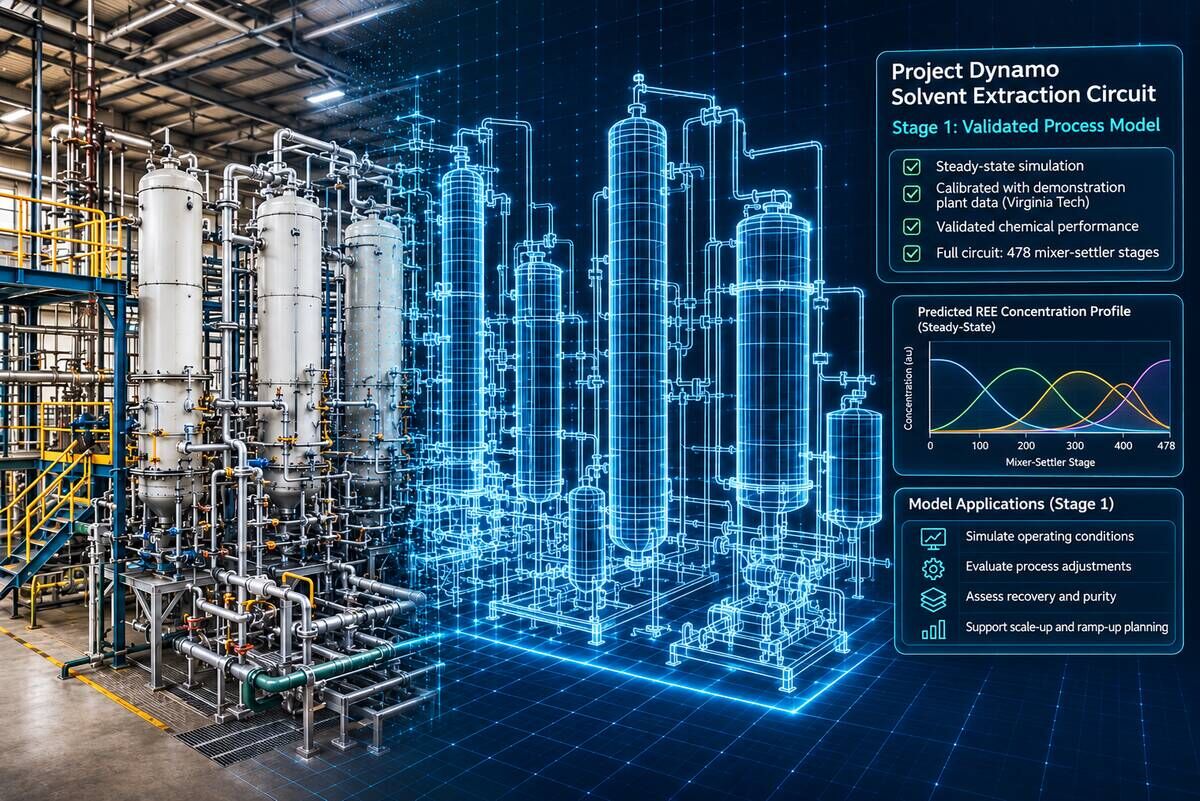
Data Mine North via ChatGPT
At the end of stage one, the AI-enabled digital twin developed by Aclara and Argonne allows engineers to virtually evaluate how adjustments to process conditions could affect rare earth recovery and purity before making those changes in the plant.
From simulation to AI optimization
While the current model describes the separation process under stable operating conditions, the next step is developing a dynamic digital twin capable of predicting how the system responds to changes over time.
Under phase one of the Genesis Mission, Aclara, Argonne, and Virginia Tech intend to use advanced computing to model the effects of operational disturbances, such as changes in feedstock composition or deviations in chemical flow rates.
This dynamic simulation would then support the development of an AI agent capable of recommending adjustments that would allow operators to make more frequent, data-driven decisions to maintain separation efficiency and product purity.
Aclara expects the technology could help reduce reagent consumption, accommodate variations in incoming rare earth material, and shorten the time required to bring Project Dynamo into stable production.
If successful, the company intends to pursue phase two of the Genesis Mission, which would involve connecting the digital twin directly to plant sensors and control systems.
This would advance the technology from providing recommendations to operators toward automatically adjusting process conditions to maintain optimal rare earth separation.
The Genesis Mission phase-one award agreement is still being finalized, and phase-two funding would require a separate application and DOE approval.
Supporting Project Dynamo
The AI development program comes as Aclara advances plans to establish an integrated rare earth supply chain connecting mineral resources in South America with separation and downstream manufacturing in the U.S.
At the center of that strategy is Project Dynamo, a $494 million rare earth separation facility the company plans to build at Port of Vinton in Louisiana.
In October, Aclara expanded the facility’s design to include additional circuits for separating yttrium, gadolinium, and samarium alongside the magnet rare earths neodymium-praseodymium, dysprosium, and terbium.
Further Reading: Aclara widens Project Dynamo REE reach
That expansion increased the number of planned mixer-settlers from 340 to 478 and raised projected annual production of high-purity rare earth oxides by approximately 157%.
The facility is designed to process rare earth carbonates from Aclara’s Carina project in Brazil and Penco project in Chile, turning those mixed materials into individual oxides for American and allied manufacturers.
With site preparation targeted for early 2027 and construction completion planned for the second half of 2028, subject to financing and other conditions, Aclara is seeking to have the digital twin technology ready to support the transition from demonstration-scale separation to commercial operations.
For Aclara, the next step is to transform the validated model into an AI-assisted operating tool capable of reducing the complexities of bringing new rare earth separation capacity online in the U.S.
Author Bio
Shane Lasley, Metal Tech News
Shane Lasley is the founder and publisher of Metal Tech News, where he covers the minerals, metals, and materials that make modern technology possible.
A journalist with nearly two decades of experience covering mining and mineral development, Lasley has expanded his reporting beyond where metals come from to explore what makes them valuable — the unique properties that allow elements such as lithium, rare earths, graphite, gallium, germanium, copper and dozens of others to enable advances in energy, transportation, electronics, aerospace, defense, and emerging technologies.
His reporting follows the entire materials story, from mineral discovery and mine development through processing, supply chains, materials science, and the technologies that ultimately put those resources to work.
Lasley has a particular interest in critical minerals and the increasingly interconnected relationship between mineral resources, technological innovation, energy security, global supply chains, and geopolitics. Through Metal Tech News, he seeks to give readers a deeper understanding of the materials behind innovation and why securing their supply matters.