
SpaceX’s Elon Musk has shared details on how his firm will cool its AI satellites in space. SpaceX has plans to launch up to one million data center satellites and target a multi-trillion-dollar total addressable market (TAM) and the executive responded to criticism on social media about the hardware’s cooling. After a commentator claimed that cooling in space is difficult due to limited methods, Musk responded that the angle of radiators and their materials would play a key role in his plans.
Elon Musk Asserts That A Hotter An Object Is In Space, The Faster It Cools Off Via Radiation
Musk and SpaceX’s plans to launch data center satellites have seen several detractors. One of the most notable ones has been OpenAI’s Sam Altman. Altman, as recently as in February, remarked in an interview with Indian Express that he thought “the idea with the current landscape of putting data centers in space is ridiculous.”
However, over the long term, the OpenAI chief believes they could be worth it, as he added, “There will come a time. Orbital data centers are not something that’s going to matter at scale this decade.”
Yet, the OpenAI CEO isn’t the only skeptic. On X, a commenter remarked that not only was a vacuum a great heat isolator, but since you could only dissipate heat through radiation, data center satellites were highly unlikely to materialize.
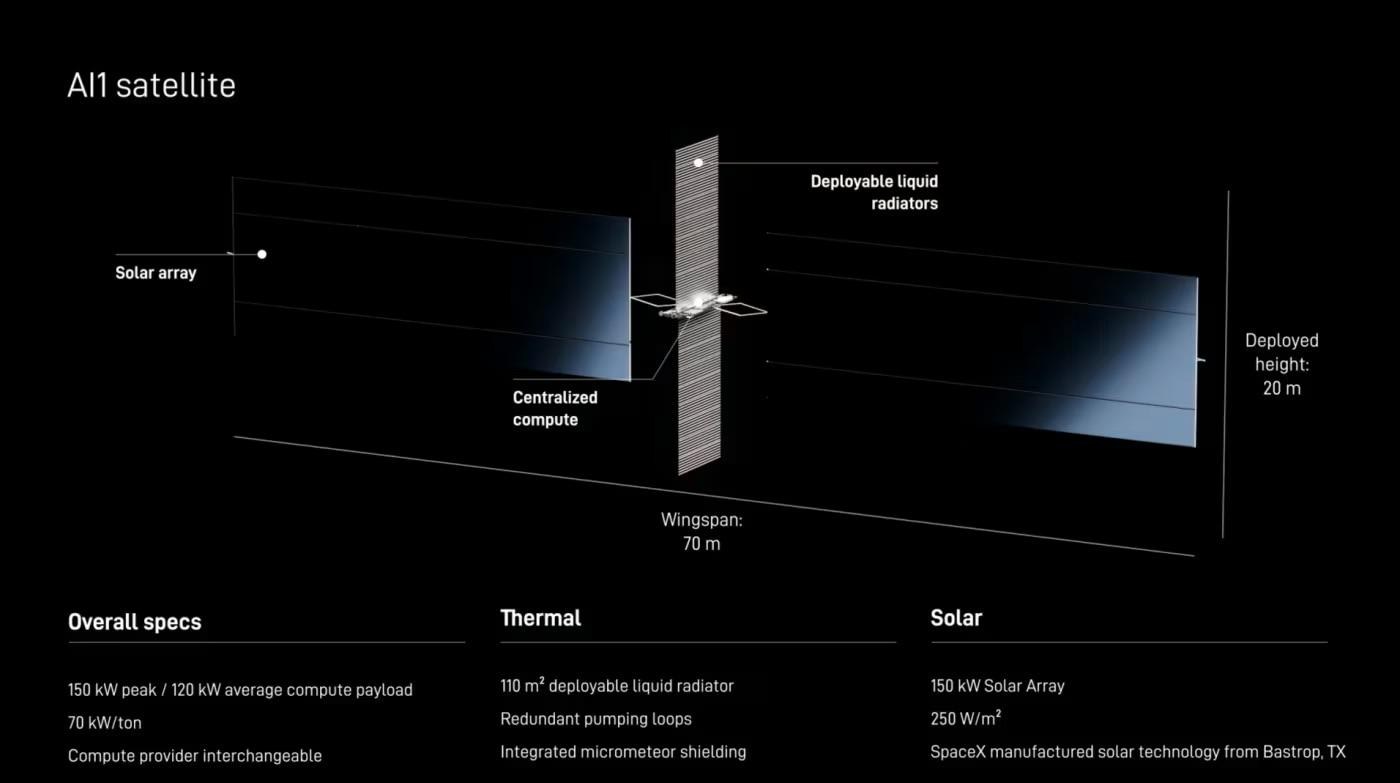 Image: SpaceX
According to Musk, achieving heat radiation of 1,300 Watts per square meter of a radiator surface on an AI satellite is easily achievable. Space radiation is entirely dependent on the Sun, whose massive energy not only heats up equipment but also requires satellite manufacturers to ensure components designed to emit heat are pointing away from it. In short, while facing the Sun heats equipment up, pointing away from it allows the equipment to emit heat into the freezing cold temperatures of deep space.
Musk alluded to the absolute cold of space as he commented:


“~1300 W/m^2 is easily achievable for an aluminum radiator pointed away from the Sun, as it is mostly just seeing cosmic background radiation at ~3 degrees above absolute zero!”
He added:
“Solar panels generate ~250 W/m^2, so you should expect them to have ~5 times the area of the radiator. Most of the mass of the satellite is solar panels.”
Heat transfer in space through radiation is determined by the Stefan-Boltzmann Law, which links heat transfer into space to the emissivity of a surface and its area, along with the Boltzmann constant, the object’s temperature and the temperature of the surrounding area. Coated aluminum radiators have a higher infrared emissivity compared to solar panels.
Data center satellites are a key part of SpaceX’s total addressable market (TAM). While in its regulatory filings the firm has pegged this figure at $28 trillion, Musk believes the estimate is insufficient.

About the author: Ramish is a seasoned technology writer and editor with more than a decade of experience. He specializes in semiconductor fabrication and market analysis.
With a background in finance and supply chain management – via his bachelor’s in Finance and a micromasters in supply chain management from MIT – Ramish can cover deep industry insight to deliver accurate and authoritative coverage.
Follow Wccftech on Google to get more of our news coverage in your feeds.