
Like many gig workers in China, freelance photographer Ah May might not be able to retire with a pension.
Constantly on the move, her income is unstable and she cannot afford the 1,000 yuan ($213) monthly bill to fully participate in China’s “social insurance” scheme.
“It’s a bit too expensive. I just can’t afford it with my current income,” Ah May, who asked to only use her first name, said.
China’s social safety net for urban workers is an insurance-style system that requires participants or their employers to make consistent payments.
The scheme includes components for medical, retirement, unemployment, work injury and maternity benefits.
Employers’ contributions on behalf of their employees are mandatory, but joining is voluntary for self-employed workers.
In October, then-vice-minister of human resources and social security Li Zhong said the government would use large databases to identify people not enrolled in the scheme.
He said the goal was to build a “more optimised and sustainable social security system” and make it “more comprehensive and robust”.
From November 1, penalties have also been standardised for employers failing to pay social insurance contributions, with potential fines of up to three times the amount of insurance owed.
Economists have argued that expansion of the social safety net to more people would allow them to put less money into emergency funds and boost household spending.
Ah May has been paying hundreds of yuan, a big chunk of her monthly income, for the medical component only, as paying full medical bills out of pocket would be more costly.
She said she would like to be covered for retirement too but could not see a way to afford it.
“Unless they come up with a policy to provide me with subsidies [to pay full insurance],” she said.

Many people in China cannot afford to pay the insurance in full. (AP: Mark Schiefelbein)
‘Living on my savings’
More than 200 million people in China work in flexible employment, according to a report from the National People’s Congress in December 2025.
The category covers freelancers, self-employed “platform workers” who provide labour, services, or goods through apps and websites.
A survey of 1,400 platform workers published earlier this year by state media China Youth Daily found 77 per cent of those under 35 said they would like to pay out of pocket to join the social insurance system.
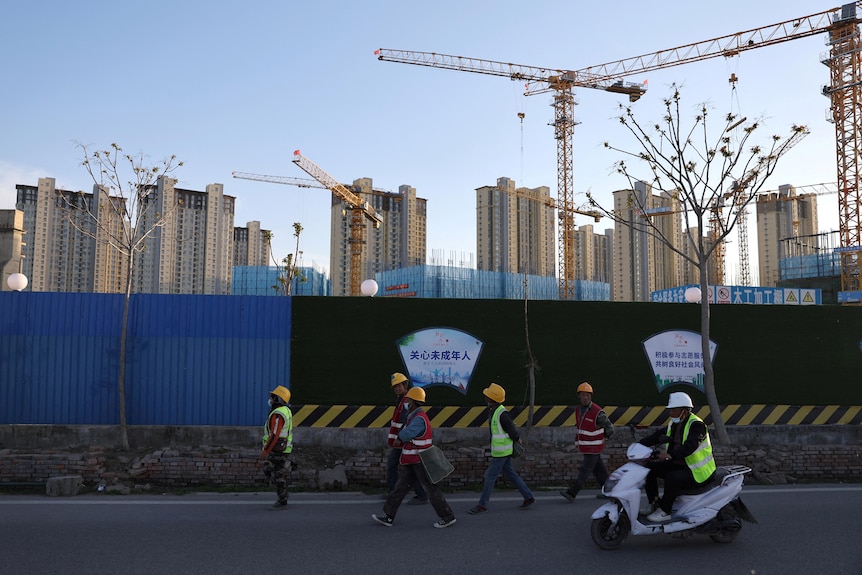
Many young people say moves to increase the retirement age has undermined their confidence in retirement insurance. (Reuters: Tingshu Wang)
However, the survey found only about 17 per cent of the young platform workers are paying social insurance in full.
Some flexible workers and sole traders — unsure about what will happen in 30 years — choose to opt out of paying the retirement insurance when they are in their 20s or 30s.
Lucian Li, who independently trades financial products, is one of them.
Mr Li said he didn’t trust retirement insurance.
“I think years of trading [by myself] yields a lot more than paying retirement insurance.
“It’s enough living on my savings,” Mr Li said.
Demographic change drives structural pressure
Bingqin Li, a professor of social policy at UNSW Sydney, said the government had been gradually tightening enforcement against employers who failed to make contributions.
In 2025, a Chinese court ruled that private agreements between companies and employees to save costs by not making social insurance contributions were invalid.
Retirement at 50 years old? China seeks to raise its low pension age
However, Dr Li said that fining employers and getting more people to join did not address the ultimate challenge facing China’s social security system.
China’s aging population means a decreasing number of working age people making payments into the pension scheme and an increasing number of older people taking money out.
According to China’s National Bureau of Statistics, 323 million people, about 23 per cent of the population, are aged 60 or over.
That number is expected to reach about 390 million by 2030, while the working-age population shrinks.
Dr Li said Chinese academics had suggested in 2019 that the pension fund for company employees would start running deficits around 2028 and could be used up by 2035.
“A later update suggested delayed retirement could postpone this by eight to nine years,” she said.
In 2025, the government announced it would gradually increase the retirement age over a 15-year period.
It would increase from 50 to 55 for blue-collar women, from 55 to 58 for white-collar women, and from 60 to 63 for men.
“There is no short-term payment crisis [with China’s social insurance system], but there is real structural [demographic] pressure,” she said.