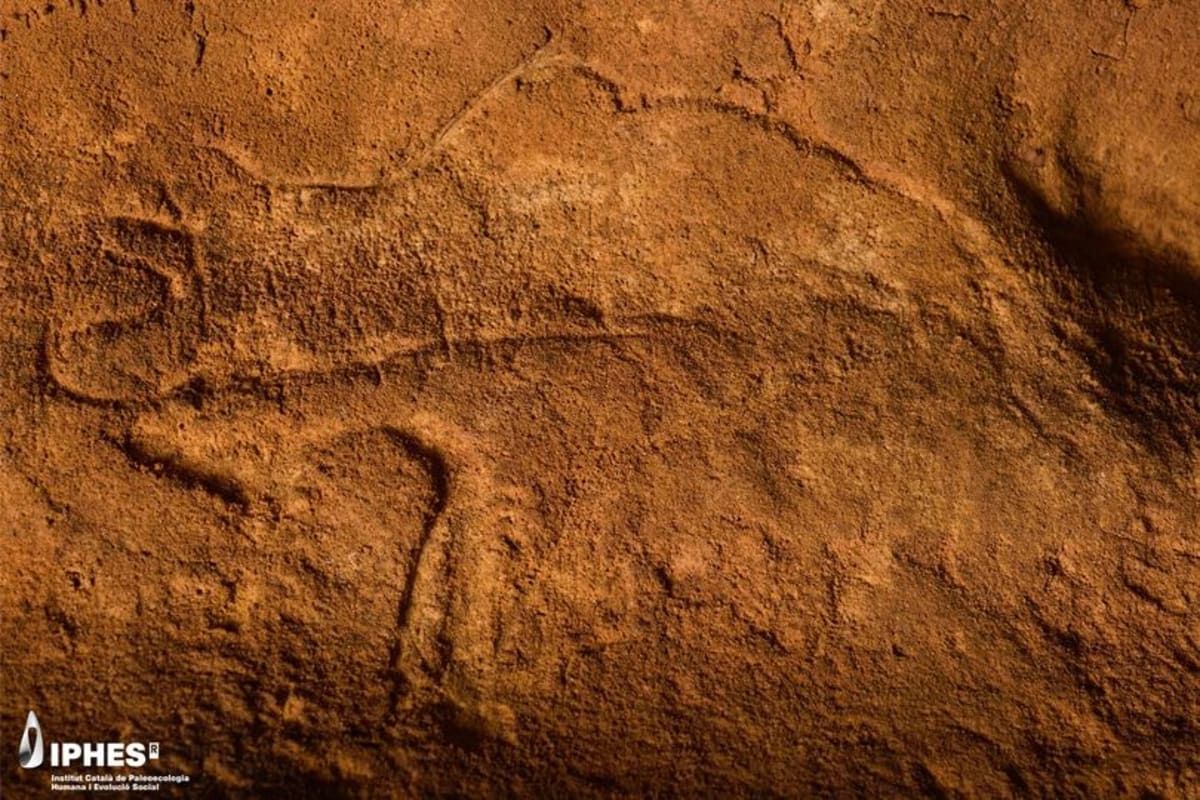
For years, tourists were unknowingly scribbling graffiti on prehistoric art in a cave in Spain.
The art was discovered in Cova de la Font Major, in northeastern Spain, a popular attraction since its discovery in 1957. Over the years, visitors explored the cave, often scrawling graffiti on the walls while not noticing something extraordinary – hundreds of engravings in the rock stretching back to the Ice Age.
A new study published in the journal Antiquity outlines the discovery of the 280 Paleolithic artworks at the cave near the town of Espluga de Francolí, in the province of Tarragona. The find, first made in 2019, is one of the largest collections ever found on the Iberian Peninsula. It includes 55 representations of animals, including horses, deer, and even a bear. Some of the artwork is more abstract, just swirls and loops.
• Disturbing abuse found on suspect’s phone after teacher found dead in shallow grave
• Lawyer who represented Tupac’s killer found dead in Las Vegas as cause of death pending
Many have been left wondering how the artwork went so long being undiscovered. Míriam Salas-Altès, a co-author of the paper and a Ph.D. student at University of Rovira i Virgili and the Catalan Institute of Human Paleoecology and Social Evolution (IPHES-CERCA), theorized it was the dark conditions in the cave that made the etchings so hard to spot.
She added that the Paleolithic engravings may have been difficult to make out from modern markings scrawled across the walls.

Archaeologists have discovered one of the largest collections of Ice Age cave art ever found in Mediterranean Iberia -Credit:IPHES-CERCA/Antiquity Publications Ltd./Josep Maria Vergès Bosch/MÃriam Salas-Altès/Cover Images
The find is also unexpected, with most Paleolithic cave art previously found in the Franco-Cantabrian region, the northern ‘neck’ of the peninsula.
The Paleolithic period is the earliest and longest period of human prehistory, lasting from roughly 3.3 million years ago to about 11,650 years ago.
Only two figures had previously been found in Catalonia, the researcher said.

One of the artworks highlighted with a faint line -Credit:IPHES-CERCA/Antiquity Publications Ltd./Josep Maria Vergès Bosch/MÃriam Salas-Altès/Cover Images
“It was a big surprise,” she added.
Access to the cave has now been limited to protect the engravings. Salas-Altès hopes that work will continue to decipher the 280 engravings, and further research will be carried out to understand the history of human presence in the cave.
For example, for now, the experts don’t know if the cave was used simply for shelter, ritual practices or something else. There could also be more engravings to be found as over the years the cave has filled with sediment which could be hiding more prehistoric art.