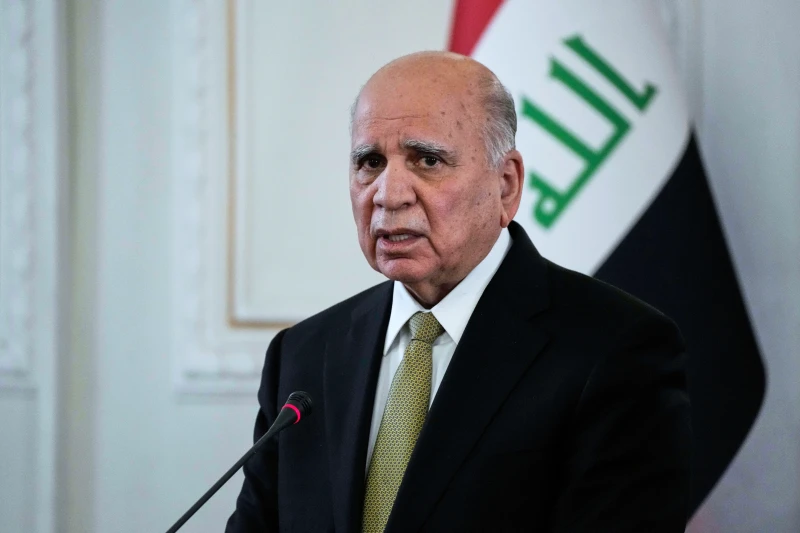
ERBIL, Kurdistan Region of Iraq – Baghdad is in talks with Tehran over Iran-backed militias in the country amid a government effort to bring all weapons under state control, Iraqi Foreign Minister Fuad Hussein said Saturday, while also confirming that Washington has requested that Iraq close all border crossings with Iran bar two.
In an interview with Al Jazeera, Hussein said Baghdad is in talks with Iran over the “issue of Iraqi factions’ weapons,” while it is also negotiating with Harakat al-Nujaba and Kataib Hezbollah, two of the main forces in the Islamic Resistance of Iraq (IRI).
“Asaib Ahl al-Haq [AAH] and Kataib Sayyid al-Shuhada have agreed to control their weapons,” Hussein added, referring to two factions that are part of the state-integrated but Iran-backed Popular Mobilization Forces (PMF).
Thus far, several armed militias have agreed to disarm, including the aforementioned two, Kataib Imam Ali, and Muqtada al-Sadr’s Saraya al-Salam.
Meanwhile, others such as the powerful Kataib Hezbollah – responsible for myriad drone attacks in the Kurdistan Region during the US-Israeli war on Iran – have rejected the prospect of laying down their weapons.
“We informed Iran that we accept friendship and alliance with them, but we reject their interference in our affairs,” Hussein said.
During the war with the US, Iran repeatedly targeted US military and diplomatic sites in Iraq, as well as Iranian Kurdish opposition groups in the Kurdistan Region. The US, Israel and regional neighbors, including Saudi Arabia, also conducted airstrikes on pro-Iran Iraqi militias.
“We have information about foreign entities using Iraqi territory to attack neighboring countries,” Hussein said, without elaborating who he was referring to.
In September, Saudi Arabia’s foreign ministry announced that “several drones launched from Iraq” had targeted its East-West pipeline in the Riyadh and Medina regions.
Iraqi Prime Minister Ali al-Zaidi, who made the restriction of weapons to state hands a key pledge upon commencing his tenure, had initially set September 30 as the deadline for the militias to handover weapons to the state.
The deadline coincided with the withdrawal of the US-led global coalition against the Islamic State (ISIS).
After several militias disagreed, he shifted to a phased process extending into 2027.
Under the plan, armed factions would first observe a 90-day period without attacks, with guarantees that they would not be targeted by US strikes, before moving toward the gradual handover of weapons and integration of fighters into state institutions.
In early October, Zaidi announced that five factions, besides those announced, had agreed to hand over their weapons, without naming them.
Border closure with Iran
Hussein also said that Washington had formally requested that Baghdad closes its borders with Iran, except for two. Iraqi officials had previously said that the closure was due to “rehabilitation works,” while international reports said they were closed under pressure from Washington
“Washington has officially requested the closure of all our border crossings with Iran, except for two,” Hussein told Al Jazeera.
Iraq and Iran share a 1,599 km border line and there are nine official border crossings linking Iran to Iraq and the Kurdistan Region.
As a result of this recent measure, only two of the border crossings would remain open, one in the Kurdistan Region and the other in federal Iraq, according to AFP in late October.
US Central Command (CENTCOM) announced Saturday that it has directed the creation of a task force seeking to clamp down on Iran’s use of land routes to transport weapons and sanctioned materials, with its remit to focus on land borders and the Caspian Sea.
Titled “Task Force Iron Gate,” the command noted that it will comprise “approximately 20 civilian and military personnel based in Tampa, Florida” and will serve to bolster the pre-existing naval blockade of Iran by disrupting Iranian ground transit routes “supporting illegal shipments.”
Washington has sought to cut off land corridors that have allowed Iran to supply its allied factions across the Middle East with weaponry and materials, including applying pressure on neighboring states to seal their borders with the country.
It also imposed a naval blockade on Iranian ports after Tehran closed the vital Strait of Hormuz, responsible for the transport of around 20 percent of the world’s oil.
The Strait’s closure also took a toll on Iraq’s economy, as it was the main export route for its oil.
Hussein said the closure cost the country $60 billion, adding that it has restarted exports through the waterway following an agreement with Tehran and Washington.