

November 1 marks the 40th anniversary of the major fire at Sandoz in Basel-Schweizerhalle. The disaster marked the final low point of the calamitous year of 1986. These four tragedies shook Switzerland.
January 28, 1986: The Challenger Disaster
For six years, NASA flew its astronauts into space aboard reusable space shuttles, allowing them to land on a runway like airline passengers once their missions were complete. Twenty-four such flights took place during that time; for the U.S., space was essentially accessible via a charter flight.
The 25th Space Shuttle flight—the 10th for the “Challenger”—also drew thousands of spectators to Cape Canaveral. Seventy-three seconds after liftoff, everyone held their breath. The launch vehicle, to which the Space Shuttle was attached, exploded. A gigantic fireball 15 kilometers above the ground left little doubt that no one had survived.
There were seven people on board, including teacher Christa McAuliffe, who—as part of the Teachers in Space program—was supposed to teach classes live from orbit to inspire children’s interest in science and technology.

73 seconds after takeoff, at an altitude of 15 kilometers, the tragedy unfolds. Seven people die—the first casualties in U.S. spaceflight.
Associated Press
The “Challenger” cabin, containing the remains of the crew, was found in the ocean by divers a month after the accident.
The explosion was caused by a sealing ring that allowed gas to escape due to the low temperatures, which ultimately triggered a chain reaction leading to the fatal explosion. Tragically, engineers had pointed out this danger shortly before launch and had spoken out against proceeding with the launch. They were overruled by management at the supplier of the sealing rings, according to the “NZZ”.
As a result, NASA changed its decision-making processes. Since then, experts have been deciding whether a launch receives approval—without any time or deadline pressure—based solely on their technical risk analysis.
The Swiss public watched the disaster on television, where space expert Bruno Stanek tried to explain what had happened. For decades, Stanek was known as Switzerland’s “Mr. Space.” He died in May 2026 at the age of 80.
April 26, 1986: The nuclear disaster at the Chernobyl nuclear power plant
When, on April 28, 1986, the monitoring instruments at the Forsmark nuclear power plant in Sweden detected unusually high levels of radioactivity, it had already been two days since the explosion at Reactor 4 of the Soviet nuclear power plant in Chernobyl. The Soviet government did not acknowledge the accident until it could no longer be denied.
What had happened? Experts at the Chernobyl Nuclear Power Plant had been testing since April 25 to determine whether the emergency power generator could provide enough energy to ensure the reactor remained cool in the event of a power outage—the plant needed a power supply to function, even though it generates its own electricity.
In order to conduct the test, they disabled certain safety systems and violated a number of safety regulations, as shown in the official investigation report later published by the Swiss Federal Nuclear Safety Inspectorate.
The nuclear technicians reduced the reactor’s power to such a low level that its operation became unsafe. When they quickly increased its power again, it overheated. This led to a meltdown, the worst-case scenario, or GAU. At 1:23 a.m. on April 26, Unit 4 exploded, blowing off the roof of the reactor building.

One of the few photos of the destroyed reactor building at the Chernobyl nuclear power plant shortly after the explosion, released by the Soviet Union. Emergency responders battled the fire for days.
AP Chernobyl Museum
For days, firefighters, military personnel, and other workers—with inadequate protection—battled a graphite fire that was nearly impossible to extinguish. The residents of the nearby town of Prypiat—built for the nuclear power plant’s workers and their families—were initially kept in the dark. It wasn’t until April 27 that authorities ordered the evacuation of the town. To this day, the 30-kilometer radius around the power plant remains an exclusion zone.
Meanwhile, a cloud of radioactive fallout was on its way, first toward Sweden, then moving southward. Switzerland watched the news with bated breath, wondering whether the wind would carry the danger toward their country. On April 30, the cloud reached Switzerland. There was great uncertainty as to whether Swiss vegetables, milk, mushrooms, or fish could still be eaten. Radioactivity was detectable in all of these foods, but the federal government did not issue specific limit values; instead, it referred to the total exposure during the period of radioactive fallout—a metric that, while sensible, was not entirely easy to understand. There were recommendations, such as avoiding fresh vegetables for a while. A contemporary witness reported a rush to buy UHT milk.

Switzerland is not imposing any bans, but advises pregnant women and young children to avoid eating vegetables or salad and to refrain from drinking fresh milk for a while.
KEYSTONE
Ultimately, only the canton of Ticino imposed a fishing ban on Lake Lugano. Heavy rain had washed radioactivity—particularly cesium nuclides—into the soil and water. It was not until the summer of 1988 that fish could once again be caught and eaten from Lake Lugano. Even today, elevated levels of cesium-137 can be detected in mushrooms in Ticino, although they are mostly below the limits currently in effect.
The number of people who died as a result of the reactor accident remains a matter of debate to this day. It is estimated that 30 to 50 people died as a direct result of the explosion—from burns and radiation sickness caused by the radioactivity to which they were exposed while fighting the fire and during cleanup and containment efforts—many just a few weeks after the nuclear disaster, others not until years later. Based on available studies and reports, the Paul Scherrer Institute estimated that between 9,000 and 33,000 people died from the short- and long-term consequences.
Nuclear power suffered a further loss of public trust in some segments of Swiss society due to the Chernobyl reactor accident. In 1988, the already controversial plans to build new nuclear power plants in Kaiseraugst, Aargau, and Graben, Bern, were scrapped. In 2017, Swiss voters approved the energy strategy and decided to phase out nuclear power—in the wake of the severe reactor accident in Fukushima, Japan.
In 2026, however—40 years after the Chernobyl disaster—Parliament lifted the ban on building new nuclear power plants.
September 8, 1986: The Unexplained Landslide at Brünig
By 2026, rockslides and landslides caused by climate change will no longer be a rare occurrence. The landslides in Brienz, in the canton of Graubünden, and in Blatten in the Lötschental demonstrate how well Switzerland has adapted to this natural hazard; thanks to close monitoring and timely warnings to the public, the worst was prevented.
In 1986, however, the Swiss were not accustomed to landslides on mountain slopes, especially not in the summer, when neither snow nor prolonged rain makes the ground unstable, as Ruedi Matter—then host of the show *Karussell*— who later became director of SRF, remarked on Swiss television after the disaster.
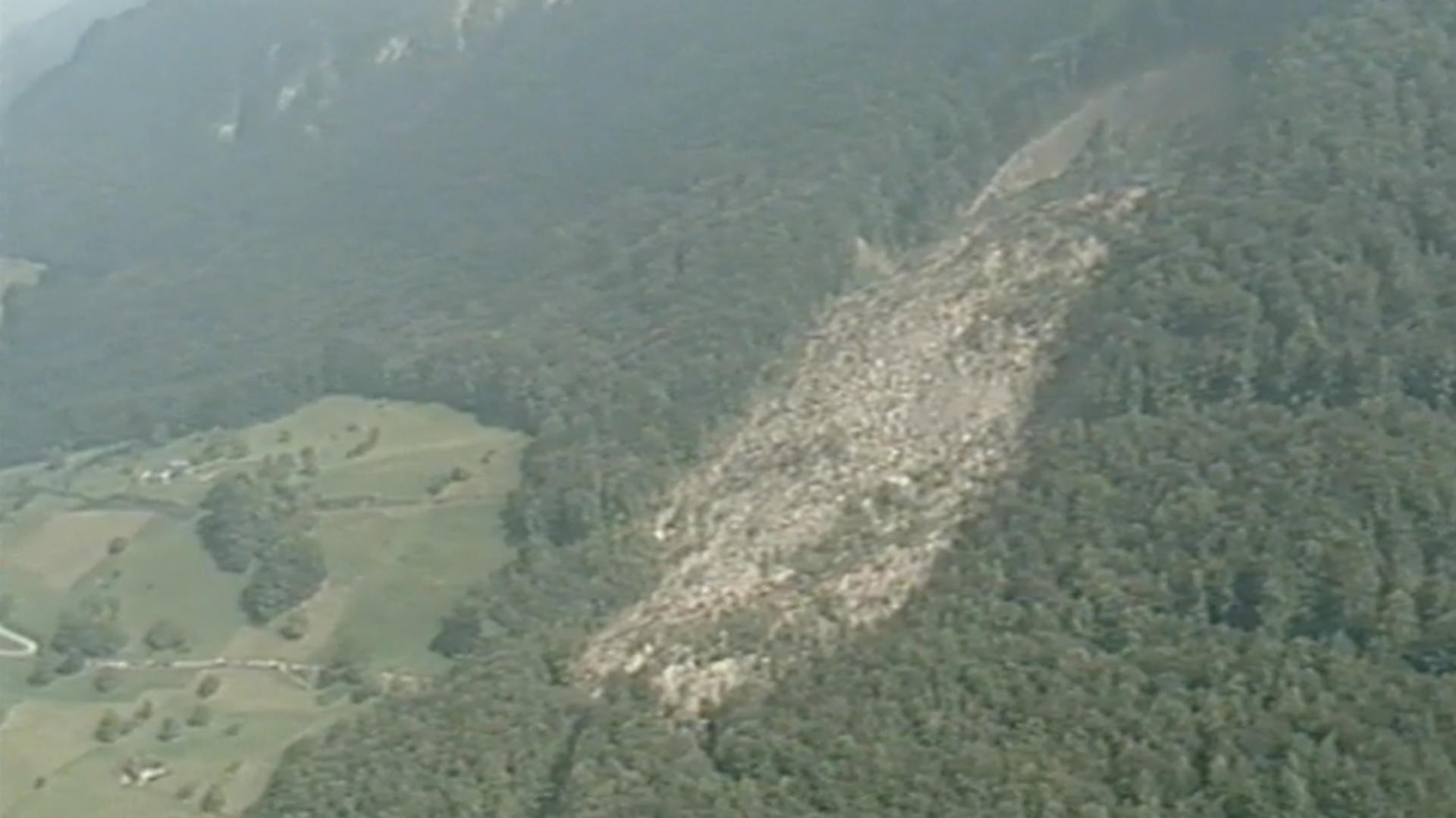
Suddenly, the forest slides down into the valley. The Brünig Pass road and the railroad tracks are buried over a 500-meter stretch. Two people die.
SRF “Carousel”
Nevertheless, on September 8, 1986, a landslide occurred between Giswil (OW) and Kaiserstuhl (OW), burying the Brünig Pass road and the railroad line below it under debris up to 15 meters high in some places. Two people were killed in their cars when they were buried under the debris, and one woman was seriously injured.
Why the steep, forested slope suddenly slid during a dry spell without warning remains unclear to this day. “Unlike the mechanism of the landslide, the timing of the event could not be plausibly explained,” as quoted by the “Obwaldner Zeitung” quotes from a report by geologist Andress Wildberger years later. If the landslide had occurred after heavy rainfall, it would have been less surprising. After a prolonged dry spell, however, it was.
From today’s perspective, it also remains unclear why a road and a railroad track had been built below this particularly steep slope. Twenty-five minutes before the landslide, a train carrying several school classes had passed the site of the disaster. The masses of debris pushed a railroad bridge 200 meters down the valley; a second bridge was never found. To this day, the railroad and the road run along the foot of the steep slope.
November 1, 1986: The chemical fire at Sandoz in Basel-Schweizerhalle
The chemical industry is as much a part of Basel as the Rhine—admittedly not as long, but it is enormously important to the city’s economy. There was controversy over just how great the environmental risk posed by the industry actually was.
The people of Basel and everyone living downstream along the Rhine were given a reality check on November 1, 1986.
Shortly after midnight, the first reports came in to the fire department. There were reports of a smoldering fire in the Schweizerhalle industrial area. This subsequently developed into one of the largest fires in Swiss history, with flames blazing up to 60 meters high while explosions could be heard and barrels flew through the air. Some drivers were still passing the inferno on the highway before it was closed at 2 a.m.

Switzerland’s worst environmental disaster and one of the country’s largest fires: For six hours, 200 firefighters battled the blaze at the Sandoz chemical warehouse.
KEYSTONE
In Muttenz, where Schweizerhalle is located, the sirens wailed; in the city of Basel, they were undergoing maintenance at the time, which is why the police used megaphones from their cars to warn the public and announce a curfew, as SRF reported in a reconstruction of the night of the fire reports.
This content comes from external providers such as YouTube, TikTok, or Facebook. Please enable “Swisscom advertising on third-party platforms” to view this content.
Cookie Settings
Shortly after 6 a.m., the fire was extinguished, and the curfew was lifted. The incident was followed by a flurry of conflicting information. At first, it was reported that schools would remain closed and that everyone should stay home. Then the schools were opened after all. The district president also announced the morning after the fire that there was no danger to the public. Yet it was not even clear at that point what had exploded in Schweizerhalle. It later emerged that highly toxic phosgene had been stored in an outbuilding adjacent to the burning warehouse—a substance that had killed thousands of soldiers as a chemical weapon during World War I.
Although more than 1,000 people subsequently sought treatment for breathing difficulties, the chemical fire did not have any serious health consequences for the people in Basel and the surrounding area. However, there was a great deal of anxiety, especially in the first few hours, due to the cloud of smoke that could be smelled from far away.
The firefighting water, however, caused an environmental disaster when it flowed into the Rhine via the storm sewer system near Schweizerhalle. When the river turned red, Sandoz reported that it was merely harmless dye. That was until, a short time later, fishermen began pulling more and more dead fish out of the Rhine.

Dead eels in Baden-Baden: Several hundred kilometers downstream on the Rhine, eels, grayling, and other fish are dying following the fire in Basel. The contaminated firefighting water killed the fish.
KEYSTONE
As subsequent analyses show, 15 million liters of water used to extinguish the fire flowed into the Rhine, contaminated with 30 to 40 metric tons of toxic substances—primarily pesticides. The red dye was, in fact, merely a harmless marking dye.
Over the next 30 days, the entire populations of grayling and eels died along a 400-kilometer stretch of the Rhine downstream; pike and zander also perished in large numbers, as did mallards and terns. Furthermore, in 1986, the Rhine served as a source of drinking water for 20 million people in Germany and the Netherlands (today that number is 30 million). As a result, water treatment plants had to suspend operations for up to 18 days.
In the months that followed, eels, grayling, and other fish migrated back into the affected area from tributaries and upstream sections of the river. It takes two to three years for the populations to recover.
The immediate result in Basel was a series of demonstrations and protests that turned official information sessions into chaotic scenes. Many were convinced that they were not being told the whole truth. At least for the first 24 hours after the fire broke out, that was indeed the case.
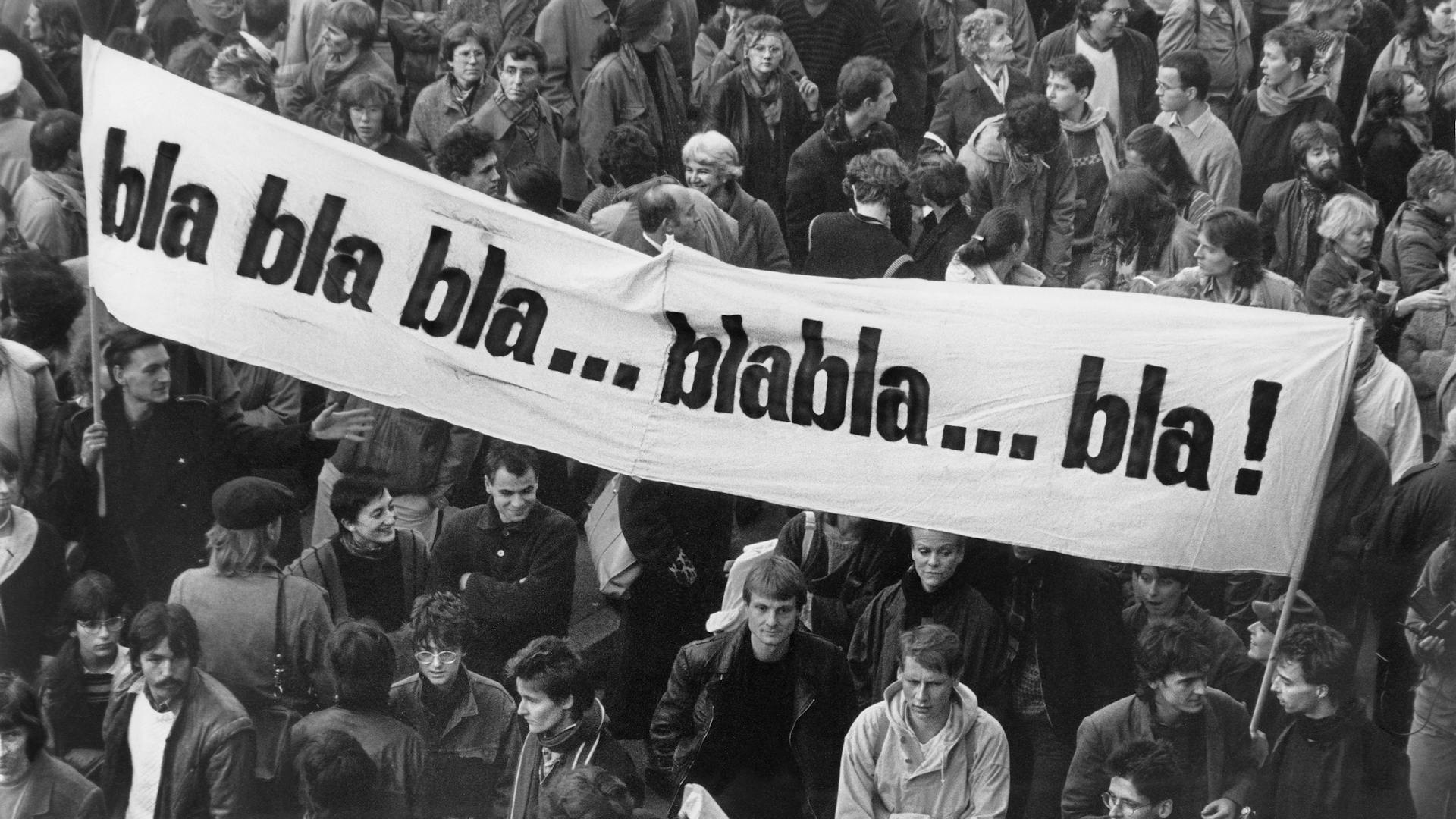
The environmental disaster and the way those in charge are handling the situation are driving people out onto the streets.
KEYSTONE
Today, the Rhine is considered clean—cleaner than it was before the fire. Following what remains Switzerland’s worst environmental disaster to date, the communities along the Rhine implemented effective protective regulations and measures. Among other things, retention basins—which are now mandatory—collect the water used to extinguish fires. However, despite remediation efforts, the soil around the site remains contaminated to this day with chemicals that were released at the time.
To this day, it remains unclear exactly how the fire started at the Sandoz warehouse in Schweizerhalle. The most likely cause of the fire is believed to be a pallet containing the highly flammable dye “Berlin Blue.” Workers had laid down plastic sheeting and heated it with a gas torch to make it shrink around the dye packages—a common packaging method. However, this likely triggered a smoldering fire that was not visible from the outside, which subsequently spread to other chemicals. This is the conclusion of the official investigation, conducted by the Scientific Service of the Zurich City Police (now the Zurich Forensic Institute).
Former Sandoz employees told the “Basler Zeitung” 30 years after the fire that fireworks had been stored in the warehouse to bid farewell to a senior employee. There is no concrete evidence for this either.
The wildest theory was put forward by a now-deceased CIA employee. The East German secret police, the Staatssicherheit—known as the Stasi—allegedly set the fire on behalf of the KGB to divert attention from the Chernobyl disaster. He provided no evidence for this claim, and the federal agency responsible for the Stasi archives found no evidence to support it either. Others also believe it was arson, though not necessarily with KGB involvement.
1986, 2001, 2026: The Half-Life of Memory
In Switzerland, 1986 was long regarded as the year of disasters. The series of sensational accidents reinforced the views of those who saw major risks in technological progress—especially opponents of nuclear power and the chemical industry. That same year, but before the fire in Schweizerhalle, several Green groups joined forces to form the Green Party of Switzerland.
But even memories have a half-life; they lose their impact. Fifteen years later, the “Autumn of Disasters” shook Switzerland’s self-image—the belief that disasters occur all over the world, but not in this prosperous, well-organized small country.
In 2026, the inferno in Crans-Montana will overshadow memories of the accidents that occurred 25 and 40 years ago. And who still remembers the crash of a British charter plane in Hochwald, Solothurn, in 1973, which claimed the lives of 108 people? Or the

03:05
Swissair Absturz vor Halifax – Das musst du vor dem Kinofilm über die Tragödie wissen229 Menschen sterben, als Swissair 111 vor Halifax ins Meer stürzt. Das Video zeigt kompakt, was damals geschah – und liefert den Hintergrund zum neuen Kinofilm über die Angehörigen der Opfer.