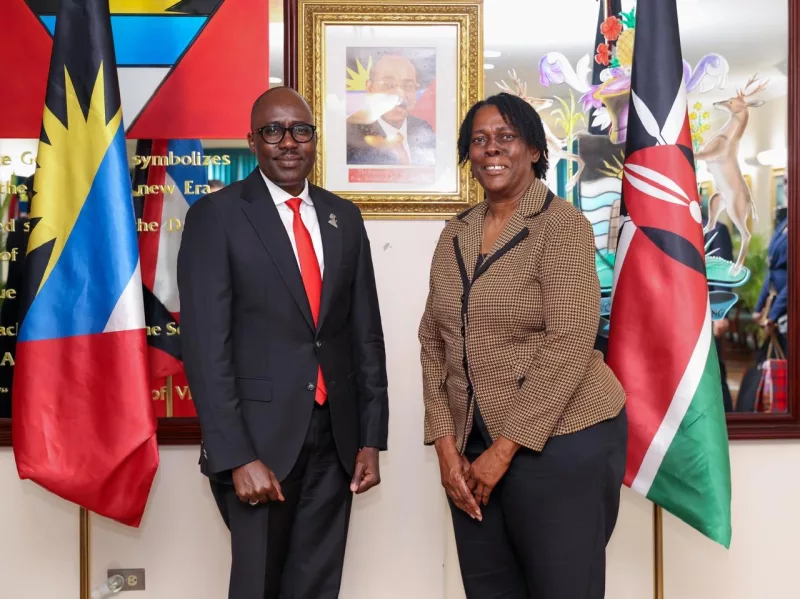
 Foreign Affairs PS Korir Sing’oei and Antigua and Barbuda Foreign Affairs Permanent Secretary Sharon Stevens on the sidelines of CHOGM 2026
Kenya has linked its decision to shift diplomatic operations from Cuba to Jamaica to mounting administrative and operational difficulties arising from longstanding United States sanctions on Havana.
Foreign Affairs PS Korir Sing’oei said the effects of US sanctions had complicated the mission’s work.
Speaking during bilateral talks with Barbados Foreign Affairs Senior Minister Christopher Sinckler, he said the decision had been informed by “the need to provide temporary operational relief to the staff of its Embassy in Havana, Cuba”.
The talks were held on the sidelines of the Commonwealth Heads of Government Meeting in St John’s, Antigua and Barbuda.
His explanation sheds new light on Nairobi’s decision to reorganise its diplomatic presence in the Caribbean, a move previously presented as part of efforts to strengthen relations with countries in the region.
Decades of US economic restrictions have complicated international financial transactions and commercial activities in Cuba.
Although the Ministry of Foreign Affairs did not specify the difficulties experienced by Kenyan diplomats, the sanctions have contributed to a challenging operating environment, particularly in international banking and access to goods and services.
The US has maintained an economic embargo against Cuba for more than six decades, restricting trade and financial dealings with the Caribbean nation.
Kenya has consistently condemned the sanctions at the UN, describing the restrictions as contrary to the principles of sovereign equality, non-interference and shared prosperity.
In a statement delivered by Kenya’s Deputy Permanent Representative to the UN, Amb Yabesh Monari, on October 28, Nairobi argued the embargo had inflicted suffering on ordinary Cubans, undermined livelihoods and worsened the country’s economic difficulties.
“For over six decades, the economic, commercial and financial embargo against Cuba has stood in stark contradiction to the very principles upon which the United Nations was founded,” Kenya said.
The government also maintained that unilateral sanctions undermine multilateralism and Cuba’s right to development, reaffirming its opposition to measures that restrict the country’s economic progress.
The restrictions have also affected Cuba’s ability to access international markets and financial services.
The shift to Kingston marks a significant adjustment in Kenya’s diplomatic arrangements in the Caribbean, where Cuba has historically been an important partner, particularly in healthcare cooperation.
Kenya and Cuba have maintained bilateral relations spanning several decades, with healthcare cooperation among the most visible areas of engagement.
Cuban medical specialists have worked in Kenyan health facilities under bilateral arrangements, while Kenyan medical professionals have benefited from training opportunities in Cuba.
The two countries have also maintained cooperation through multilateral institutions, including the United Nations.
During the meeting with Barbados, Sing’oei also outlined Kenya’s plans to strengthen economic and diplomatic cooperation across the Caribbean.
He called for increased access to the Barbadian market for Kenyan coffee, tea, horticultural produce and dairy products, alongside stronger investment links.
The two countries also discussed financial technology, banking, healthcare cooperation and maritime trade, including a proposed sister-port arrangement between Mombasa and Bridgetown.
Kenya further expressed interest in opportunities for qualified Kenyan nurses to work in Barbados as part of wider cooperation in the health sector.
Sing’oei also sought Barbados’ support for Kenya’s bid to host the 2028 Commonwealth Heads of Government Meeting in Nairobi.