Semiconductor chips – the “brain” of the digital age.
On November 3rd, the launch of the VGC v1.0 security chip marked a proud milestone, as Vietnamese ingenuity officially mastered everything from cryptographic algorithms to integrated circuit design, a “Make in Vietnam” product successfully researched and manufactured by the Government Cipher Committee in collaboration with the Military Telecommunications and Technology Group ( Viettel ).
 An AI -generated illustration of a semiconductor chip.
According to Mr. Nguyen Quy Linh, Director of the Nghe An Department of Science and Technology, semiconductor chips (microchips) are integrated circuits containing millions to billions of transistors on a substrate material (most commonly silicon), acting as the “brain” that processes, controls, and stores information for all electronic devices. This technology is present in almost all pillars of digital technology: from consumer devices (phones, computers), smart transportation ( electric vehicles , sensors), high-tech infrastructure (5G/6G, AI, cloud computing), to industry and healthcare (diagnostic equipment, automation).
Considered the “lifeblood” of the Fourth Industrial Revolution, the super-fast computing power, energy efficiency, and flexibility of semiconductor chips directly determine national competitiveness and cybersecurity.
 Mr. Nguyen Quy Linh, Director of the Nghe An Department of Science and Technology, speaks at a meeting on the progress of implementing Resolution No. 57-NQ/TW of the Politburo in Nghe An. Photo: PV Potential and prospects
Nghe An province does not yet have a factory manufacturing core chips in the advanced silicon processing stage, but the reality shows that local businesses have quietly entered this supply chain from the basic materials stage and have formed a large-scale supporting electronics industry base.
Luxshare-ICT (Nghe An) Co., Ltd. is a subsidiary of Luxshare-ICT Group, one of the world’s leading manufacturers of electronic components and electronics. The Luxshare-ICT (Nghe An) 2 project is located in the VSIP Nghe An Industrial Park (Hung Nguyen commune) on a total area of 40.61 hectares. The factory has a designed capacity of over 163.8 million products per year, focusing on main product groups including electronic components, phone accessories, smart wearable devices, cameras, communication equipment, robotic vacuum cleaners, and drones. To ensure the well-being of its workforce, the company has planned a separate dormitory area covering 4.43 hectares, comprising 12 ten-story buildings, accommodating up to 12,000 workers and experts.
 Manufactured by Everwin Precision Technology Co., Ltd., VSIP Industrial Park, Nghe An Province. Photo: Tran Chau
Luxshare – ICT (Nghe An) does not manufacture or fabricate semiconductor microspheres (chips/wafers), but operates downstream in the semiconductor industry’s value chain. Specifically, the company has been involved in applying semiconductor chips to circuit boards: The SMT (surface mount technology) stage in the manufacturing process directly places the finished chips onto electronic circuit boards to create controllers for devices.
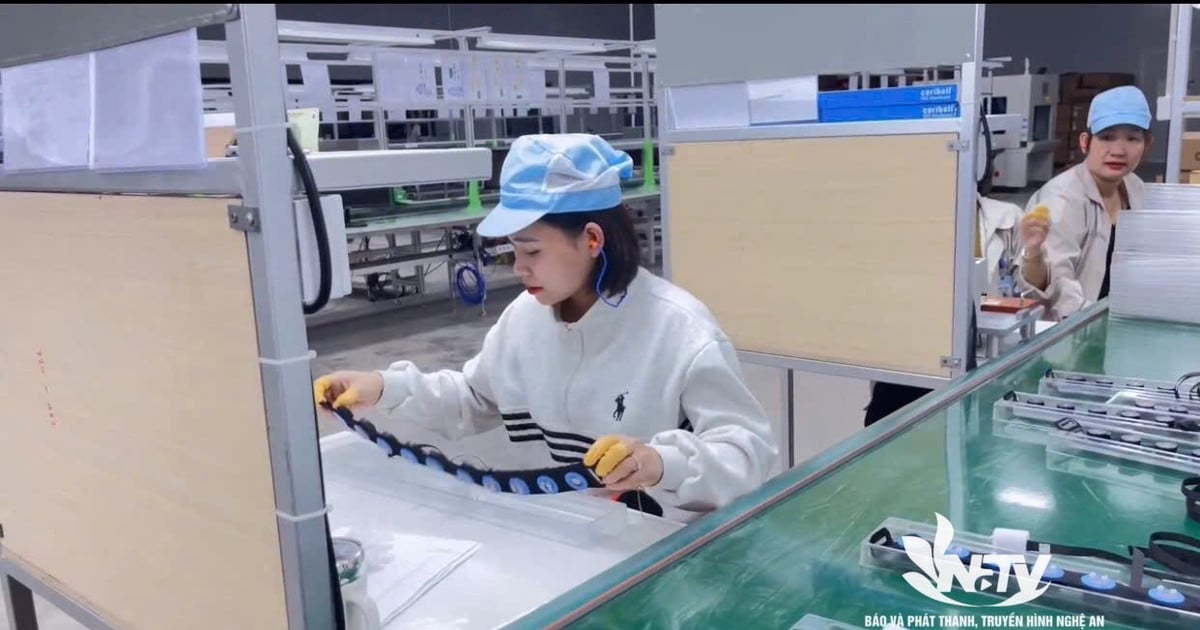
The factory serves as a receiving and integration center for chips into complete hardware products such as headphones, inverters, WiFi routers, and cameras. Quality control processes such as optical inspection, X-ray imaging, and ICT (internal circuit inspection) are used to assess the accuracy of solder joints and semiconductor chip contacts on the circuit board.
Mr. Pham Tien Dung, Head of the General Director’s Office of Everwin Precision Technology Co., Ltd. (Vietnam), stated that the project to manufacture electronic components for smart devices and integrated components for new energy vehicles in Nghe An has an initial investment of approximately 200 million USD. This is one of Everwin’s key investment projects and also the largest overseas production facility of the Everwin Group.
 Inspecting products at a factory in the Southeast Economic Zone. Photo: Tran Chau
The factory focuses on producing electronic components, metal parts, and precision components for mobile phones, laptops, and other smart devices. These are products that demand high standards in manufacturing technology, precision, quality, and stability.
Everwin (Vietnam) focuses on applying precision technology in production, automation, and quality control to meet the stringent standards of major technology companies. These projects are part of a wave of high-tech FDI investment, helping the province complete the infrastructure of the supporting industrial supply chain, component processing, and electronics, creating the necessary foundation for the electronics and precision mechanics industries to attract deeper ecosystems in the semiconductor industry, attract more high-tech investors, and participate more deeply in the global supply chain.
A prime example is the Runergy Group’s factory in Hoang Mai I Industrial Park (with an investment of $440 million), specializing in the production of single-crystal silicon ingots and semiconductor wafers – core input materials for chip manufacturing and clean energy. Runergy is considered a leading company in the materials sector, operating a factory producing single-crystal silicon ingots and semiconductor wafers with a capacity of hundreds of millions of wafers per year. The emergence of this project demonstrates Nghe An’s potential for developing high-tech materials, as silicon semiconductor wafers are the starting material for etching/implanting microcircuits.
 High-tech operations at the Everwin Precision factory. Photo: Tran Chau
Meanwhile, Goertek Group (Goertek Vina – VSIP Nghe An Industrial Park), with an investment of $500 million, specializes in manufacturing smart electronic devices, high-precision system components, and microelectromechanical components for global corporations such as Apple. In addition, Everwin Precision Company and Ju Teng Electronic Technology Co., Ltd. also specialize in producing housing components, heat sink alloy housings, and ultra-precision metal components for electronic devices and integrated circuit systems.
Export turnover from FDI enterprises in Nghe An’s industrial parks reaches over 2 billion USD/year, creating infrastructure and conditions for the semiconductor industry in the future.
The Southeast Economic Zone, along with a chain of new-generation industrial parks (VSIP, WHA, Hoang Mai), boasts internationally standardized technical infrastructure, a reasonable occupancy rate, and significant expansion potential. Logistics infrastructure is becoming increasingly integrated with the Cua Lo deep-water seaport currently under construction, which has a capacity of over 10,000 tons. The North-South expressway has already connected to the inter-regional transportation system, and Vinh Airport is undergoing modernization. Furthermore, the Southeast Economic Zone’s support in expediting procedures helps businesses shorten factory construction time and operate efficiently. This optimizes logistics for semiconductor products in the future, which require fast shipping times.
In addition, Nghe An has a significant advantage in training and supplying engineers and technicians in information technology and electrical-electronics who are ready to transition to the field of microchips.
Proactively develop a Resolution of the People’s Council stipulating specific support policies for the semiconductor industry.
Mr. Nguyen Quy Linh, Director of the Nghe An Department of Science and Technology, stated: Nghe An is gradually laying the foundation in terms of legal framework and building conditions to anticipate the semiconductor industry. Specifically, the Department of Science and Technology is currently seeking opinions from organizations, businesses, and individuals on the draft Resolution of the Provincial People’s Council stipulating the criteria, conditions, procedures, content, and level of support for the development of the semiconductor industry and digital technology in the province.
 VSIP Nghe An Industrial Park. Photo: Vinh Hoang
With these advantages, Nghe An is currently one of the key localities for attracting investment, especially high-tech projects. To date, the province has 11 industrial parks with a total area of over 3,007 hectares, with an occupancy rate of approximately 45.98%.
Accordingly, Nghe An is among the few localities that have proactively developed a People’s Council Resolution stipulating specific support policies for the semiconductor and digital technology industries. The draft proposes support packages of up to 25 billion VND per project, focusing on human resource training, chip design costs, technology transfer support, and the development of local supply chains. As one of the few provinces and cities leading the way in preparing the conditions for issuing a People’s Council Resolution specifically for this core technology sector, Nghe An demonstrates strong political determination and a long-term strategic vision.
A key highlight of the province’s investment attraction mechanism is the proposal of direct financial support packages of up to 25 billion VND per project. Meanwhile, businesses participating in the semiconductor supply chain receive up to 15 billion VND in support for technology transfer, pilot production, line improvements, and production process automation. Regarding human resource training, the goal is to build a high-quality workforce that meets the stringent standards of the semiconductor industry.
The draft resolution also proposes support for chip design costs: supporting R&D and enhancing technological self-reliance, technology transfer, and the development of local supply chains. It also emphasizes strengthening linkages between businesses and building a sustainable supporting industrial ecosystem. With increasingly improved transportation infrastructure, abundant industrial land, and a trained workforce, proactively implementing superior incentive policies will be a crucial driving force for Nghe An to attract leading companies in the semiconductor sector. This will not only promote the shift in the local economic structure towards modernization and high added value but also contribute positively to the national semiconductor industry development strategy.
 Manufacturing of equipment components in Hoang Mai I Industrial Park. Photo: Tran Chau
Regarding the 2030 goals: Nghe An aims not to attract FDI at all costs, but to prioritize a strong shift from extensive to intensive development. The focus will be on high-tech industries, information technology, artificial intelligence (AI), new materials, and electronic and semiconductor components. The province plans to expand the Southeast Economic Zone to develop it as a free economic zone, creating an integrated space for electronic manufacturing complexes, semiconductor materials, logistics, and seaports.
Semiconductor packaging, testing, and manufacturing plants require extremely stable power supply (no fluctuations or power outages, even for a second), ultra-pure water (UPW), and a highly stringent chemical waste treatment system. Therefore, Vietnam is accelerating its nuclear power plant construction programs.
Another challenge is the shortage of highly skilled human resources: Although Nghe An has the advantage of being a regional education center in the North Central region with an abundant workforce, the province mainly has unskilled laborers or general electrical and electronic engineers. There is a great need for specialized training programs to meet the demands of the microchip production chain in the future. Nghe An still needs to frankly confront the specific barriers of this high-tech industry.
Mr. Pham Tien Dung, representative from Everwin Precision Technology Co., Ltd., stated: “We recognize several key challenges related to recruiting highly skilled technical personnel, maintaining a stable workforce, and promptly updating and implementing new government policies and regulations to align with our production and business operations.”
Building a groundbreaking legal framework, offering specific investment incentives regarding taxes, land, and administrative procedures for high-tech enterprises, especially large projects; developing specialized industrial parks and high-tech zones with complete electricity, water, environmental treatment, and digital infrastructure meeting international standards… these are the preparatory steps for Nghe An to integrate into the nation’s strategically important semiconductor industry.