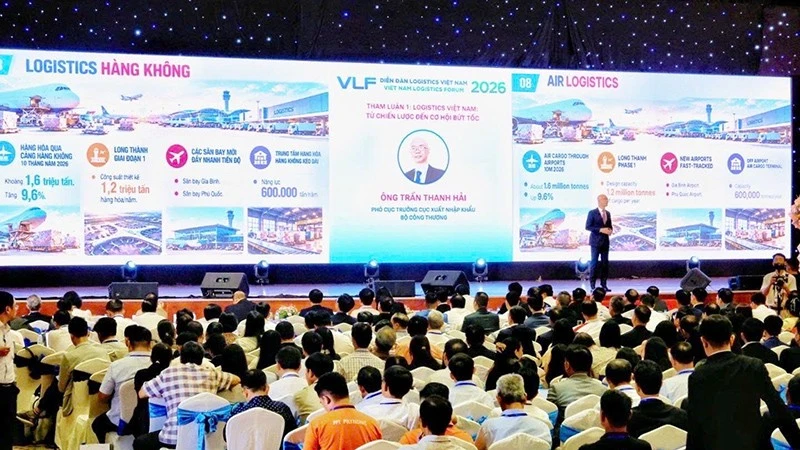
 The scene at the Forum. (Photo: PHUC THANG)
Speaking at the forum, Deputy Prime Minister Pham Gia Tuc affirmed that logistics is an essential service industry, ensuring the flow of goods, strengthening connections between stages in the supply chain, linking production with consumption, and connecting the domestic market with the international market.
Efficient and effective logistics help reduce costs, boost production, expand exports, enhance competitiveness and adaptability, and improve the self-reliance of the economy . Therefore, investing in logistics is investing in the country’s development capacity, bringing tangible benefits to businesses, workers, and the people.
 Permanent Deputy Prime Minister Pham Gia Tuc delivers a directive speech. (Photo: PHUC THANG)
According to the Deputy Prime Minister, Vietnam’s logistics industry has achieved outstanding results. According to published information, the industry is projected to grow by approximately 14-16% per year in 2026, contributing about 4.5-5% to GDP. In the first 10 months of 2026, total import and export turnover will exceed US$1 trillion for the first time, reaching US$1,010.55 billion, with a large trade surplus of US$7.31 billion in October.
Total retail sales of goods and consumer service revenue are estimated to increase by 14.7%; passenger transport and freight transport increased by 16.7% and 15.5% respectively. This scale indicates a growing demand for logistics services.
 Delegates attending the forum. (Photo: PHUC THANG)
Along with the breakthrough development of socio-economic infrastructure, the potential for development of Vietnam’s logistics industry is expanding. In the first 10 months of 2026, an additional 395km of expressways were completed, the entire eastern North-South expressway was put into operation, construction simultaneously commenced on 5 urban railway lines in Hanoi , and many important national projects and key transportation projects were implemented nationwide…
This is not only an opportunity to promote potential and attract investment, but also a crucial chance for the province to better understand its position and role in the national logistics network, seek new linkages, and gradually transform its geographical advantages into genuine competitive advantages.
Comrade Pham Gia Tuc expressed confidence that with the shared determination and concrete actions of all of us, the Vietnamese logistics industry will develop strongly, participate more deeply in the global supply chain, and make a worthy contribution to the double-digit growth target…
However, Comrade Pham Gia Tuc also pointed out that logistics capacity has not yet kept pace with the development requirements of the economy. Specifically, logistics costs in the economy are still high, equivalent to 16-17% of GDP, while the world average is about 10-12%, increasing the cost of goods, reducing the competitiveness of businesses and the economy.
The capacity to organize, connect, and operate supply chains remains limited; the connection between production areas, industrial zones, logistics centers, and ports, railway stations, and border gates is not yet synchronized. International logistics connectivity is limited, and direct access to markets is not high.
 Gia Lai province grants approval for investment to THAGRI Gia Lai Agricultural Company Limited. (Photo: PHUC THANG)
Meanwhile, the Ministry of Industry and Trade also pointed out long-standing problems in the logistics sector, such as the lack of synchronization in some areas between production regions and seaports, border gates, and distribution centers; limited capacity for integrated service provision by domestic enterprises; fragmented data; and sometimes untimely handling of inter-sectoral issues.
In his opening remarks at the forum, Deputy Minister of Industry and Trade Luong Hoang Thai stated that this year’s forum takes place one year after the Prime Minister issued Decision No. 2229/QD-TTg dated October 9, 2025, approving the Strategy for the Development of Vietnam’s Logistics Services for the period 2025-2035, with a vision to 2050.
The national logistics service development strategy has established major directions and tasks; the requirement now is to organize effective implementation and create changes that businesses and people can feel.
The Deputy Minister of Industry and Trade also pointed out long-standing problems in the logistics industry, such as the lack of synchronization in some areas between production regions and seaports, border gates, and distribution centers; limited capacity for integrated service provision by domestic enterprises; fragmented data; and sometimes untimely handling of inter-sectoral issues.
For the Ministry of Industry and Trade, the responsibility is to proactively review and resolve issues within its jurisdiction and to coordinate thoroughly on matters requiring the participation of multiple agencies. Each proposal must be considered based on practical considerations, legal regulations, and its impact on businesses.
The Deputy Minister of Industry and Trade emphasized that the forum’s theme sets a very specific requirement: connecting the highland region’s supply sources with the seaport system, production and distribution centers, and international markets.
In Gia Lai province, the area stretching from the western raw material regions to the Quy Nhon coastal gateway provides favorable conditions for developing a chain of production, processing, preservation, transportation, and export. This opportunity needs to be realized through services tailored to the characteristics of the goods and the needs of buyers.
This is also a common problem for many economic regions across the country. An improved transportation route needs to be accompanied by improved cargo consolidation, service provision, and market connectivity; a logistics center needs to be linked to cargo sources and efficient exploitation plans.
Farmers, cooperatives, and small businesses must have the opportunity to participate in these supply chains. Connections with China, Laos, Cambodia, and other markets need to bring tangible benefits to businesses, be consistent with international commitments, and be feasible to implement.
 Gia Lai Provincial Party Secretary Thai Dai Ngoc delivers a welcoming speech. (Photo: PHUC THANG)
From a local perspective, Central Committee member and Gia Lai Provincial Party Secretary Thai Dai Ngoc affirmed that the forum holds special significance as the province enters a new phase of development after the merger, with a wide-open development space, connecting the highlands with the coast, and linking raw material areas and production centers with seaports, border gates, and international markets.
According to the Secretary of the Gia Lai Provincial Party Committee, the province currently has more than 300 businesses involved in export activities; goods are present in approximately 120 countries and territories, with export turnover exceeding 3.5 billion USD per year.
Along with its strengths in agriculture, forestry, processing industries, and marine economy, Gia Lai has the Le Thanh International Border Gate, two airports (Phu Cat and Pleiku), Quy Nhon Port and the Phu My Port project currently underway, the North-South expressway passing through it, and the Quy Nhon-Pleiku expressway is under construction…
“However, to fully capitalize on these advantages, it is necessary to continue improving infrastructure connectivity, organizing efficient multimodal transport, developing warehousing, storage, and cold chain logistics services, and enhancing the quality of services for exports,” Comrade Thai Dai Ngoc emphasized.