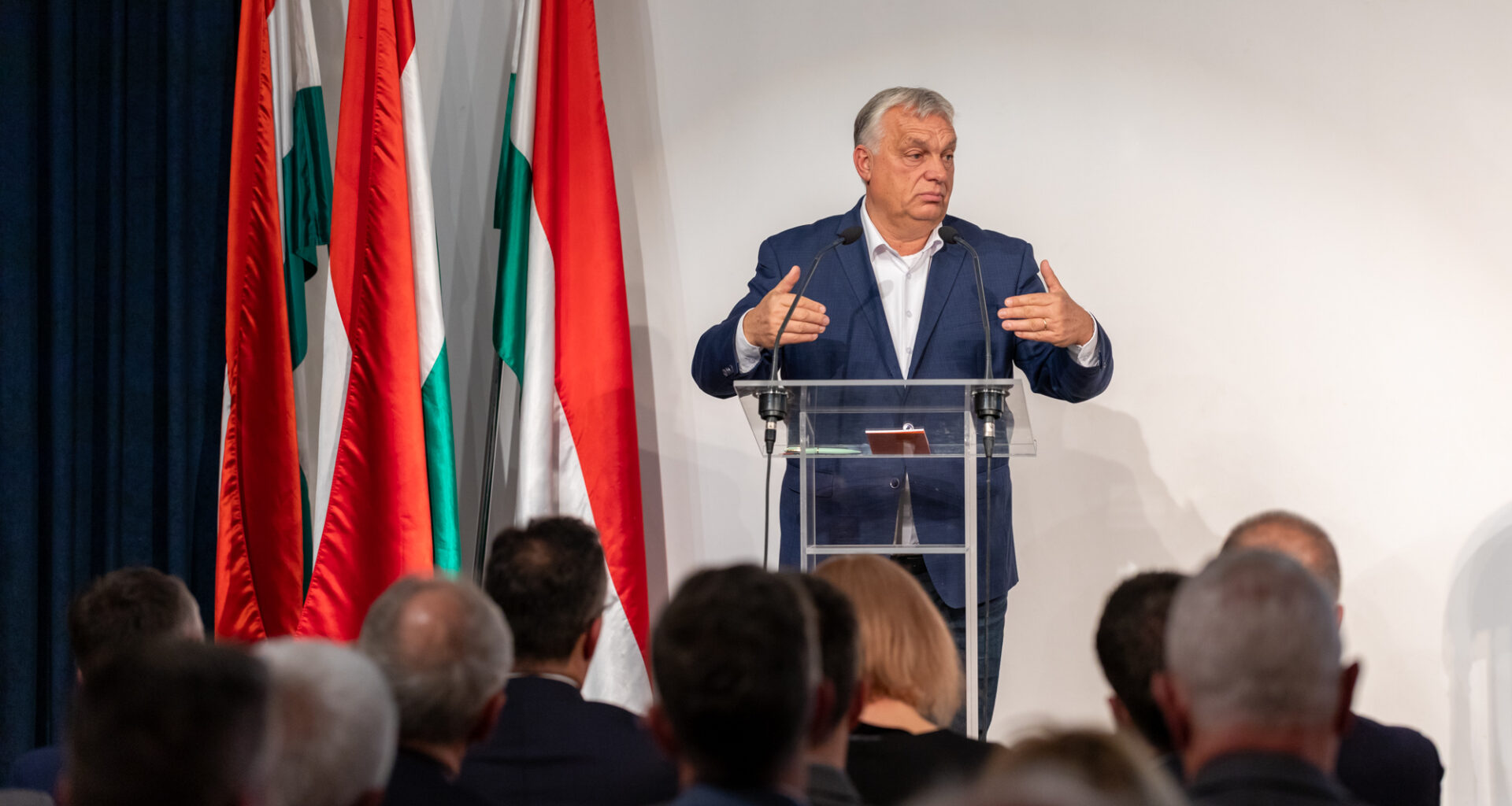
At an event titled Municipal Forum 2026 organized by Tibor Navracsics in Budapest on 6 November, former Hungarian prime minister Viktor Orbán told party loyalists that the new government will collapse by next spring, described the prime minister as a ‘court jester’ focused on spectacle rather than substance, and conceded that Fidesz is ‘not in good shape’ following its election defeat.
Orbán opened by situating Hungary’s troubles within a global pattern. ‘Every European election is being lost by incumbent parties,’ he said, noting that even Donald Trump had lost the midterms despite unprecedented support two years earlier.
 Former Hungarian prime minister Viktor Orbán PHOTO: Tamás Gyurkovits/Hungarian Conservative
‘There is something in Western civilization, a spiritual and psychological phenomenon that is condemning governments to death,’ he said.
The root cause, he argued, is the deterioration of Western competitiveness. ‘It is not the state coffers that lack money, but people’s pockets,’ he said. He cited Germany, where heating a single unit cost 72 cents 18 months to two years ago and now costs two euros.
‘You cannot win elections while the whole world is sliding downward,’ he said.
This framework underpins his reading of Hungary’s own trajectory: deteriorating living standards, public frustration, and voters punishing incumbents at the ballot box.
‘There is something in Western civilization, a spiritual and psychological phenomenon that is condemning governments to death’
Orbán described the new government as beset by overlapping disorders. There is political chaos, he said, because the government has ‘no direction and no goal.’ There is professional chaos, because the administration lacks a knowledge base and is distrustful of outsiders, so ‘they turn to no one’. He cited a principle they fail to grasp: ‘You can never be smart enough alone.’
There is also a power-political chaos: the government ‘does not know who it is or whom it wants to cooperate with’, and an identity chaos affecting both its professional competence and political identity. ‘Everything we see is a consequence of this,’ he said.
He reached for a classical metaphor to describe the government’s approach. The Romans, he noted, understood that politics requires both ‘circus and bread’. Today, he said, ‘there is circus, and we still have bread in the warehouse, but that will run out.’ ‘The political factor ahead of us will be dissatisfaction,’ he predicted.
 PHOTO: Tamás Gyurkovits/Hungarian Conservative
He drew a sharp contrast between his own governing style and that of the current prime minister. A prime minister, he argued, must decide at the outset whether to focus on bread or circus. ‘I put the emphasis on bread,’ he said. ‘The current prime minister put it on circus; we do not have a prime minister, we have a court jester.’ As bread becomes the pressing need, he said, the jester will become ‘increasingly inadequate, because it will not be circus that is required.’
Orbán was equally dismissive of the new government’s economic approach. When Fidesz built the economy, he said, the focus was never on macroeconomic headline numbers, but on operating a developmental state, ’a blueprint for the Hungarian economy’ with 12 to 15 large regional companies at the top, 15 thousand export-capable mid-sized enterprises below them, small businesses below that, and workers at the base.
‘Maybe there is a better blueprint than this,’ he added, ‘but you need a blueprint, and they have no idea.’
Instead, he argued, the new government is thinking in terms of classical socialist left-wing economic policy. The consequence, he predicted, is that multinationals will refrain from investing, and those with assets will move them abroad because they will now be taxed on them.
‘The purifying fire is more like a destructive fire,’ he said.
 Viktor Orbán predicted significant power realignments within a year. PHOTO: Tamás Gyurkovits/Hungarian Conservative
Orbán predicted significant power realignments within a year, saying the current government ‘will be a defeated government by late spring.’ He invoked the atmosphere of the Bajnai era, the sense that a government is already doomed even before an election is held. ‘That mood will arrive sooner than we think,’ he said. He pointed to the budget as evidence of unrealistic expectations, arguing it is not possible for a Hungarian government to set expectations as it has and then write 5.6 per cent wage growth and 3 per cent inflation into the budget.
On accountability, he was unsentimental: ‘Accountability is not revenge; it is a rational political strategy.’
He acknowledged the opposition’s limited leverage. ‘The government does not want to talk to us. We have no chance to stop bad governmental decisions,’ he said. ‘There is only one thing we can do for the country: strengthen ourselves. We do not want to overthrow the government; we want to protect our country from harm.’
The most candid section of the remarks concerned Fidesz’s own condition. ‘As party leader, I can say: we are not in good shape; our people have been forced out or have forced themselves out,’ Orbán said. Those who worked in the campaign ‘cannot step forward now,’ he added.
 ‘We do not want to overthrow the government; we want to protect our country from harm.’ PHOTO: Tamás Gyurkovits/Hungarian Conservative
He assessed the succession landscape, saying that former foreign minister Péter Szijjártó and former cabinet minister János Lázár are ‘further from taking control than they were before the election’, with MEP Bóka possibly emerging as a contender.
He closed with an appeal to party loyalists. ‘Help us pull ourselves together; I will do a year’s work,’ he said. ‘I would rather be with my grandchildren than with you, but I don’t have that luxury. The work must be done now.’
Despite the party’s weakened state, Orbán insisted the fundamentals favour Fidesz. ‘Everything is on our side. We are under very great pressure, and we must endure it, but time is on our side. Experience and local organizations are on our side.’
He contrasted the new government’s ‘mobilized hordes reminiscent of a popular uprising’ with Fidesz’s ‘structure’. 16 years in power is one thing, he conceded, but the party was re-elected every four years, and he insisted the problems that matter are those ‘between 2024 and 2026’.
‘They cannot replicate what we did,’ he said. ‘There are very few things where they will be able to put as much on the table within a foreseeable time as we did.’
Related articles:
At a time when public debate is increasingly polarized and superficial, Hungarian Conservative remains committed to depth, intellectual honesty, and independent conservative thought.
Producing high-quality journalism requires resources. Your contribution helps us expand our coverage, reach new audiences, and keep our content accessible.

Please consider supporting our mission.