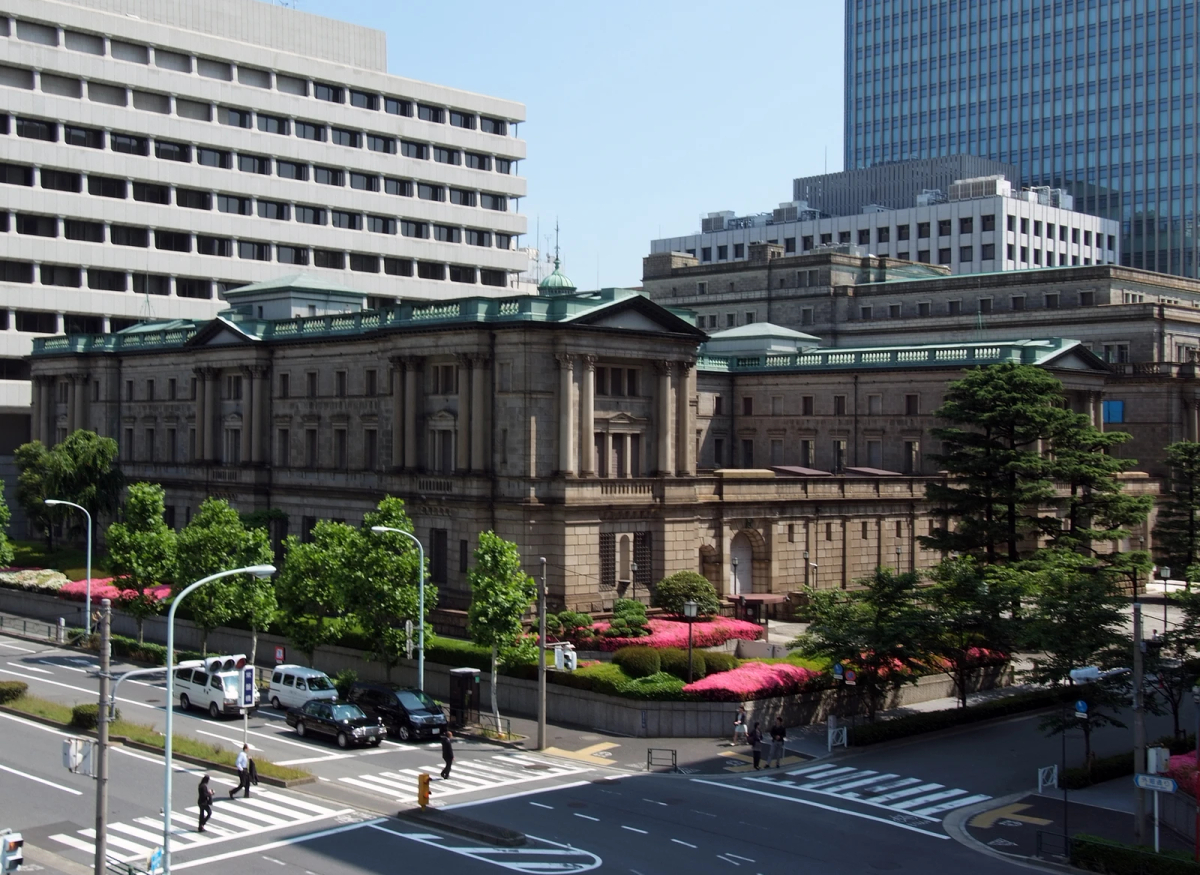
Bank of Japan Governor Kazuo Ueda delivered a lecture on November 6, 2026, at the Michel Camdessus Central Banking Lecture hosted by the International Monetary Fund (IMF), presenting an analysis showing that the structure of Japan’s current account surplus has shifted significantly from being led by trade surpluses to being driven by overseas investment income. He also pointed to signs of change as companies reinvigorate domestic capital investment in response to severe labor shortages, revealing his view that corporate risk-taking is “awakening.”
According to Ueda, Japan’s current account surplus has generally ranged between 2% and 4% of gross domestic product (GDP) over roughly the past 40 years. But its composition has changed dramatically. The trade surplus, which reached more than 4% of GDP in the mid-1980s, subsequently shrank and turned toward deficit. Meanwhile, the primary income surplus, which was near zero at the time, has continued to expand and now exceeds 6% of GDP. Ueda characterized the shift as a move from a structure that earns money by exporting goods to a “mature creditor nation” model in which income from overseas investment—such as profits from foreign subsidiaries and interest and dividends—supports the surplus.
Ueda explained the reasons the surplus has persisted over the long term from the perspective of the savings-investment balance. Standard economic theory predicts that as populations age, households’ net savings decline and the current account surplus shrinks. But in Japan, changes in the behavior of nonfinancial corporations offset that decline. Because asset prices collapsed after the bubble burst while nominal debt remained, companies prioritized debt repayment and balance-sheet repair and sharply curtailed domestic capital investment. In the late 1990s, the corporate sector shifted from being a large net borrower to a large net saver, and even after financial health recovered, cautious investment behavior and excess savings became entrenched.
After balance-sheet adjustment progressed from 2012 onward, high levels of corporate savings were redirected into foreign direct investment. The share of direct investment in the asset side of the financial account (excluding financial derivatives) rose sharply from 21.0% in 1996–2011 to 46.5% in 2012–2025, becoming the main driver of capital outflows, surpassing portfolio investment. Returns on foreign direct investment reportedly remained above 8% in many periods after the adjustment period ended. However, it was also noted that a considerable portion of profits generated by overseas subsidiaries was retained and reinvested locally and recorded statistically in both the primary income balance and foreign direct investment, meaning not all investment returns were repatriated to Japan.
Against the long-term tendency toward restrained investment, there are signs of change in corporate behavior recently. In a Bank of Japan corporate survey conducted in 2024, more than 70% of companies responded that they had made domestic investment more active in 2023–2024 than before. The most frequently cited reason for stepping up investment was responding to domestic labor shortages, with labor-saving and automation investment progressing. Decarbonization, digital transformation (DX), and the return of supply chains to Japan were also cited, mainly by large companies. Domestic capital investment after the pandemic has surpassed the peak of the early 1990s, and the growth rate of bank lending has recently reached 5% or more—the fastest pace in the past 30 years, excluding special factors in 2020.
Ueda said it remains uncertain whether the recovery in domestic investment immediately means the realization of the “domestic-demand-led adjustment” envisioned 40 years ago. Further aging could act to reduce corporate savings surpluses through the drawdown of household savings, while expanded capital investment accompanying improved domestic productivity could also work in that direction. Nevertheless, citing the reality that Japan has accumulated massive net foreign assets and that overseas investment maintains higher returns than domestic investment, he expressed the view that the primary income surplus will “remain a sustained pillar of Japan’s external balance for many years to come.”
Item1996–20112012–2025Share of direct investment in the asset side of the financial account21.0%46.5%
Note: Excludes financial derivatives. Figures presented by Bank of Japan Governor Kazuo Ueda in his IMF lecture.
IndicatorLevelCurrent account surplus (as % of GDP)Roughly 2–4% over the past 40 yearsTrade surplus (mid-1980s)More than 4% of GDPPrimary income surplus (current)More than 6% of GDPShare of companies that made domestic investment more active (2023–24)More than 70%Bank lending growth rate (recent)5% or more
Note: The share of companies is based on the Bank of Japan’s 2024 corporate survey.
What market participants are watching is how the recovery in domestic capital investment will be positioned as a factor in monetary policy decisions. If companies’ investment appetite strengthens, demand that supports a virtuous cycle of wages and prices is more likely to emerge domestically. That said, Ueda himself has hedged on the shift to a domestic-demand-led economy as “uncertain,” suggesting the view that the structure of excess savings and reliance on overseas investment income will continue for the time being. Income returns generated by massive net foreign assets are also susceptible to fluctuations in the yen exchange rate and overseas economic conditions. How to balance the sustainability of domestic investment with the depth of the primary income surplus will be a medium-term focal point for the Japanese economy.