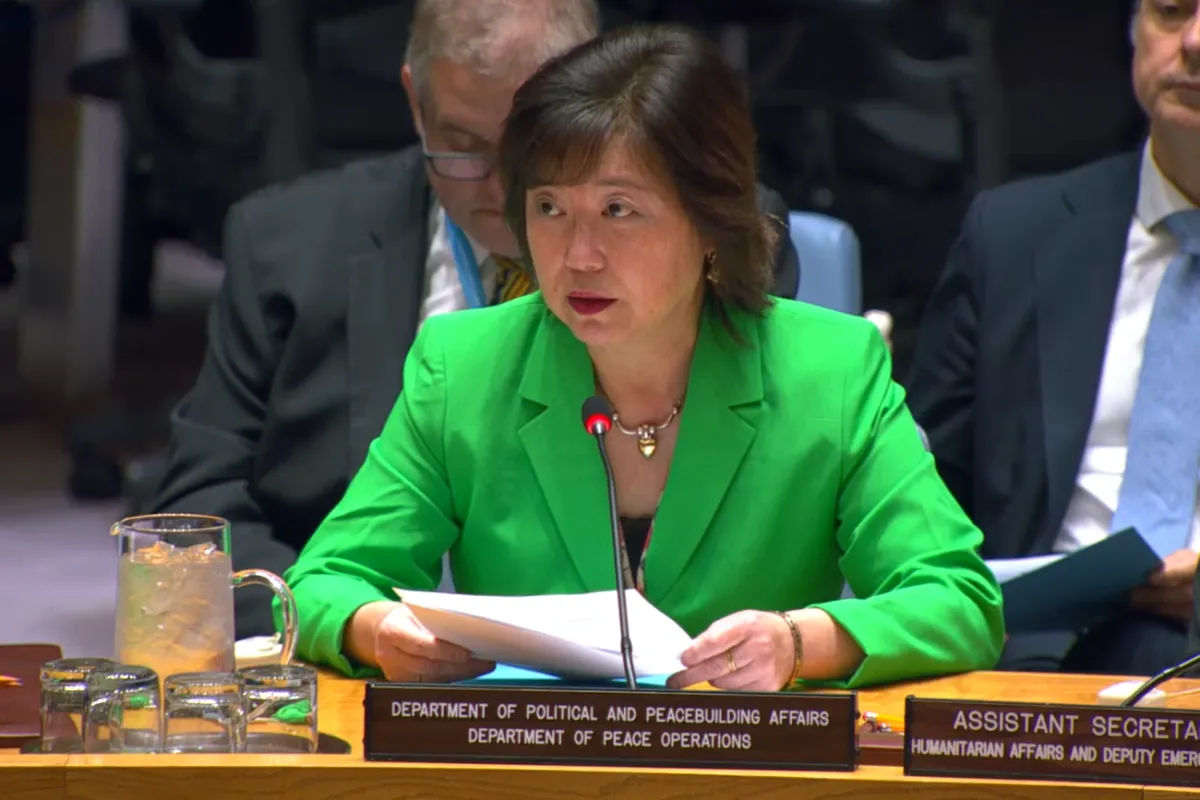
New York, UN
Kayoko Gotoh, Director for Europe and Central Asia Division, Departments of Political and Peacebuilding Affairs and Peace Operations
Madam President,
The situation in Ukraine has become even more dire and dangerous since our briefing one month ago.
Millions of Ukrainian civilians remain under constant fire as the Russian Federation intensifies attacks on population centers and civilian infrastructure across Ukraine.
Just a week ago, on 2 November, at least 55 people were reportedly killed and five injured in a horrific attack on a school building that served as a shelter and as a humanitarian distribution site in Komyshuvakha, Zaporizhzhia region of Ukraine. Forty-five people are still reportedly missing in the rubble.
The following night, on 3 November, in Kharkiv, a Russian airstrike hit a hospital complex, injuring at least 73 people.
That same day, in Dnipro, a Russian missile strike destroyed a hospice, forcing dozens of terminally ill and elderly patients to be evacuated.
On 29 October, the Russian armed forces conducted several deadly attacks across Ukraine hitting civilian locations at busy daytime hours.
In Dnipro, a Russian jet-powered drone struck a busy train platform, reportedly killing 15 civilians and injuring 14 others.
In Chernihiv, two 15-year-old girls were reportedly killed and 37 civilians injured, including five children in a drone attack on a busy downtown street.
Civilian deaths were also reported in Kremenchuk, Poltava region, and in Izium, Kharkiv region, and in Kyiv.
New attacks resulting in civilian casualties were reported overnight and this weekend in the Kyiv, Dnipropetrovsk, Zhytomyr, Poltava and Odesa regions.
I reiterate the Secretary-General’s strong condemnation of these recent, appalling attacks.
As such attacks continue to escalate, civilian casualties in Ukraine are reaching record highs.
This September, at least 328 civilians were killed and 2,105 injured. This figure is 85 per cent higher than in September last year.
Preliminary analysis indicates that the number of civilian casualties in October was just as high as in September.
In total, since the start of the Russian Federation’s full-scale invasion of Ukraine, the Office of the High Commissioner for Human Rights (OHCHR) has verified that at least 17,968 civilians, including 874 children, have been killed in Ukraine. At least 57,713 civilians, including 3,504 children, have been injured.
The actual figures are likely significantly higher.
Madam President,
The Secretary-General has also expressed concern over continuing reports of civilian casualties and damage to civilian infrastructure inside the Russian Federation.
According to Russian authorities, during the month of September, at least 53 people were killed and 462 injured as a result of Ukrainian strikes in various parts of the Russian Federation.
Reports of further civilian casualties are continuing.
One person was reported killed from the overnight Ukrainian drone attack today in the northwestern Leningrad Region.
This followed another reported death of a civilian yesterday as a result of a Ukrainian drone attack in the western Russian region of Kursk.
On 25 October, four people were reportedly killed in drone strikes on the city of Belgorod in western Russia.
Over the last several weeks, Ukrainian attacks on Russian oil and industrial facilities were also reported.
In one of these reported strikes, on 30 October, in the Samara region, industrial sites were hit by Ukrainian drone attacks, where at least two people were reportedly killed as they responded to fires that broke out.
Madam President,
As the Secretary-General repeatedly stressed, all attacks on civilians and civilian infrastructure, wherever they occur, are a violation of international humanitarian law and must cease immediately.
Madam President,
As the winter season rapidly approaches, the Russian Federation’s intensifying attacks on Ukraine’s critical energy facilities are of grave concern. Their cumulative impact on civilian lives is becoming increasingly severe.
Between 30 October and 2 November, damage to multiple critical energy facilities left hundreds of thousands of households across Ukraine without electricity, in some cases for several days, including in Kyiv, Dnipropetrovsk, Zaporizhzhia, and Kharkiv regions. The outages also disrupted water supply and public transport, particularly in Kyiv and Dnipropetrovsk regions.
This destructive pattern continued again this weekend, when another 600,000 people were reportedly left without power as a result of Russian strikes on energy sites in the eastern Dnipropetrovsk region of Ukraine.
We once again reiterate our strong call for an immediate halt to attacks on energy infrastructure, which, if allowed to continue unabated, would bring immense hardship and further displacement to Ukrainian civilians this winter.
Attacks against energy infrastructure also endanger the safe operations of Ukraine’s nuclear sites. In this regard, we are also concerned about the reports of repeated recent Russian attacks hitting substations of several Ukrainian nuclear power plants.
Alarmingly, the International Atomic Energy Agency (IAEA) continues to report military activities near the Zaporizhzhia Nuclear Power Plant, which this weekend, was again left without a stable external power supply.
Madam President,
The regional and global fallout of this war continues to worsen. In the Black Sea, incidents affecting commercial shipping continue to impact global food security.
Over the weekend, the Russian armed forces reported carrying out attacks targeting two container ships in the Ukrainian port of Chornomorsk and the port of Odesa, respectively. A third vessel, dry cargo ship was reportedly hit in the Black Sea, south-west of the Ukrainian port of Odesa.
Such attacks are also spreading well beyond the ports of Ukraine and the Russian Federation.
On 28 October, a Liberian-flagged container ship was struck by drones in Bulgaria’s exclusive economic zone in the Black Sea, and subsequently sank.
This follows similar reported attacks on ships in Romanian territorial waters.
This ongoing trend of attacks continues to undermine maritime safety and put at risk global food security, as alternative routes cannot fully replace the Black Sea’s shipping capacity.
We reiterate our call for the protection of civilian vessels and port infrastructure. We urge the sides to de-escalate and agree on practical arrangements that ensure safe navigation.
Madam President,
After nearly five years of record levels of death, devastation, and civilian suffering, the war in Ukraine is only getting more dangerous and unpredictable.
The unrelenting attacks are not consistent with the ongoing diplomatic efforts.
In the current grim reality, practical steps for immediate de-escalation are urgently and vitally needed, even if limited in scope.
The Secretary-General welcomed the recent six-day local ceasefire in the town of Oleshky, in Ukraine’s Kherson region.
This humanitarian ceasefire – the longest since 2022 and fully implemented by the sides – was an encouraging example of what can be achieved with the necessary political will to save lives and provide humanitarian respite.
We commend the United States First Lady, Pope Leo XIV, the Ombudspersons of Ukraine and the Russian Federation, and all others involved in enabling this arrangement.
It also gave us some hope that it could be replicated in other areas where civilians are suffering, contributing to broader de-escalation.
In this regard, we welcome the United States-led diplomatic efforts, as well as other regional initiatives for dialogue. We urge the sides to seize the opportunity of the planned trilateral talks in Abu Dhabi later this week to make tangible progress.
We hope that such efforts will help prevent further escalation, create conditions for a ceasefire and a peaceful settlement, and contribute to inclusive dialogue on the future of European security.
The United Nations is ready to make its capacities and expertise available in support of such efforts.
Madam President,
In conclusion, I once again reiterate the Secretary-General’s repeated call for an immediate, full and unconditional ceasefire, as an important step towards a just, lasting and comprehensive peace in Ukraine, in line with international law, including the UN Charter and relevant UN resolutions.
To break the current dangerous escalatory cycle, we must redouble diplomatic efforts and see concrete outcomes. The United Nations will continue to fully support all meaningful efforts to this end.
Thank you.