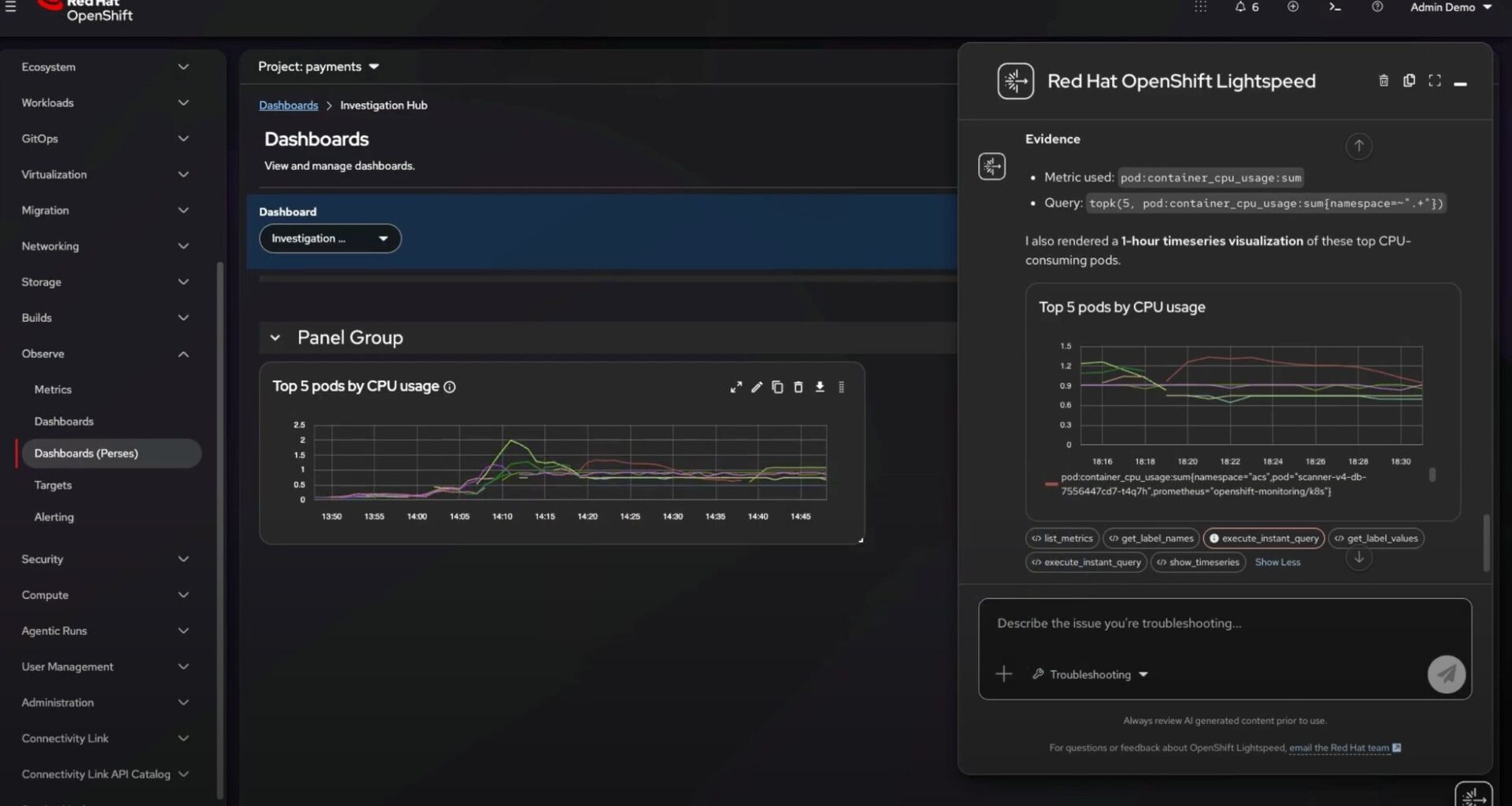
Red Hat announced general availability of OpenShift 5 on November 9, 2026, at KubeCon + CloudNativeCon North America, bringing agentic troubleshooting and a single operating platform for AI workloads, virtual machines and containers. The Kubernetes-based release is available to customers with existing subscriptions through the Red Hat Customer Portal.
Red Hat is pairing the release with an in-place update from OpenShift 4.22 and a longer support model, addressing two operational barriers to adopting a new platform generation. Its technical overview also draws an important distinction: supervised agentic workflows are part of the release, while autonomous troubleshooting and an update agent remain in technology preview.
Agentic Operations With Human Approval
OpenShift Lightspeed moves beyond its previous role as a conversational assistant to investigate alerts and present findings and proposed remediation paths in natural language. In supervised mode, it waits for an administrator’s confirmation before changing the cluster. The autonomous preview can conduct deeper investigations on its own, but it also stops for final human approval before executing changes, so neither mode removes the execution gate.
The same operating model extends to maintenance. Lightspeed-augmented update guidance maps cluster status, potential conflicts and blast radius before a maintenance window, while pre-flight checks assess API compatibility and optional operators. A separate operator planner consolidates lifecycle status, cluster compatibility and available updates. The preview update agent goes further by helping plan and run update paths.
For connections between agents and platform services, the OpenShift Model Context Protocol server and MCP gateway through Red Hat Connectivity Link are generally available. MCP provides a governed channel through which agents can reach platform APIs and services. Administrators can also generate Perses observability dashboards through conversational chat instead of constructing queries manually.
Security for AI and Shared Clusters
OpenShift 5 moves several protections into platform defaults. Post-quantum cryptography covers control-plane communications, with quantum readiness built into platform images and TLS configuration. Centralized, enforced TLS policy applies across core OpenShift and layered products, and tailored network policies restrict traffic into and out of control-plane operand namespaces. Automated certificate lifecycle management and native disconnected-deployment support address air-gapped, edge and regulated environments.
For AI workloads, confidential containers encrypt model weights at rest and in use. The Red Hat build of Agent Sandbox, also a technology preview, uses OpenShift sandboxed containers to place agent workloads inside VMs, creating a boundary intended to keep untrusted or autonomous code from gaining unrestricted access to the wider cluster. That protection addresses the risk created when agents generate and execute code that administrators have not reviewed.
For mixed estates, OpenShift Virtualization 5 uses Lightspeed and MCP integration for natural-language VM provisioning and workflow automation. Storage-agnostic incremental backup uses QEMU Change Block Tracking to copy modified blocks rather than full virtual disk images, while memory-aware load balancing and native swap adjust allocations based on actual consumption. Red Hat also says its automated GPU compute slicing is designed to improve hardware utilization across AI inference and traditional enterprise workloads.
In-Place Updates and Five-Year Support
The update path does not force an immediate operating-system change. Clusters updated from OpenShift 4.22 remain on Red Hat Enterprise Linux CoreOS 9, while newly created OpenShift 5.0 clusters default to CoreOS 10. Red Hat plans to let CoreOS 9 and CoreOS 10 nodes coexist in one cluster in a future release; that is not an OpenShift 5.0 capability.
Red Hat is establishing a three-year major-release cadence, roughly one year after major Red Hat Enterprise Linux releases. Included support lasts 24 months, split into one year of full support and one year of maintenance support.
Red Hat plans one Extended Life Cycle release each year, backed by five full years of enterprise support through a three-year add-on beyond the included periods. The five-year lifecycle also covers optional operators including Red Hat Advanced Cluster Security, OpenShift Service Mesh, OpenShift Pipelines and OpenShift GitOps.
OpenShift 5’s immediate significance is the combination of that update path with tighter operational control: OpenShift 4.22 clusters can move in place, but the platform’s most autonomous functions still require approval and remain previews. The release therefore puts agentic assistance into production cluster management without making autonomous execution the default, while the longer lifecycle gives infrastructure teams more room to coordinate AI, VM and container operations.