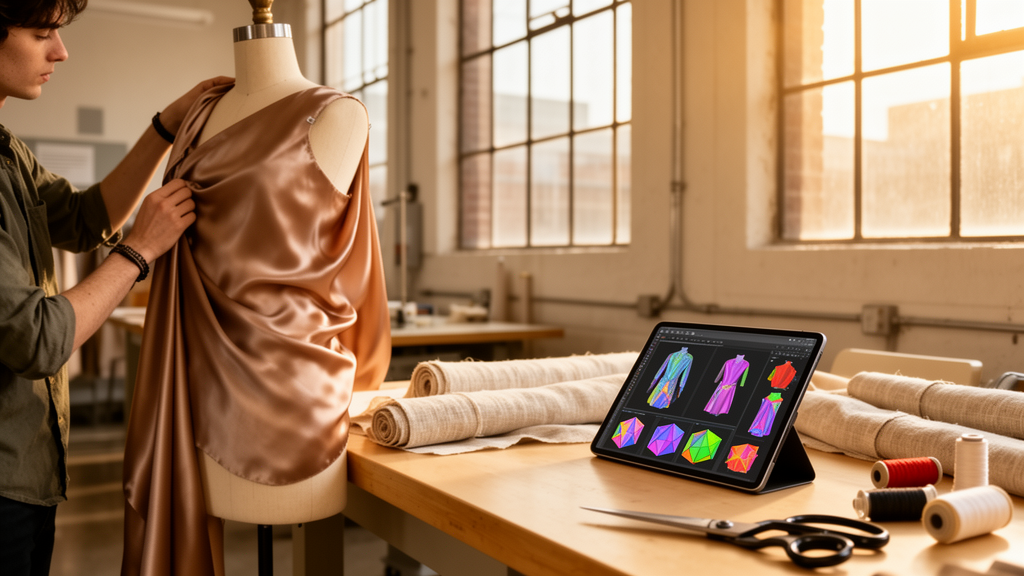
A qualitative investigation into higher education curricula has outlined how artificial intelligence tools can be systematically integrated into fashion design pedagogy to address persistent student learning hurdles. Conducted through semi-structured interviews with ten university-level instructors from South Korea and the United States, the research examines the intersection of student difficulties, technological capabilities, and instructional guidance across the creative cycle. Rather than assessing automated systems solely for their technical processing capacities, the study investigates their functional utility as educational supports across distinct phases of the apparel design process, including initial concept planning, ideation, technical construction, and presentation.
The study was prompted by an observed disparity between the rapid proliferation of generative digital technologies and the limited empirical examination of their instructional applications within creative studio disciplines. While artificial intelligence in education encompasses adaptive learning systems, automated assessment tools, and learner analytics platforms across higher education, adoption rates in creative arts have historically lagged behind engineering and business fields. Previous research in fashion design has largely emphasized the visual outputs of neural networks or isolated computational tools, leaving a pedagogical gap concerning how university faculty structure assignments and guide students through complex design problem-solving using these platforms.
To investigate these dynamics, researchers Hyosun An and Minjung Park structured their inquiry around three core questions examining the primary difficulties encountered by students, the functional ways algorithmic systems can assist problem-solving, and the specific instructional strategies required for effective classroom implementation. The underlying theoretical orientation draws on established fashion design frameworks that divide creative production into sequential yet iterative stages: problem definition, preliminary exploration, refinement, prototype development, evaluation, and implementation. Within this structured context, the investigation sought to evaluate how instructors perceive the educational transition from automated content generation toward collaborative human-machine interactions that preserve student autonomy.
The empirical sample consisted of ten university educators purposefully selected through professional outreach and snowball sampling, balancing experienced faculty members having more than five years of studio teaching with early-career instructors possessing practical expertise in digital tools. The cohort comprised eight instructors teaching in South Korea and two based in the United States, providing comparative perspectives across institutions with differing pedagogical traditions. Online in-depth interviews lasting approximately one hour were conducted between July and October 2024. Participants discussed specific platforms commonly applied in fashion coursework, including Midjourney, DALL-E 2, Deep Dream Generator, Artbreeder, and specialized Creativity Support Tools, with video demonstrations provided for less accessible systems to establish a baseline technical understanding.
Data analysis was conducted using thematic analysis procedures supported by ATLAS.ti software, following six sequential phases from initial transcription through code refinement and category definition. Verbal transcripts processed via ClovaNote speech recognition were verified through member checking with participants. Two researchers independently coded the interview data, establishing a coding frame and resolving interpretative discrepancies through structured discussions to reach an intercoder reliability rate of 96.6 percent. This systematic analysis yielded three overarching thematic domains tracking student challenges in fashion design, competencies supported by automated tools, and essential considerations for integrating technology into academic curricula.
The findings identify four primary phases where fashion students consistently encounter learning obstacles. In initial planning, nine out of ten instructors observed that students struggle to establish distinct project directions and formulate clear concepts, frequently relying on narrow digital repositories such as Pinterest rather than collecting diverse, raw reference materials. During ideation and creative exploration, another nine instructors reported that students face difficulties translating abstract concepts into physical details such as textures and silhouettes. Tight course schedules, rigid tutorials, and fear of academic assessment frequently created psychological pressure, causing students to avoid creative experimentation, prioritize volume over depth, and defer heavily to instructor opinions rather than developing autonomous judgment.
Technical execution emerged as a third critical hurdle, with eight out of ten instructors observing that students encounter substantial setbacks during prototype development due to a limited comprehension of garment anatomy, pattern drafting, and structural construction. Sketching often occurs without planning for necessary closures, seams, or fastener placements, necessitating extensive revisions during physical fabrication and compressing the time remaining for final presentations. In the final stage of communication and critique, instructors noted that students often struggle with persuasive public presentation and frequently misinterpret critical feedback as punitive grading rather than developmental dialogue, a tendency observed among several South Korean instructors where cultural educational norms historically emphasize evaluative correctness.
In evaluating the supportive capabilities of algorithmic software, instructors identified three functional competency domains that correspond to these student difficulties. In design generation and visualization, seven instructors reported that text-to-image prompting assists students lacking confidence in freehand sketching by producing diverse keyword combinations for inspiration. Photorealistic generation allows learners to assess proportions, styling, and fabric drape digitally before production, while virtual simulations provide opportunities for non-destructive visual testing that reduces material waste. In visual refinement, all ten instructors recognized image manipulation and merging tools as valuable for exploring novel stylistic hybrids, adjusting fashion figure poses, and correcting anatomical distortions during illustration.
The third functional competency domain involves design optimization through analytical sorting and data management. Instructors observed that systems utilizing checklist-based inputs, such as Creativity Support Tools, allow students to filter extensive market datasets by item type or color palette to identify commercial precedents that align with their initial concepts. Recommendation algorithms similarly assist students in organizing presentation layouts and portfolios efficiently, enabling data-informed decision-making rather than relying strictly on unexamined intuition. Through these tools, students can systematically test multiple iterations and verify feasibility before committing resources to physical manufacturing.
Despite these technical affordances, the interviewed educators emphasized that meaningful pedagogical integration requires re-evaluating assessment methods and actively managing learning risks. Instructors argued that studio evaluation must shift away from grading the sheer quantity of visual outputs toward assessing the quality of a student’s creative process, prompt formulation, and reflective intervention. Seven out of ten instructors specifically cautioned that uncritical overreliance on automated generation could induce design fixation, degrade manual trial-and-error reasoning, and lead students to bypass foundational research. Technical drawbacks such as usage caps, inconsistent outputs, distorted anatomical rendering, and an absence of usable flat-pattern files like those found in CLO3D further restrict direct translation into physical garments.
To structure these educational relationships, the study articulates a pedagogical framework that connects learner challenges, tool functionalities, and instructional strategies across four curriculum stages: problem definition, ideation, prototype development, and evaluation. At the early stages, large language models and generative visual platforms support market research and brainstorming, provided students receive prior instruction in domain-specific terminology. During prototyping and evaluation, simulation tools facilitate structural analysis and fit testing, while hybrid feedback models combine algorithmic dialogue with personalized faculty critiques to encourage independent reflection. The authors conclude that successful curriculum adoption requires institutional backing, faculty training, and subsidized software access, while emphasizing that the exploratory nature and small sample size of ten instructors warrant broader quantitative validation across diverse cultural institutions.
The broader educational context framing the investigation reflects nationwide policy initiatives and shifting models of technology-enhanced instruction. In their review of educational policy, the authors note that the European Union has promoted artificial intelligence literacy through its Digital Education Action Plan 2021–2027, while the Korean Ministry of Education established its First Comprehensive Plan for Information Education to cultivate convergence competencies. Theoretically, the study situates fashion education within evolving paradigms of artificial intelligence in education, specifically drawing upon distinctions between learning about algorithmic principles and learning with supportive digital systems. Rather than treating learners merely as passive recipients in automated sequences or limiting software to structured collaborator roles, the researchers highlight an empowered model where algorithmic tools serve as cognitive enhancers within a broader educational ecosystem of students, instructors, and course materials. Furthermore, university fashion curricula are structured around national occupational standards, such as those established in South Korea, Canada, Germany, and the United Kingdom, which formalize competencies spanning concept planning, material analysis, garment structure, prototype fabrication, and evaluative documentation.
The findings also shed light on institutional governance and the risks associated with outright administrative prohibitions. The authors caution that implementing blanket bans or restrictive institutional rules can trigger unintended consequences, such as the Streisand effect, which inadvertently magnifies student fascination and reliance on unauthorized software. Consequently, educators advocate establishing nuanced assessment rubrics that balance technological utility against academic integrity, fairness, and student agency. Instructors also noted that integrating automated workflows requires substantial domain knowledge and prompt literacy, leading several participants to suggest that advanced coursework may be better suited for algorithmic experimentation than introductory classes where students have not yet mastered foundational principles. In addressing speaking anxiety and critique during the final evaluation stage, the study suggests that specialized rehearsal systems and script-writing tools can help students prepare for design defenses and cultivate reflective self-assessment practices.
To address potential interpretive bias during data collection, the researchers maintained deliberate methodological reflexivity, actively distancing their own instructional backgrounds when interviewing faculty peers who were familiar with their professional standing. While the qualitative findings provide a structured roadmap for studio curricula, the authors emphasize clear boundaries regarding the generalizability of their results. The study relied on a sample weighted toward South Korea, did not evaluate specific software applications through controlled classroom testing, and derived conclusions solely from faculty observations rather than direct student reporting. Future investigations will need to employ quantitative methods across broader geographical and institutional settings, measure how students directly experience algorithmic tools in design studios, and empirically evaluate specialized fashion platforms to establish evidence-based curricular benchmarks.
Subject of Research: Pedagogical integration of artificial intelligence tools in university fashion design curricula
Article Title: AI tools and fashion design education: instructor perspectives on student challenges and design process tool support
Article References: An, H., & Park, M. (2026). AI tools and fashion design education: instructor perspectives on student challenges and design process tool support. Fashion and Textiles, 13(1), Article 3. https://doi.org/10.1186/s40691-025-00452-9
Image Credits: AI Generated
DOI: 10.1186/s40691-025-00452-9
Keywords: artificial intelligence, fashion design, design education, higher education, pedagogical frameworks, creative technologies, qualitative research, instructional design, tools, fashion, design, education