
Republicans have chosen a counterintuitive remedy for voters’ stunning midterm election rebuke of President Donald Trump: more Trumpism.
The House GOP conference on Tuesday picked combative Ohio Rep. Jim Jordan to lead its minority next year, days after the president promoted Stephen Miller, the “America first” agitator, to serve as White House chief of staff.
And the soon-to-be extinct Republican House majority emerged from mourning the election debacle to save Defense Secretary Pete Hegseth — the Trumpiest member of the president’s Cabinet — from impeachment.
These are hardly the actions of a party seeking to atone for sweeping national losses, including in deep-red territory. Rather the GOP’s defiance seems to animate the verdict of outgoing House Speaker Mike Johnson on Monday: “The voters made the wrong choice.”
Aside from Trump, there’s no more pugilistic pair in MAGA politics than Jordan and Miller.
Jordan is a sharp-elbowed master of disruption who may be even more effective in opposition than in government, and who has sparked uproar in many a congressional hearing with his staccato defenestration of witnesses. He’ll be Trump’s first line of defense when the Democratic investigative blitz fires up next year.
Miller is the avatar of unfiltered nationalism in Trump’s base and will wring every second from his boss’s remaining two-year lease on power.

Their elevation sends a strong signal that there will be no contrition and no retreats in the Trump GOP just because voters rejected multiple aspects of Trump’s policies, performance and personality last week.
This is not a party looking for reinvention. It wants a fight.
An outsider might have expected more reflection from Trump and his team after his red wall crumbled and they lost the House and the Senate to Democrats. Surely, the party needs to appeal to a wider audience if it is to reverse its losses and have a chance of winning back Congress and retaining the White House in 2028?
But revolutions rarely get more moderate. And having lost the political middle, Trump may now be down to his truest believers.
His still-strong hold in his party was revealed on Tuesday when the House GOP surprisingly united to stave off dissident GOP Rep. Thomas Massie’s attempt to impeach Hegseth.
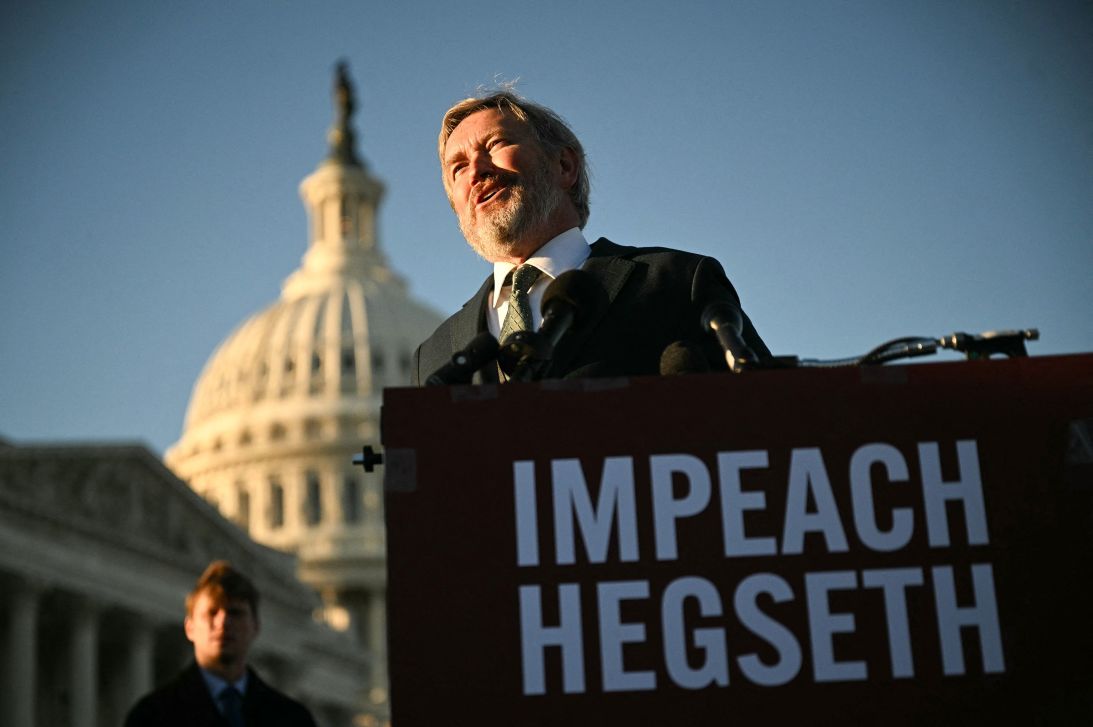
Saving Hegseth’s job may seem like an insult to voters: He is the primary planner of and cheerleader for the Iran war, which even many GOP voters hate.
But the vote was a morale boost for House Republicans a week after a devastating election night and was exuberantly celebrated by Trump on social media.
Still, massive incoming Democratic majorities mean this was likely a rearguard win by an already-defeated army. “This is not the end of it; it’s just the beginning,” said Democratic House Minority Leader Hakeem Jeffries, who is poised to become speaker in the new year.
The size of the Democrats’ midterm victory — they are up to 54 seats in the Senate with two undeclared, and 256 seats so far in the House — means Republicans have a massive task to win back power in 2028.
So two years of Trump doubling down on an approach that voters already hate seems like poor strategy.
But the new Republican Party reflects the DNA of a president who has spent a lifetime responding to every defeat by intensifying the fight, often on more extreme terms.
And the Trump GOP long ago stopped listening to pundits, moderates and establishment leaders regarding its smartest next steps. After the 2012 election, the party commissioned an autopsy on why its nominee, Mitt Romney, failed to thwart President Barack Obama’s reelection bid. The study found that the GOP needed to broaden its base to appeal to a more diverse base of nonwhite, young and female voters to win back the White House. But the opposite happened: Trump arrived, with his populist, nationalist, anti-immigration juggernaut and swept to power in a race that transformed the starchy old GOP in his image.
The rise of Jordan and Miller from the wreckage of the 2026 electoral catastrophe represents an updated version of this pivot, to Trump’s base.

Jordan’s victory also reflects political physics. The Democratic rout last week wiped out the most moderate Republicans in swing seats. Survivors are from the deepest-red districts and are therefore more conservative and more pro-Trump. The president might have an even tighter grip on a smaller GOP.
Democrats will face an opposite scenario in the new Congress after winning in areas long thought out of reach for their party. Their ideological span is now far wider — senators from red states like Texas, Kansas and South Carolina will highlight internal divides between centrist Democrats and progressives from liberal bastions.
The GOP base’s refusal to moderate despite a heavy midterms defeat is best illustrated by an intense controversy over immigration, after Trump seemed to hint in a “60 Minutes” interview at a potential deal on immigration reform with the new Democratic Congress. Homeland Security Secretary Markwayne Mullin then suggested such an agreement could involve permanent legal status for undocumented migrants brought to the US as children — so-called Dreamers.

An explosion on MAGA social media raised the prospect that Trump was betraying his most loyal supporters. A majority of Americans might have rebelled against draconian immigration crackdowns that he told CBS may have gone too far. But the base wants no retreat.
Fox News star Laura Ingraham warned on her show Monday against “amnesty” in a segment entitled “Wrong Lessons.” By Tuesday evening, Mullin was on her program to insist nothing had changed in immigration and deportation policy.
In truth, it was always unrealistic for a party still controlled by Trump to course-correct after the election. A debate over the potential repositioning of the GOP in the post-Trump era is best left to those who might lead it. First hints of that process could be seen last week in reactions to the GOP wipeout by Vice President JD Vance, who repudiated the war, and Florida Gov. Ron DeSantis, who warned of a possible decade of political damage.
But for now, the Trump, Miller, Jordan and Hegseth show is gearing up for a final season. That means 2027 will be a tempestuous year in Washington.