
Thank you for reading! Letters from Leo is a reader-supported publication and the fastest-growing Catholic community in the country. To receive new posts and support this movement, consider becoming a free or paid subscriber.
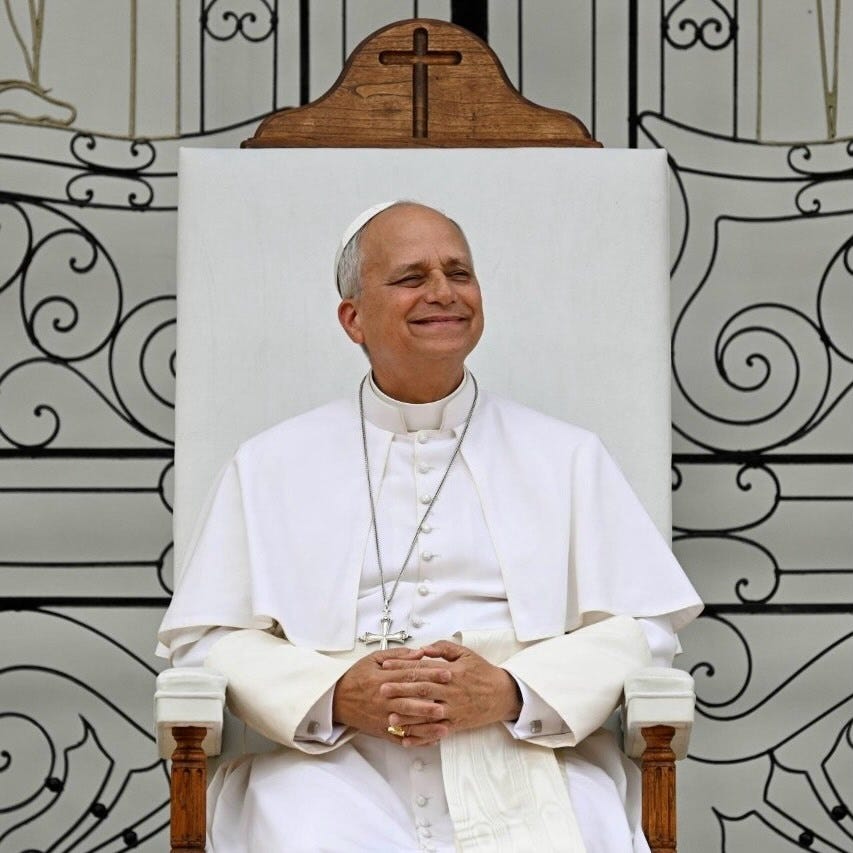
Pope Leo XIV stood outside the cathedral of Córdoba on Tuesday afternoon and handed Argentina’s clergy a phrase that belongs to his beloved predecessor Pope Francis. “Dream of a Church that keeps making a mess,” he told them, “as your countryman Francis asked of you.”
In Spanish, the words were hagan lío. Francis first used them on young Argentines in Rio de Janeiro in 2013, four months into his pontificate, and they stuck to him for the next twelve years.
A few hours later, Leo flew back to Buenos Aires, where roughly a million young people were waiting for him in the dark along Avenida del Libertador.
Tuesday was the fifth day of Leo’s twelve-day journey through South America and his third in Argentina, the country Francis never visited as pope. On Monday he drew 2.5 million people to Mass in Buenos Aires, and he told Argentina’s bishops, gathered in Francis’s old cathedral, to start with the jobless and the poor.
His day began with a one-hour flight to Córdoba, Argentina’s second-largest city, and a drive out to the grounds of the Argentine Aircraft Factory, where about 650,000 people had gathered for Mass. The ground carries a hard memory.
As the Associated Press noted, the air force plant built the attack planes Argentina’s military first used in late 1975 against leftist guerrillas, months before the coup that opened the 1976–1983 dictatorship.
Leo built his homily around the Spiritual Exercises of St. Ignatius of Loyola, the Jesuit founder whose spirituality formed Francis. Then he read out a roll of Argentina’s saints and blesseds.
Mama Antula and the Cura Brochero were on it (both were canonized by Francis), and so was Cardinal Eduardo Pironio, the Argentine beatified in 2023 who helped build the World Youth Days.
“We are all called to holiness,” Leo said. “This is our task here on earth: to attain perfect union with God.”
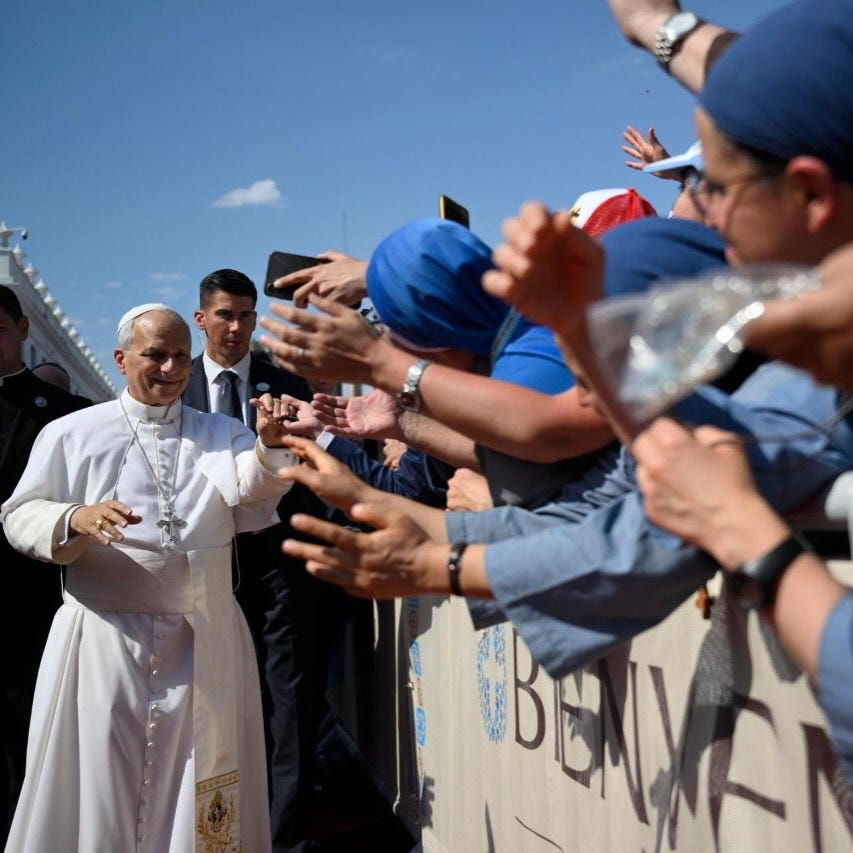
In the afternoon, the popemobile carried him from the archbishop’s residence to the cathedral plaza, where bishops, priests, religious sisters, seminarians and pastoral workers from across the country waited with Cardinal Ángel Rossi, the Jesuit archbishop whom Francis made a cardinal in 2023.
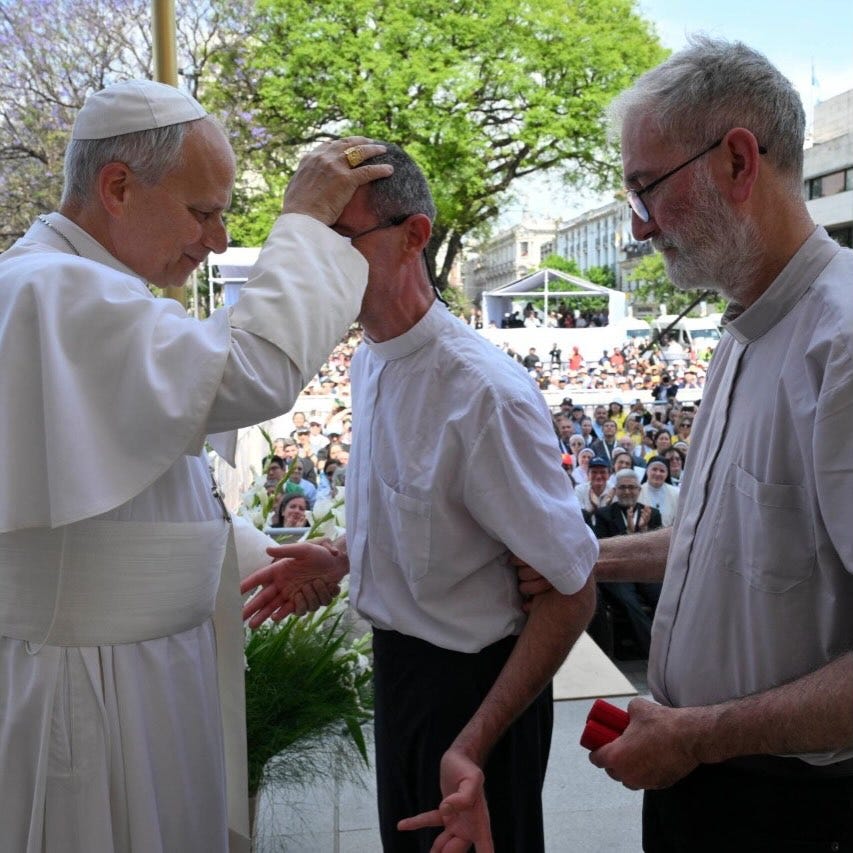
A priest of the archdiocese spoke about his own body.
For years he had trained seminarians at Córdoba’s major seminary, and then, eleven years ago, his brain was starved of oxygen during what should have been a simple surgery. Walking and speaking are now a struggle for him, his hands no longer move easily, and he has lost some of his sight.
He told the pope that bitterness and resentment had been open to him. He chose “to open myself up rather than withdraw.” Once a month he presides at Mass in the seminary while a brother priest reads the homily he wrote.
His parish priest, his friends, and Radio María recovered recordings of the voice he had before the operation, and an artificial intelligence app now reads his reflections aloud in it.
Leo listened with tears in his eyes. When the priest finished, the pope walked over and held him.
Leo is recovering from an operation of his own. Surgeons removed part of his right lung in mid-October, and on Tuesday he recalled his own hospitalization as he spoke to the clergy. “Neither age nor physical limitations can extinguish our zeal,” he said. “Our strength may run out, but God’s power never will!”
“Over the years, something paradoxical can happen,” he said. “We work hard for God yet spend less and less time with him.”
He leaned on Francis again and again, once to insist that the Church “is not a business” or “an NGO,” and later to remind them that, in Francis’s words, the worst discrimination the poor suffer is the lack of spiritual care.
God wants to count on them, he said, to carry his grace “from La Quiaca to Ushuaia,” the northern and southern ends of the country. Then came his charge:
“Dare to look at Argentina through God’s eyes. Dream of young people asking whether Christ is calling them, of parishes that are living communities of faith, of religious families with the daring of their founders, of seminaries and novitiates where saints are formed. Dream of a Church that keeps making a mess, as your countryman Francis asked of you! A mess that carries her into every corner and makes the Gospel of Jesus Christ ring out everywhere.”
Francis coined the line on July 25, 2013, during World Youth Day, in a packed cathedral in Rio full of pilgrims from home. “I want a mess in the dioceses,” he told them, according to the Vatican’s transcript, and he said he wanted the Church out in the streets. Two years later in Paraguay he added a grinning caveat, telling young people to make their mess and then help organize it.
Leo is an Augustinian canon lawyer from Chicago, and by temperament he is the calmest man in most rooms. MAGA Catholics spent last Christmas calling him “more dangerous than Francis.”
On Tuesday, in Francis’s own country, he picked up the most unruly sentence Francis ever spoke and asked Argentina to keep living it.
By a little after 6 p.m., Leo was back on the ground in Buenos Aires. Priests were hearing confessions on the sidewalks of Palermo, and the young people who had been arriving since the night before packed the avenue around the Monumento de los Españoles for a vigil titled “Take courage, arise!”
As the popemobile passed, they chanted, “This is the pope’s youth!”
The AP put the crowd at about a million, and the Buenos Aires Times reported 1.3 million. Organizers handed out tens of thousands of candles and switched off the big screens. The night recalled the World Youth Day that John Paul II brought to the same city in 1987, the last time a pope set foot in Argentina.
Two young Argentines spoke before Leo did. Agustín Schinca, 25, described the bullying that isolated him as a boy, the cocaine he first tried at 15 and the years it cost him, and the recovery he found through a Hogar de Cristo community, part of the network of drug-recovery homes built by the slum priests Francis championed as archbishop. “Today I am standing,” he said. A 31-year-old postulant told the crowd that she had resisted her vocation until a spiritual director asked her, “Who told you it was too late?”
Leo took Agustín’s sentence and set it beside the Book of Daniel, where three young men refuse to kneel before King Nebuchadnezzar’s golden statue and are thrown into the furnace.
“Today idols arise and demand our worship: success at any cost, money, an obsession with appearance, popularity, or the unrestrained pursuit of pleasure,” the pope said. “Sometimes, in order to win the approval of others, we may go so far as to lie, betray, or humiliate someone on social media. Do not bow down before anything that cannot give you life. And if you have ever fallen, get back up.”
He named pornography and drugs among the pleasures that enslave, and he told anyone who felt they had wandered off that the Church had room for them.
“To each of you I would like to say that there is a place for you in the church, with your questions, your wounds and your story,” he said, according to America. He built the whole address on Francis’s “Everyone, everyone, everyone!” from World Youth Day in Lisbon, recasting it as “everyone toward Christ, everyone with Christ, everyone like Christ.”
Before he blessed a cross that will now travel from parish to parish across Argentina, Leo gave the young people the second half of his trip’s motto. “Go and proclaim!” he said, and then he told them why: “May those who feel far from God discover through you that Christ is seeking them.”
His final words went to Argentina’s patroness. “May Our Lady of Luján accompany you and guide you always on this path,” he said, “everyone toward Christ, everyone with Christ, everyone like Christ!” Fireworks broke over Palermo while the crowd sang “Alma Misionera.”
Humor me for a minute and look at who carried Tuesday programming.
A priest who cannot easily speak preached through a voice his friends rebuilt for him; a young man who started on cocaine at 15 stood up in front of a million people and said he was standing. The man who answered them is 71 and still healing from lung surgery.
In a country where roughly one in three people now lives in poverty, Leo told all of them to get up anyway.
That is the mess Francis meant. It is a Church that leaves the sanctuary and goes looking for people, the way Leo says Christ goes looking for them. On Wednesday, his last day in Argentina, he begins at 8 a.m. inside the Buenos Aires Federal Prison Complex.
At Letters from Leo, we stand with Pope Leo XIV, with the disabled priest of Córdoba who chose to keep loving, and with the million young Argentines who stood in the dark tonight with candles in their hands. We believe the Gospel still sends the Church out of its buildings and into the streets, toward the addicted, the sick, the poor and everyone who has been told it is too late.
Our own country is crowded with the idols Leo named in Buenos Aires, from success at any price to the small cruelties we commit on social media to win a little approval. People of every faith are hungry for a community that refuses to bow to them, and for the joy those three young men in Babylon carried out of the furnace.
That hunger is why this has become the fastest-growing Catholic community in the country. Every day, we report on a pope who keeps telling the world that every human life carries a dignity no market and no government can grant or revoke, and we try to live that teaching together.
If you believe this movement matters — Catholics and people of goodwill standing for human dignity against the idols of our age — I am asking you to join us.
If you’d like to invest in our mission, here are three ways you can help:
Subscribe as a paid member to receive exclusive posts about the life and formation of Pope Leo and help sustain this newsletter.
Donate with a one-time gift to fuel this project’s mission.
Share this post (and Letters from Leo) with a friend who might enjoy it.
Paid subscribers receive our full series on Pope Leo’s life and formation, from his boyhood in Dolton to his years as a missionary in Peru, where he travels next, along with our Sunday Scripture Reflection Series and our exclusive investigations.
Whether you give $0, $5, $50, $500, $1,000, or more, your presence here matters — no matter your faith or your politics.
Thank you for reading. I’ll see you on the road.
