Another dismal gun massacre swung the bright but brief searchlights of news towards Poland a week ago. I could write a whole separate article on these rather frequent murders and the foolish attempts to claim they are political when they usually aren’t. But my point is different.
Much more important things are happening in Poland and nobody in Britain pays much attention. The country is locked in a dispute between parties and ideologies which lays bare a new (or more accurately restored) political dynamic of historic significance.
This conflict led Poland’s president recently to abort a foreign trip mid-flight, in order to return home and storm through police lines into a courthouse to protest at what the government of his own country was up to. If Emmanuel Macron had ordered his presidential Dassault to turn back in the middle of a foreign visit to do hand-to-hand battle with domestic opponents, we’d pay attention. But when the same thing happens in a country at least as important to our continent’s security, we ignore it. This is worse than insularity – it is self-harming ignorance.
Perhaps a significant number of Poles do not want to be governed by the flashy secularists who sit in Brussels
The political struggle going on in Poland is not easy to understand. But that is because we have forgotten our history and, in our amnesia, lost the ability to see that there are much deeper divisions in politics than economic ones. They can move men in a way that quarrels over interest rates or taxes never can.
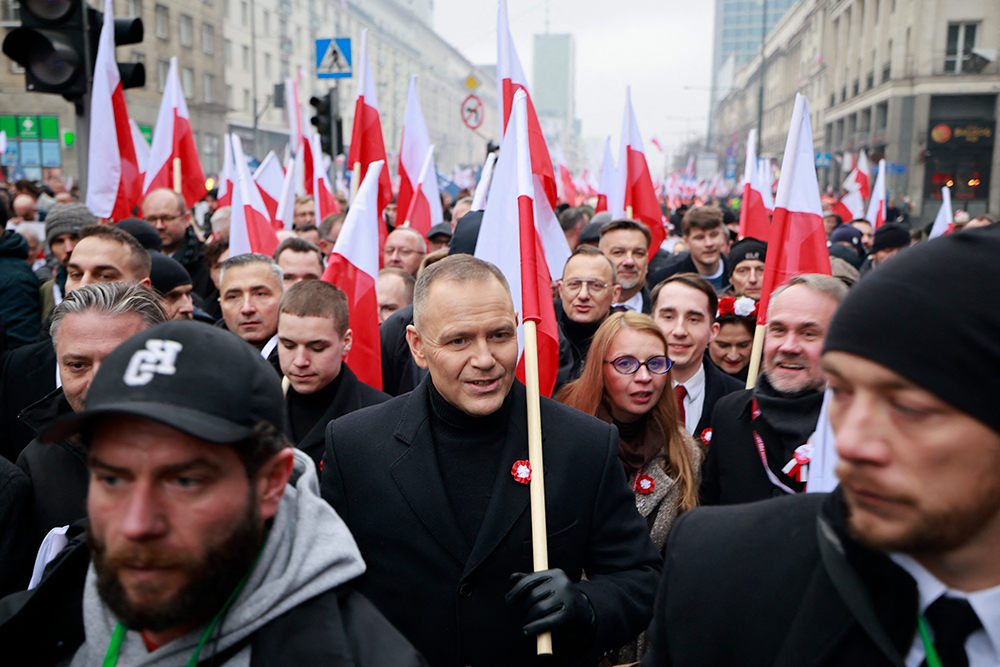
Poland does not really have a right or a left, as we understand those terms in the modern West. Instead, it has a struggle between two different branches of Polish nationalism. President Karol Nawrocki is a standard-bearer for the socially conservative nationalists, clustered around the Law and Justice Party, the PiS. Despite the shrivelling of religion in Poland, there is still a powerful culturally nationalist constituency. Its enemy is the government led by the Christian Democrat Premier, the Eurocrat Donald Tusk. He is (comparatively) socially liberal and beloved in Brussels.
The zone of combat between the cultural conservatives and the Europhiles is the country’s Constitutional Court, which both sides have tried to rig in recent years.
The quarrel can at times seem like four-dimensional chess, played by people with six-syllable names. There may also seem to be something more than a little self-consciously melodramatic about a president battling riot police to uphold a court’s independence from interference.
But there is also a real dispute. It concerns two different ways in which Poland might pursue its independence, recovered in 1989 after humiliations, mass deportations and partitions which would have destroyed most nations. The easy route is the EU route. Take this, and the subsidies will flow smoothly and respectability in Brussels beckons. The awkward route is the old path of Polish independence, recognising that sovereignty is worth more than respectability.
For anyone who has ever felt the pull of patriotism on his own soil, the hard path is rather appealing. And few peoples have been as brave in recognising how much freedom as a nation matters as the Poles.
I will never forget my first brush with Polish courage, an interview in a glum Gdansk hotel on a freezing day in November 1980, with the defiantly Christian, defiantly Polish strike leader Lech Walesa.
Everything he did and said was free. His conscience was free and his speech was free and he was free. It should have been impossible in a communist country, where defiance could get you killed. Yet he did it anyway. Nearly ten years later he would achieve total victory, an outcome I am sure he never doubted. It was like witnessing a true miracle, a mediaeval event bursting into lavish colour on those bald, blank, brownish concrete streets with their communist red banners. I’ve never got over it.
So I like to keep a sympathetic eye on Poland, a country whose spirit is too strong to fit in anybody’s empire, and whose national fire could not even be extinguished when Stalin and Hitler got together to snuff it out. They thought they could dance on its grave, and their armies held a revolting, smarmy joint victory parade in Brest-Litovsk in September 1939. Pictures exist of this event and are not forgotten in Warsaw, though Brest-Litovsk itself is now in Belarus. This, like several such anomalies, is thanks to the bodily shifting of Poland 150 miles to the west, which Stalin achieved in 1945.
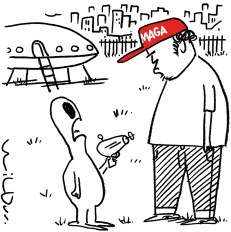
‘Take me to your lame duck.’
So what is the problem? Surely the second world war was the end of empires in this part of the world, and Poland is free? Or is it that a ghostly new empire, modern in appearance but ancient in shape, is slowly solidifying on the Continent? Why should Poland’s leaders be brawling in public about its European future? Is it possible that Poland is more sensitive to such forces than anyone else? Perhaps a significant number of Poles, mainly the old Roman Catholic nation called back into being by Pope John Paul II, do not want to be governed by the flashy secularists who sit in the hideous Berlaymont building in Belgium. Nor do they really see why Poland should be subject to the rulings of EU courts when it has perfectly good courts of its own.
There is another linked problem, the EU’s uncritical relations with Ukraine. Poland would fight to the death rather than let a single Russian soldier cross its frontier ever again. But the old-fashioned nationalists of Warsaw have, even so, fallen out of love with Volodymyr Zelensky. President Nawrocki recently stripped Zelensky of Poland’s highest honour, the Order of the White Eagle. This smack in the face followed Ukraine’s decision to name a modern military unit after the UPA, a nationalist militia (let us try to be dispassionate here) which massacred 60,000 Poles in the Volhynia region in 1943.
Many Polish patriots will not accept the idea that Poland’s freedom can only be secured if it goes along with Brussels, especially in foreign policy and the courts. They value highly what they once lost, precisely because they lost it. If we truly treasure our own national freedom, we should pay more attention to theirs.