 Image credits: Wiki Commons.
Ancient Egyptians revered cats, seeing them as animals associated with powerful deities, especially Bastet, the feline-headed goddess of protection. But life wasn’t exactly peachy for cats in Egypt.
One ancient Egyptian cat survived a blow to the head that left a deep scar in its skull. Another had puncture wounds that appeared to match the teeth of a much larger feline. Others suffered broken bones, infections, and missing teeth.
And these weren’t simply beloved pets. Their remains came from a cemetery of animals mummified as sacred offerings to the gods.
Now, a new study published in the Journal of Archaeological Science suggests that some of ancient Egypt’s revered cats may have lived remarkably difficult lives. Far from being pampered, they may have endured cramped conditions, fights with other cats, disease, and sometimes deliberate violence at human hands.
In fact, Egypt’s worship of cats may have prompted a dark cat-farming industry, with some fairly grim practices.
Ancient cats, classic problems
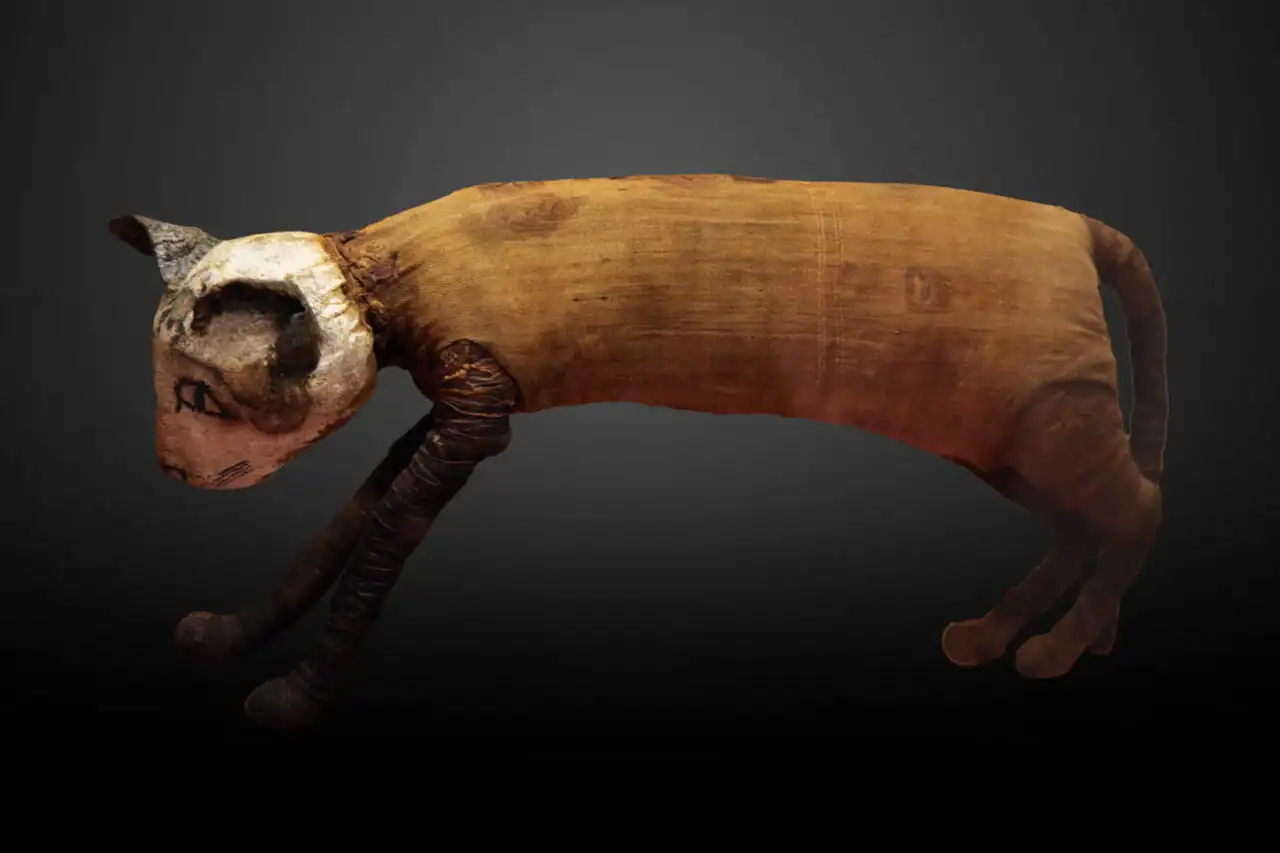
Egyptian attitudes toward cats were complex. Ancient Egypt is practically synonymous with cat worship. Cats appear in paintings, sculptures, and elaborate burial arrangements. But while some cats were beloved household companions, others were ignored, or even worse: raised or collected specifically to be mummified as religious offerings. Worshippers could acquire these mummies and dedicate them to a deity, much as someone today might light a candle at a shrine.
The demand was staggering.
At Beni Hassan, an ancient religious burial site in central Egypt, archaeologists uncovered enormous deposits of mummified cats. Early accounts described pits filled with densely packed layers of animals, sometimes stacked 10 to 20 deep.
Early archaeologists claimed there were millions of such cat mummies. In 1890s alone approximately 180,000 mummified cats were shipped to Liverpool, where they were sold at auction for agricultural fertiliser.
Fortunately, not all of the remains met this fate.
 Image credits: Michael Reeve.
At the Natural History Museum in Vienna, Austria, researchers recently examined a largely overlooked collection of 131 well-preserved cat skulls originating from Beni Hassan. The skulls had been removed from ancient mummies during the nineteenth century and retained for research.
The team, led by zooarchaeologist Wim Van Neer of the Royal Belgian Institute of Natural Sciences, investigated the animals’ ages, species, injuries, and diseases. They also used radiocarbon dating and chemical analyses of bone to learn more about when and how the cats had lived.
The picture was troubling.
Evidence of gruesome violence
Of the 131 skulls, 81 (nearly 62%) exhibited at least one pathological alteration.
Twenty-six cats showed evidence of periodontitis, an inflammatory disease affecting the tissues supporting their teeth. Twenty-four had missing teeth, although some were probably missing from birth rather than lost to disease or injury.
Other skulls bore unusual changes to the bone itself. Thirty-five showed pitting on the skull surface, while 19 had small perforations in the bony floors of their eye sockets. Some of these are consistent with infections or metabolic disorders, potentially including nutritional stress. But because only the skulls survived, the researchers couldn’t confidently diagnose every condition. There were very likely other pathological signs on the rest of the bodies, which the researchers just didn’t have available.
But the even more disturbing evidence came from the injuries.
Several skulls told grim stories
Fourteen of the 131 skulls showed traumatic lesions, including fractures and puncture wounds.
Some of these injuries had healed. Others hadn’t.
This is a telling clue because bone can repair itself after an injury, leaving traces of healing that remain visible long after death. An unhealed injury, meanwhile, may have occurred shortly before death, caused death itself, or happened after the animal died.
Some of the punctures appeared to be bite wounds from other cats.
In one particularly revealing case, the researchers compared healed puncture marks on a smaller cat’s skull with the canine teeth of a jungle cat (Felis chaus), a wild feline larger than a typical house cat.
Other injuries pointed toward humans.
One skull displayed parallel marks consistent with blows from a sharp metal implement. Other skulls had fractures and depressions that the researchers linked to blunt-force trauma, potentially from something like a heavy wooden stick.
Why were these cats beaten?
Why would people inflict such injuries on animals they considered sacred?
Some cats were deliberately killed in preparation for mummification. Previous investigations have found evidence of cats being killed through blows to the head or neck-breaking. Death was, after all, part of the process that transformed these animals into religious offerings.
But the healed injuries tell a different, perhaps more troubling story. These cats survived their wounds, sometimes long enough for broken bones to mend. The researchers suggest that some may have been struck as punishment or during attempts to break up fights between animals.
Still, the combination of bite wounds, human-inflicted injuries, and evidence of disease points toward an environment where life could be dangerous.
We cannot know for certain. The skulls reveal what happened to these cats, but not always why.
Still, the combination of bite wounds, human-inflicted injuries, and signs of disease paints a picture of lives that could be harsh and dangerous. The researchers suspect that crowded captive conditions contributed to the violence and may have allowed infections to spread, although the exact circumstances remain uncertain.
All this points to a bitter irony.
Ancient Egyptians preserved these animals because they were sacred, giving them a kind of immortality. More than two thousand years later, that preservation has allowed scientists to uncover something far less glorious: the suffering some of those cats endured while they were still alive.
The study was published in the Journal of Archaeological Science.