
Ionising radiation and its types
Space vehicles do not need advanced node Moore’s Law follower chips with a billion-transistor count, just less-complex chips to handle navigation, commands, faults and transmit data, writes Venus Kohli.
Voyager 2, the Nasa robotic probe that left Earth in 1977 and never returned, does not contain a microprocessor. Personal computers did not exist back then. Voyager’s heart — the Computer Command System (CCS) — was built on discrete components rather than chips. Guinness World Records names CCS the longest-running computer in the world. The fact that Voyager 2 is still in space rewards component longevity over intelligence.
How is space tougher to survive?
In ‘normal’ environments, such as an enterprise laboratory or a consumer device at home, electromagnetic interference (EMI) remains a challenge. In space, EMI is a minor issue, as components need to deal with the vacuum. The first obstacle is escaping Earth’s gravitational pull and surviving high G-acceleration, continuous vibration and acoustic loads [noise].
Pyroshock: explosive separations between the launch vehicle and the rocket trigger high-frequency shockwaves through the structure, enough to destroy circuits.
Atomic oxygen: once the vehicle enters low-Earth orbit, new problems such as atomic oxygen, a group of single oxygen atoms, deteriorate organic materials.
Shock waves: the built-up electrical charge might release as a spark. Vendors note that a typical satellite can charge up to thousands of volts with respect to surrounding plasma and then discharge. This produces a shockwave.
Low gravity: microgravity, the weakest version of Earth’s gravity, starts to take over. It is weightless space travel, as shown in real space videos and sci-fi movies. Parts can mechanically drift, charged particles can float, and cooling liquids don’t settle. Buoyancy, hydrostatic pressure, sedimentation, etc are absent. This prohibits liquids from behaving normally.
Ionising radiation: besides microgravity, another bottleneck is ionising radiation, which tends to occur when high-energy ions knock off electrons from atoms. This happens because Earth’s atmosphere is not there to trap ionised particles and protect electronic devices.
On Earth, thankfully, air carries away heat from hot components. In space, air is absent. Heat can escape only by radiation. It becomes even worse if the vehicle leaves Earth and enters space, as galactic and cosmic rays carry stronger particles.
Total ionising dose: ionising radiation, in most cases, is a slow build up. It gradually develops over time and reduces the component lifespan. The slow build up is known as total ionising dose. But it’s difficult to replace parts in space, as repair missions are very expensive.
Single-event effects: a single high-energy charged particle can flip bits. This leads to soft errors, which can damage the circuit but are recoverable. In some extreme cases, latch-up might occur. It is an example of a worst-case irrecoverable hard error. All of these come under single-event effects.
Sunlight dilemmas: if the vehicle is in the line of sight of the Sun, continuous sunlight can weaken electronics. Most space vehicles remain in line of sight of the Sun, relying on solar panels to generate continuous power. Cooling becomes a challenge.
Temperature swings between sunlit and eclipse phases can challenge power generation and consumption. The opposite is not better either. If the space vehicle is on Mars, far away from the Sun, cold temperatures can deteriorate systems.
Space-grade electronics
Space-compliant design and manufacturability take years before the launch. This means space-grade electronics undergo extensive testing and need to meet dozens of regulatory standards. While space-like conditions such as microgravity cannot be replicated on Earth, these components undergo similar physical tests and simulations to prove their reliability.
Silicon-on-insulator (SOI) is a manufacturing process applicable in military and some space-based electronics. Silicon dioxide, known as buried oxide in this case, is sandwiched between thin silicon layers. The smaller volume of silicon on the insulating surface leaves less room for radiation damage.
A specialised process hardens the buried oxide to prevent radiation and charge build up in space. Another fabrication method is the radiation-hardened-by-design process, which is carried out by a specialised radiation-hardened foundry. The term radiation-hardened means that the device should be capable of withstanding ionising radiation. Some features include guard rings, geometric changes, and backup circuits.
Furthermore, space-grade electronics are cooled to a very low temperature. This reduces thermal noise and transient events. In fact, every watt and joule is a significant expenditure in space. Agencies place electronic components in cryocoolers, which are simple by design, to protect against radiation and avoid energy wastage.
Coming back to chips, space electronics don’t need a Moore’s Law follower chip. Nasa’s Perseverance Rover, the motorised vehicle that landed on Mars in 2021 – it is still there exploring the traces of possible ancient life on the planet — relies on Apple’s 1997 processor, released by IBM and Motorola.
It is not the commercial off-the-shelf (COTS) processor found in older generations of MacBooks, but has a new name: RAD750. Space-grade electronics are counterparts of many COTS versions to withstand harsh space conditions.
RAD750 is a purpose-built, radiation-hardened version of the COTS processor to withstand -55oC to 125oC and 200,000 to 1,000,000 Rads (Radiation). A commercial space-grade system-on-chip example is a radiation-hardened BAE RAD510 processor by BAE Systems, built with GlobalFoundries on a radiation-hardened 45nm SOI process. The manufacturer labels it as the successor to the RAD750.
Another space-grade commercial example is the Qualcomm Snapdragon 801 processor that accompanied Nasa’s Ingenuity helicopter over Martian lands. It was the latest technology found in 2014 Smartphones.
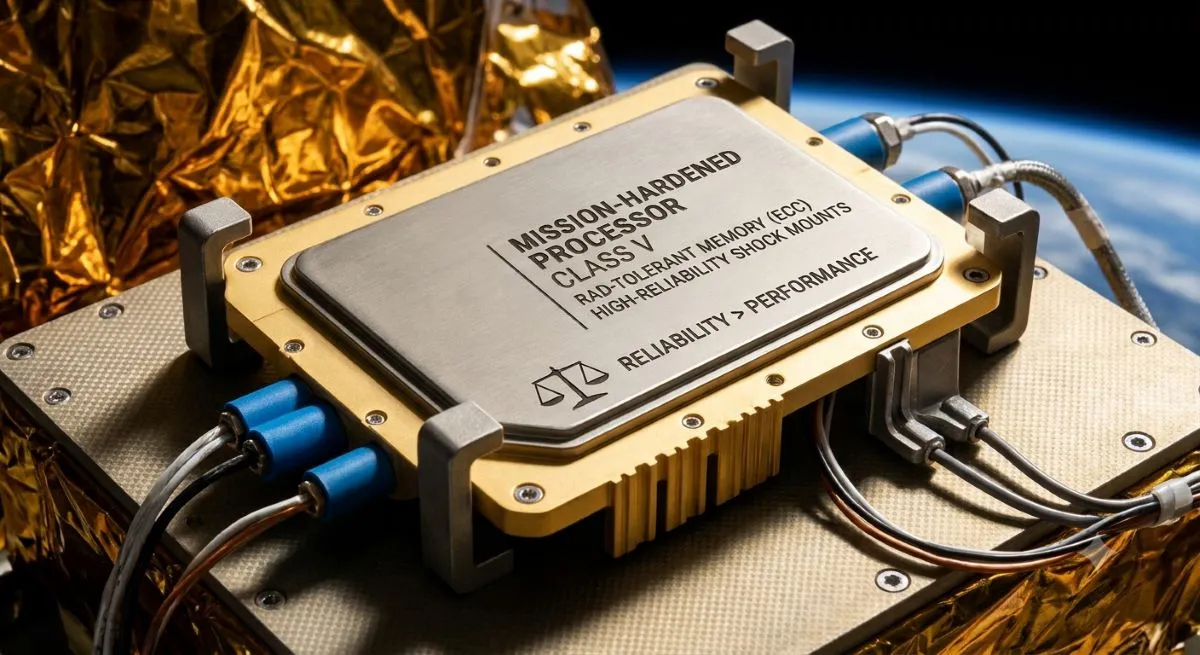 AI-generated image, courtesy Gemini
In 2010, Voyager 2 fell victim to radiation. A single bit-flip in the computer system shifted an unexpected data pattern. Thanks to the engineers, they reset the system and brought the robot back into action.
Space agencies, manufacturers, and vendors continue the quest to improve space-grade electronics. One such innovation is Nasa welcoming wide-bandgap semiconductors, silicon carbide and gallium nitride, in space to reduce component weight and optimise power conversion efficiency.
Venus Kohli is a freelance technology journalist
See: MP Space raises $16 million for spacecraft power development