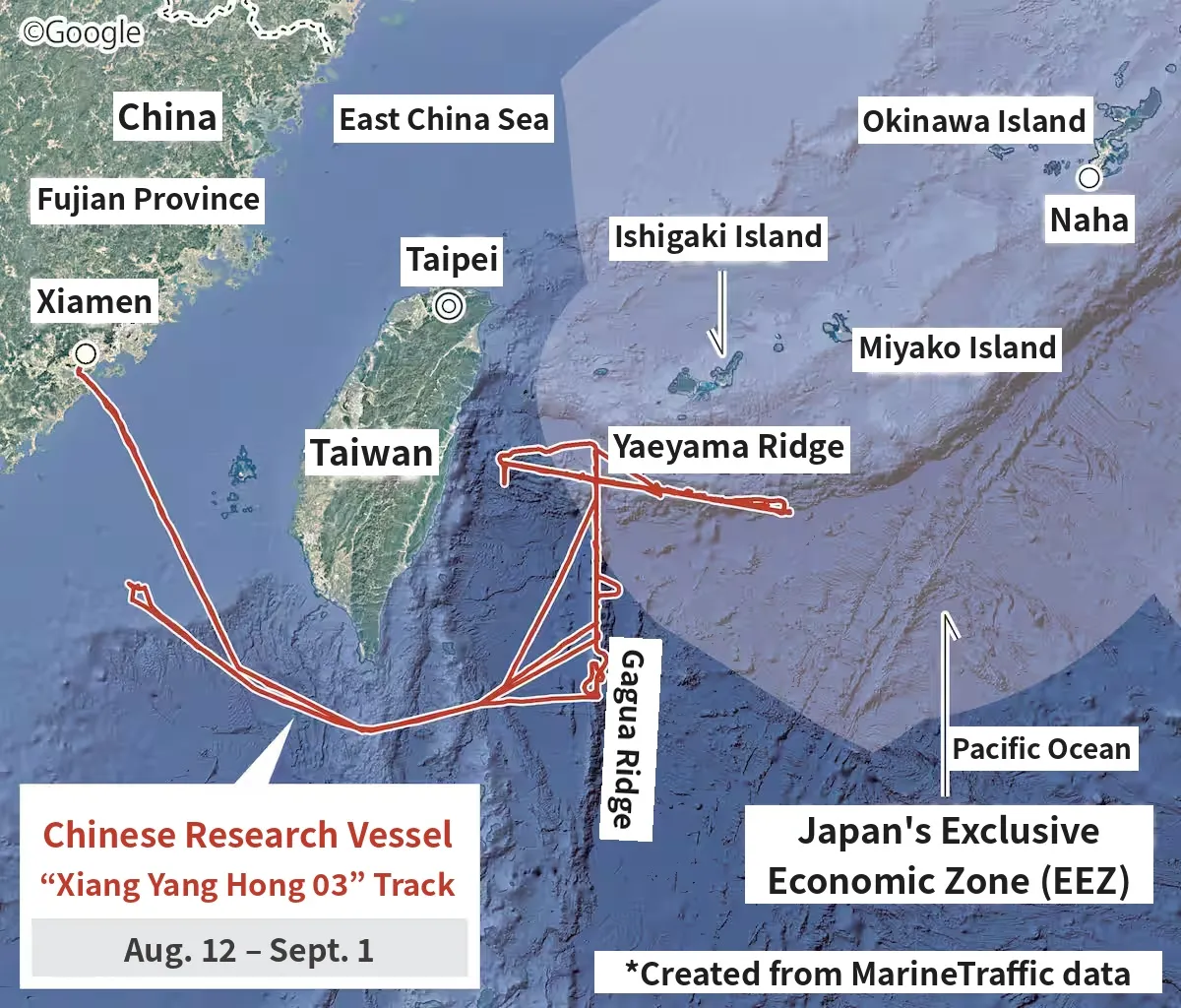
Data from US geospatial analytics firm IngeniSPACE, analyzed by The Sankei Shimbun, shows that the Chinese oceanographic research vessel Xiang Yang Hong 03 repeatedly sailed back and forth along an undersea mountain range while surveying waters east of Taiwan in August. The ridge is considered strategically important for submarine navigation.
Taiwanese authorities and military experts are closely monitoring the movements of Chinese research vessels. They suspect the ships are collecting data on seafloor topography and hydrographic conditions to support submarine operations in the event of a Taiwan contingency.
Off Taiwan’s east coast, the seabed is steep and rugged, dropping sharply from the edge of the continental shelf toward the Ryukyu Trench, which reaches depths of several thousand meters.
The interaction between the warm Kuroshio Current and cold deep-sea waters creates complex variations in water temperature and salinity. These conditions can significantly affect sonar detection, which relies on sound waves, making submarine navigation more challenging while also providing opportunities for submarines to evade detection.
Tracing Key Undersea Ridges
AIS data indicates that the Xiang Yang Hong 03, a research vessel operated by China’s Ministry of Natural Resources, departed from Xiamen, Fujian Province, on August 12. It then made repeated back-and-forth trips through waters east of Taiwan, following the Yaeyama Ridge, an elevated underwater formation running parallel to the Ryukyu Trench, and operating near the Gagua Ridge, which extends northward into the trench.
Two China Coast Guard vessels, 2502 and 1306, and a maritime militia fishing vessel, Min Fuding Yu 07902, were also observed near the Xiang Yang Hong 03, apparently leading and escorting the research vessel. The Xiang Yang Hong 03 returned to a Chinese port on September 1.
The Japan Coast Guard reported that the vessel had deployed a wire-like object into the water within Japan’s Exclusive Economic Zone (EEZ) off Hateruma Island, Okinawa Prefecture, between August 17 and 24. The Japan Coast Guard subsequently demanded that the activity be halted.
Mapping the Underwater Battlefield
Lin Chao-lun, a retired Navy rear admiral and appointed associate research fellow at the Institute for National Defense and Security Research, a think tank affiliated with Taiwan’s Ministry of National Defense, noted in a report that the navigation route of the Xiang Yang Hong 03 “aligns remarkably well with paths used by submarines for covert underwater operations.”
He also pointed out that Chinese oceanographic research vessels conduct extensive “preparation of the underwater battlefield environment” at the military’s request.
Such vessels, he explained, collect data on seafloor topography, water temperature, and salinity around Taiwan, providing information that “aids the Chinese military in planning submarine routes, optimizing sonar detection, and executing tactical deployments.”
In response to an inquiry from The Sankei Shimbun, Taiwan’s Coast Guard Administration said that, amid the growing activities of Chinese marine research vessels, it “cannot rule out the possibility that these operations are aimed at ‘preparing the battlefield environment.'”
Jason Wang, Chief Operating Officer (COO) of the firm IngeniSPACE, also expressed his agreement with the view that Chinese research vessels — such as the Xiang Yang Hong 03 series — are surveying seabed topography and hydrological data to model how sound would propagate to support weapons presents.
Supporting Submarine Operations
China possesses more than 120 oceanographic research vessels, which are believed to serve a wide range of purposes, from detecting US military underwater surveillance systems to locating undersea cables connected to Taiwan.
Su Tzu-yun, a researcher at the Institute for National Defense and Security Research, emphasized that “the most critical function is conducting surveys to support submarine operations.”
A Taiwanese military source noted, “Much of the waters off eastern Taiwan are highly favorable for submarine operations. In a contingency — such as a scenario where the Chinese military seeks to block US intervention or impose a blockade on Taiwan — submarines would prove to be an extremely effective asset.”
RELATED:
(Read the article in Japanese.)
Authors: Yoshiaki Nishimi and Ryo Nishiyama, The Sankei Shimbun
Continue Reading