
December WTI crude oil futures are lower for the week, but the market has recovered a good portion of its early loss. The contract opened at $90.83, broke to $83.88, then rallied back to $88.20. At that price, WTI is down $2.63 for the week, or 2.90%.

Traders took war premium out of crude after President Trump played down the possibility of new U.S. strikes on Iran. Higher Saudi production and a large build in U.S. inventories gave sellers more to work with. But attacks on Saudi energy infrastructure and continued threats to shipping brought buyers back.

Peace Hopes Trigger Early Break

The week opened with traders focused on the possibility of a less aggressive U.S. approach toward Iran. Trump said he was unlikely to order fresh attacks while efforts to end the conflict were making progress. He later said he planned to hold off on new strikes for the time being after appeals from countries in the region, including Qatar.

WTI had already been under pressure as traders reduced the premium built into prices over months of war and shipping disruptions. The market reached a two-month low on Tuesday.

The United States and Iran had not announced a peace agreement, however, and attacks on vessels and energy infrastructure had not stopped. Traders were selling the possibility of less disruption, not reacting to a settlement that had restored normal shipping.

Attacks Bring Buyers Back

On Thursday, Yemen’s Iran-aligned Houthis claimed attacks…
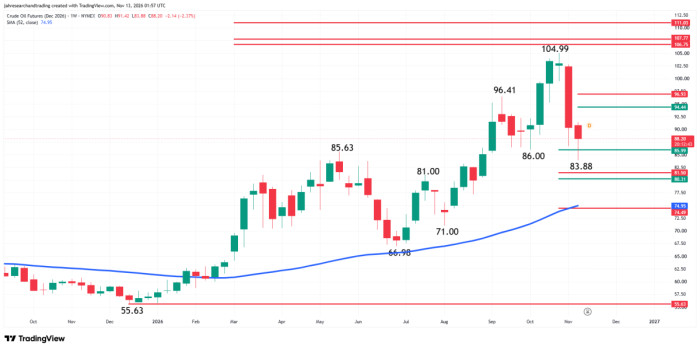
December WTI crude oil futures are lower for the week, but the market has recovered a good portion of its early loss. The contract opened at $90.83, broke to $83.88, then rallied back to $88.20. At that price, WTI is down $2.63 for the week, or 2.90%.

Traders took war premium out of crude after President Trump played down the possibility of new U.S. strikes on Iran. Higher Saudi production and a large build in U.S. inventories gave sellers more to work with. But attacks on Saudi energy infrastructure and continued threats to shipping brought buyers back.

Peace Hopes Trigger Early Break

The week opened with traders focused on the possibility of a less aggressive U.S. approach toward Iran. Trump said he was unlikely to order fresh attacks while efforts to end the conflict were making progress. He later said he planned to hold off on new strikes for the time being after appeals from countries in the region, including Qatar.

WTI had already been under pressure as traders reduced the premium built into prices over months of war and shipping disruptions. The market reached a two-month low on Tuesday.

The United States and Iran had not announced a peace agreement, however, and attacks on vessels and energy infrastructure had not stopped. Traders were selling the possibility of less disruption, not reacting to a settlement that had restored normal shipping.

Attacks Bring Buyers Back

On Thursday, Yemen’s Iran-aligned Houthis claimed attacks on a pumping station on Saudi Arabia’s East-West pipeline, an oil facility in Yanbu and a Saudi Aramco building in Riyadh. There was no immediate Saudi confirmation of the Riyadh claim.

The reports put the supply threat back in front of traders. WTI and Brent rallied even as the market digested evidence of higher output and rising U.S. inventories.

Trump also gave traders a different message when he said Washington did not need a deal with Iran. His comment did not say the United States would resume bombing. But after a week that began with hopes for less escalation, it gave the market another reason to question how quickly the conflict might end.

The issue for oil traders is whether an attack eventually interrupts a meaningful amount of production or shipping. The risk alone can support a rally, but a sustained loss of barrels would give buyers a stronger reason to hold it.

Saudi Production Recovers

Saudi Arabia reported production of 10.563 million barrels per day in October, according to OPEC. That was more than 2 million barrels per day above September and close to the level recorded before the war. OPEC+ production rose about 2.04 million barrels per day to 41.23 million.

The increase shows producers have been able to bring more supply back despite the conflict. It does not make the shipping threat disappear, but the market has more supply to work with than it did when the disruption was at its worst. Unless attacks begin taking barrels off the market, higher production could make it harder for buyers to sustain a large war premium.

U.S. Inventories Build

U.S. commercial crude inventories rose 4.7 million barrels to 414.4 million in the week ended November 6, according to the EIA. Traders had expected a 1.1 million-barrel draw.

Gasoline inventories increased 1.8 million barrels, while distillate stocks rose 4.1 million. The distillate build was especially noticeable because traders had expected a decline of 1 million barrels.

Crude still rallied Thursday. That tells me traders were more concerned about the risk to future supply than the extra barrels reported in U.S. storage. Another round of builds would give sellers a better case.

Russia Talks and Attacks Continue

U.S.-mediated talks between Russia and Ukraine produced an agreement in principle on a prisoner exchange, but no major breakthrough toward ending the war. U.S. envoys also met with Russian President Vladimir Putin.

Meanwhile, attacks on Russian oil facilities continued. A drone attack reportedly caused a fire at the Kirishi refinery, and Ukraine said its drones struck fuel tanks at the Ust-Luga port. Traders are watching both the talks and the threat to energy supplies.

Weekly December WTI Crude Oil Futures Technical Analysis

WTI

Trend Indicator Analysis

The main trend turned down this week when sellers took out the swing bottom at $86.00, but the market did bounce from the weekly low at $83.88 after a test of the first major retracement zone. The move represented the common clash between trend traders and value-seeking passive bidders.

A trade through $83.88 will signal a resumption of the downtrend. The main trend will change to up if buyers take out the swing top at $104.99.

The intermediate range is $66.98 to $104.99. Its retracement zone is $85.99 to $81.50. This area is providing support this week.

The long-term range is $55.63 to $104.99. Its retracement zone target is $80.31 to $74.49. This zone forms a potential support cluster at $81.50 to $80.31 next week. Another potential support cluster is formed by the 52-week moving average at $74.95 and the long-term 61.8% level at $74.49.

Counter-trend buyers may show up on a test of the support clusters.

The short-term range is $104.99 to $83.88. The next potential upside target is its retracement zone at $94.44 to $96.93. With the main trend down, sellers could return if this area is tested.

Weekly Technical Forecast

The direction of the Weekly December WTI Crude Oil futures contract for the week ending November 20 is likely to be determined by trader reaction to $90.34.

Bullish Scenario

A sustained move above $90.34 will be the first sign that buyers have returned. The signal will strengthen over $91.42. This will put the market in a position to possibly rally into $94.44 to $96.93.

Bearish Scenario

A sustained move under $90.34 will indicate that new sellers have entered the market. This could trigger a retest of $85.99, followed by $83.88.

If $83.88 is taken out, then look for a test of the support cluster at $81.50 to $80.31. Watch for a counter-trend technical bounce. If $80.31 fails as support, then look for the selling to possibly extend into the next support cluster at $74.95 to $74.49. The aggressive counter-trend buying could be stronger on a pullback into this area since the 52-week moving average at $74.95 is both major support and a long-term trend indicator.

Weekly Forecast

The outlook for next week is mixed, but the recovery from the weekly low suggests sellers are not ready to ignore the supply threat. I expect attacks on Saudi infrastructure and shipping to keep a floor under crude unless traders see evidence that the risks are easing.

Higher Saudi production and another U.S. inventory build could limit the upside. A verified disruption to production or exports could bring buyers back quickly, while a concrete peace agreement and safer shipping would give sellers another reason to remove the war premium.

Technically, if upside momentum returns, then the primary upside target will likely be $94.44 to $96.93. If sellers retake control and $83.88 fails, then look for a test of $81.50 to $80.31 or $74.95 to $74.49. These two areas could be attractive to aggressive counter-trend traders.