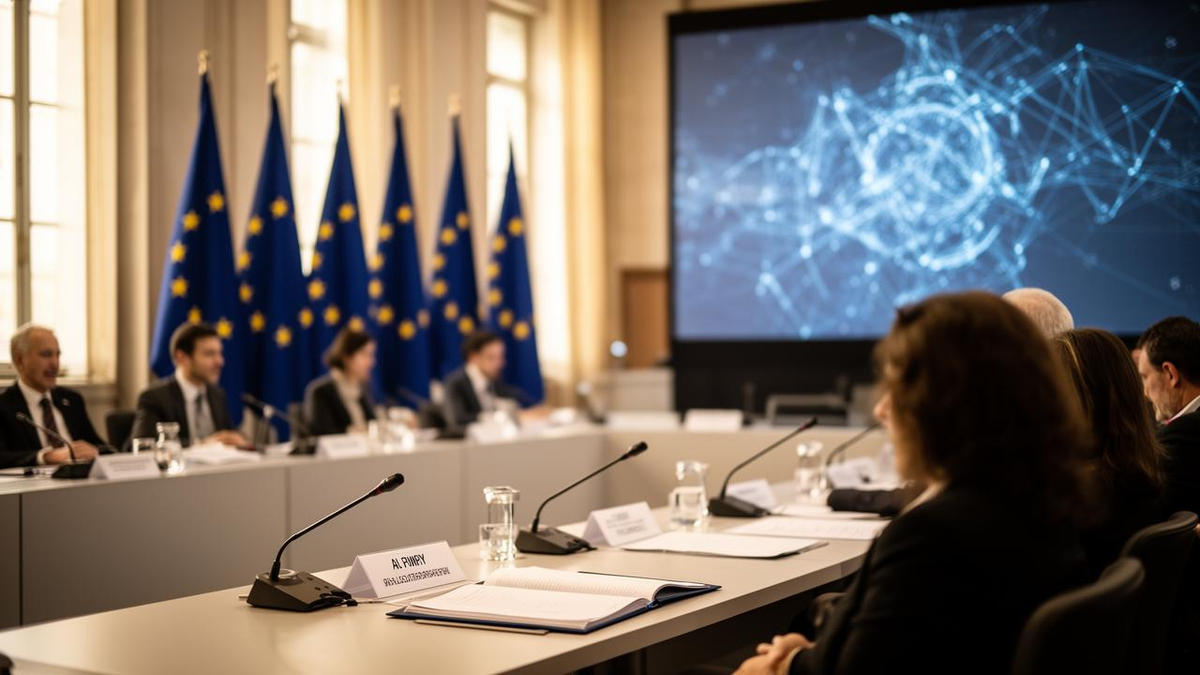
EU leaders met Friday in the Irish capital of Dublin for the bloc’s first AI-focused summit, discussing how to keep pace with the US and China in AI development while guarding against technological risks. Arthur Mensch, CEO of French AI company Mistral, urged the EU to “act now,” warning that decisions made over the next two years will shape the industry for the next decade.
“Europe has all the technology and talent it needs to lead in the AI race,” Mensch told EU leaders at the summit. His company, Mistral, is seen as Europe’s leading AI model developer. In his view, what Europe lacks right now is speed, funding and strong coordination among member states. “That is why we are calling on European leaders to act immediately. At least for now, the choice is still in our own hands.”
The informal summit is also part of the EU’s effort to reduce its reliance on foreign technology and services and strengthen its own technological autonomy. Irish Prime Minister Micheál Martin said before the summit opened that leaders would focus on how to balance regulation with innovation, strengthen Europe’s tech sovereignty, and how Europe should respond to global developments in AI.
Geoffrey Hinton, a pioneer in the field of AI and a Nobel laureate, was also invited to attend. During discussions on AI’s impact on society and security, the researcher, who formerly worked at Google, was expected to explore with European leaders how to protect citizens’ rights and jobs, and how to address the security challenges posed by AI. In the months after OpenAI launched ChatGPT in 2022 and sparked a new wave of AI enthusiasm, Hinton and fellow computer scientist Yoshua Bengio repeatedly warned about the potential risks of AI.
“Lost the race” claim rejected
European Parliament President Roberta Metsola told reporters before the informal summit began that she was tired of hearing that Europe had “somehow lost the AI race.” “We have world-class talent, and from a technological point of view, we have a very strong… ecosystem.”
Her remarks echoed Mistral’s position. This year, while US tech executives such as OpenAI CEO Sam Altman and Anthropic CEO Dario Amodei called for slowing the pace of AI development, Mistral continued to press Europe to speed up its industrial push.
Risk issues also took a prominent place at the summit. EU High Representative for Foreign Affairs and Security Policy Kaja Kallas warned that AI also has a “dark side.” “We can already see this on the battlefield in Ukraine. Drones equipped with AI technology are being trained to identify and lock onto any target that needs to be attacked.”
In a joint letter this week, Estonia and Finland said Europe needs to “establish an EU-level mechanism to respond to serious AI safety incidents,” and called for building a responsible governance system while advancing the development of cutting-edge AI technology. Estonian Prime Minister Kristen Michal said Europe had paid a price in the past for over-relying on suppliers outside the EU for fossil fuels and critical minerals. “We should not repeat the same mistakes, but instead invest in new technologies.”
The summit comes as Nvidia, a core supplier of AI chips and also a major investor in the EU, is embroiled in a scandal. An EU official said Nvidia was not formally on the summit agenda, but that did not mean participants could not raise the matter on their own initiative, and EU leaders may want to discuss the security implications of the controversy.
Calls grow for a comprehensive strategy
James Green, a researcher at the Centre for European Reform, believes the EU needs a comprehensive AI development strategy spanning multiple areas. He said Europe should improve the business environment for its domestic AI industry and strengthen its bargaining power to ensure access to the most advanced models and related technologies; at the same time, it should promote the deployment of AI technology and unlock economic benefits under responsible conditions, while reducing potential harm through regulatory systems and international cooperation.
In terms of policy direction, the EU is trying to find a balance between “promoting development” and “preventing risks.” The speed and funding emphasized by Mensch reflect the industry’s urgency to catch up with the US and China, while the concerns of Hinton, Kallas, Estonia and Finland point to the absence of safety governance mechanisms.
It is worth noting that China has previously stressed that China and Europe each have their own strengths and advantages in AI and are fully capable of complementing each other and pursuing common development. China is willing to expand exchanges and cooperation with the EU in AI, make it a new growth point for China-EU cooperation, and jointly promote global AI governance.
For the market, the signals from this summit point in two directions: first, European domestic AI companies may receive more policy and funding support, and the industry position of leading players such as Mistral is expected to be further consolidated; second, if an EU-level governance mechanism for AI safety incidents is accelerated into place, it will raise compliance costs for tech companies and affect the pace of deployment of related products in the European market. Whether the Nvidia controversy will be included in follow-up discussions remains one of the variables investors are watching.