
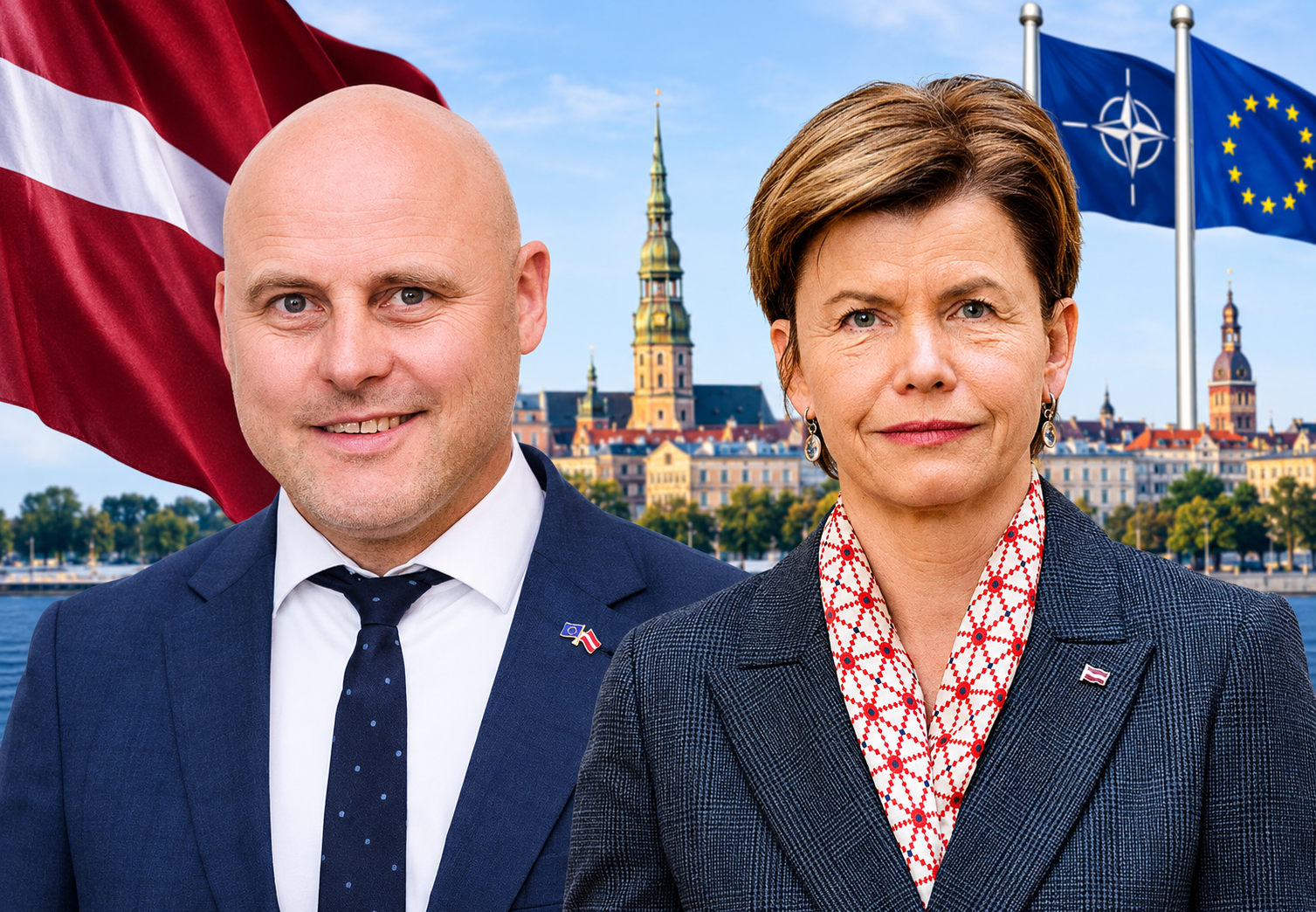
 Andris Kulbergs and Baiba Braže: Latvia’s leadership faces the challenge of balancing economic reform, defence preparedness and diplomatic continuity amid growing security concerns on NATO’s eastern frontier.
Latvia stands at a critical juncture in its political and strategic evolution. Situated on the European Union’s eastern frontier, sharing borders with Russia and Belarus, the Baltic nation faces an increasingly demanding security environment.At the same time, sluggish economic growth, rising fiscal deficits and expanding defence commitments are placing considerable pressure on public finances. For Latvia, the challenge is no longer simply to strengthen national security. It is to build an economy and a political system capable of sustaining that security over the long term.Against this backdrop, two political figures have emerged as potentially decisive in shaping Latvia’s future: Prime Minister Andris Kulbergs and Foreign Minister Baiba Braže. Kulbergs represents a leadership approach centred on fiscal discipline, administrative reform and stronger defence capabilities.Braže brings extensive diplomatic experience, established international relationships and a deep understanding of European and transatlantic security institutions. Their continued collaboration could provide Latvia with the combination of domestic stability and international credibility that its present circumstances demand.The significance of their partnership extends beyond individual political careers. Latvia’s security cannot be separated from its economic resilience, just as its economic prospects cannot be insulated from the geopolitical realities of its neighbourhood. The effectiveness of the next government will depend on how successfully these interconnected challenges are addressed.A Political Mandate Tested by Economic Realities
Kulbergs entered office on 28 May 2026 following the resignation of Prime Minister Evika Siliņa’s government amid the political fallout from drone attacks in Rēzekne. His cabinet secured parliamentary approval by 66 votes to 25, establishing a substantial initial mandate. His subsequent electoral success further strengthened his political position, with the United List securing 41 seats in the 100-member Saeima in the October parliamentary election.The election results reflected public expectations of more decisive leadership, particularly on national security, government accountability and economic management. Yet the strength of the mandate must be viewed alongside a less encouraging indicator: voter turnout fell to approximately 52 per cent, reportedly a record low. This suggests that electoral success has not necessarily translated into broad public confidence in Latvia’s political institutions.Kulbergs’ professional background distinguishes him from many conventional political leaders. Before entering parliament in 2022, he worked in telecommunications marketing and the automotive industry. His subsequent parliamentary responsibilities included oversight of public expenditure and an investigation into heating costs in Riga. These experiences provide a foundation for his emphasis on administrative efficiency, fiscal accountability and public procurement reform.However, the transition from identifying inefficiencies to correcting them is rarely straightforward. The Prime Minister must now demonstrate that his commitments to reduce waste, improve transparency and strengthen public services can produce measurable results. Latvia’s economic outlook makes that task particularly urgent.According to the European Commission’s 2026 projections cited in the original analysis, Latvia’s economy grew by 2.1 per cent in 2025 but is expected to expand by only 1.4 per cent in 2026 and 1.6 per cent in 2027. Higher energy costs and international instability are expected to weigh on economic activity, while inflation is projected to reach 3.6 per cent in 2026.The fiscal outlook is equally demanding. The general government deficit is projected to increase from 2.5 per cent of GDP in 2025 to 3.3 per cent in 2026 and 4.3 per cent in 2027. Government debt is expected to rise from 46.9 per cent of GDP in 2025 to 53.8 per cent by 2027.These figures illustrate the central contradiction confronting Latvia: the country must spend substantially more on defence while maintaining the fiscal discipline necessary for economic stability.Kulbergs has pledged to address this challenge without relying primarily on higher taxation. His programme emphasises reductions in unnecessary expenditure, greater efficiency across ministries, stronger procurement oversight and action against corruption and collusive practices.The direction is defensible, but the execution will determine its success. Reducing administrative waste can create fiscal space, yet savings from efficiency measures alone may not be sufficient to finance rising defence commitments. Latvia will also need stronger private investment, higher productivity and a more competitive economic environment.The European Union’s decision to permit Latvia to use the national escape clause provides some flexibility for additional defence expenditure. Nevertheless, fiscal flexibility should not be mistaken for fiscal sustainability. The government must ensure that exceptional security spending does not become an excuse for weakening long-term budgetary discipline.Defence Spending Must Translate into Real Security
Latvia’s defence transformation has been remarkable in scale. A decade ago, the country allocated approximately one per cent of GDP to defence. Planned expenditure is expected to reach 4.9 per cent in 2026, with legislation providing for defence spending of five per cent of GDP from 2027.Such commitments demonstrate the seriousness with which Latvia regards the threats along NATO’s eastern flank. Yet higher expenditure does not automatically produce greater security.The drone incidents in Rēzekne, which contributed to the collapse of the previous government, exposed the political and operational consequences of vulnerabilities in national air defence. They also demonstrated that modern security threats increasingly involve relatively inexpensive technologies capable of challenging sophisticated military infrastructure.For Kulbergs, the immediate priority must therefore be to convert financial commitments into operational capabilities. Strengthening air defence, improving drone detection and interception, expanding surveillance and reinforcing military readiness are essential components of that effort.The appointment of Defence Minister Colonel Raivis Melnis, described in the source material as a serving military officer and former military attaché in Kyiv, reflects the government’s emphasis on operational experience and an understanding of contemporary warfare.However, effective defence planning requires more than military expertise. Procurement decisions must be transparent, equipment acquisitions must be integrated into a coherent capability-development strategy, and spending must be assessed against clearly defined security outcomes.Latvia’s geographical position also makes collective defence indispensable. The country is not merely protecting its own territory; it is contributing to the security of the European Union and NATO.Kulbergs has argued that eastern-flank countries deserve greater European support because they carry a disproportionate share of the responsibility for protecting the continent’s external frontier. This argument has considerable strategic merit. A stronger Latvian defence system contributes to European security as a whole, making burden-sharing a legitimate subject of negotiation with Brussels and allied capitals.The challenge is to transform this strategic argument into sustained political and financial support. Here, diplomacy becomes as important as defence expenditure.Baiba Braže and the Value of Diplomatic Continuity
For a country of Latvia’s size and strategic exposure, foreign policy is not a secondary instrument of government. It is a central pillar of national security.This makes the question of who leads Latvia’s foreign ministry particularly consequential. Baiba Braže offers a combination of institutional knowledge, international experience and established relationships that would be difficult to replace during a period of geopolitical uncertainty.Braže began her diplomatic career in 1993 and has held several important positions, including ambassador to the Netherlands, permanent representative to the Organisation for the Prohibition of Chemical Weapons, director general for security policy and international organisations, and ambassador to the United Kingdom.Between 2020 and 2023, she served as NATO’s Assistant Secretary General for Public Diplomacy, acquiring direct experience of the alliance’s political and military institutions. Her appointment as Latvia’s foreign minister in April 2024 brought this experience into national policymaking.Her diplomatic credentials are especially relevant because Latvia’s principal security concerns require continuous engagement with NATO, the European Union, the United States and other international partners. Braže has consistently emphasised the importance of European and transatlantic cooperation, sustained support for Ukraine and preparedness for a prolonged period of confrontation with Russia.In her January 2025 foreign policy assessment, she described enduring tensions with Russia as a new normal, underscoring the need for Latvia to strengthen its own resilience while maintaining international solidarity.Latvia’s election to the United Nations Security Council in June 2025 added another dimension to its diplomatic responsibilities. Securing 178 votes in the UN General Assembly, the country won its first non-permanent seat for the 2026–2027 term.Its scheduled presidency of the Security Council in November 2026 offers an opportunity to raise its international profile and contribute to debates on European security, the war in Ukraine and the international rules-based order.For a relatively small country, such opportunities are strategically valuable. They allow Latvia to influence international discussions that directly affect its security, even when its economic and military resources are limited. Braže’s experience makes her particularly well placed to use these opportunities effectively.Why Continuity Matters More Than Coalition Bargaining
The parliamentary election has created a new phase of coalition negotiations, and the distribution of ministerial portfolios will inevitably involve political bargaining. Reports have suggested that control of the foreign and defence ministries could become part of negotiations among coalition partners.Yet foreign policy continuity should not be sacrificed merely to accommodate competing political interests.Latvia’s principal foreign policy commitments enjoy substantial strategic justification. Support for Ukraine, close cooperation with NATO, stronger European defence capabilities and a credible response to Russian security threats are not policies that should fluctuate with every change in coalition composition.Braže’s retention in the previous government and subsequently under Kulbergs demonstrated recognition of this principle. Her continued service would reinforce the message that Latvia’s international commitments remain stable despite changes in domestic political leadership.This does not mean that a foreign minister should be immune from scrutiny or replacement. Diplomatic performance must be evaluated against national interests, and political accountability remains essential. However, replacing an experienced foreign minister during an active UN Security Council term and a period of heightened regional tension would require a compelling strategic justification.In the absence of such justification, continuity offers clear advantages. Braže already possesses the institutional relationships needed to advance Latvia’s security agenda. She understands NATO’s internal processes, has experience dealing with major European governments and has been directly involved in shaping Latvia’s response to the changing European security environment.For Kulbergs, retaining such experience would allow the government to concentrate on domestic reform while maintaining consistency in its external engagements. The potential division of responsibilities is therefore complementary rather than competitive. Kulbergs can focus on economic management, administrative reform and defence modernisation, while Braže works to strengthen the international partnerships necessary to support these objectives.Economic Resilience and National Security Are Inseparable
Latvia’s future will depend on its ability to recognise that economic policy, defence planning and diplomacy are not separate spheres of governance.A country that spends five per cent of GDP on defence while facing widening fiscal deficits cannot afford inefficient administration or poorly designed procurement. Equally, a government focused exclusively on expenditure reduction risks weakening the economic foundations on which long-term military preparedness depends. Economic reform must therefore support, rather than undermine, national security.Improving productivity, attracting investment, strengthening infrastructure and increasing public-sector efficiency are essential to sustaining Latvia’s defence commitments. At the same time, stronger international partnerships can facilitate military cooperation, technological development and access to European funding mechanisms.The relationship also works in the opposite direction. Greater security can improve investor confidence, protect economic activity and reinforce Latvia’s attractiveness as a location for business within the European Union. The government’s central task is to establish a credible connection between these objectives.That requires political leadership capable of making difficult domestic decisions and diplomatic leadership capable of securing international cooperation. Kulbergs and Braže bring different professional experiences to this challenge, but those differences could become a source of strength if their priorities remain aligned.The Test of Leadership
Latvia’s immediate problems are substantial, but they are not insurmountable. The country possesses important institutional advantages through its membership of the European Union, NATO and the United Nations Security Council. It also benefits from a political consensus on several fundamental security priorities.What remains uncertain is whether these advantages can be translated into sustained economic resilience, credible military capabilities and greater international influence. Kulbergs has received a mandate to pursue reform and strengthen national security. His success will depend on whether his government can deliver measurable improvements in fiscal management, public administration and defence preparedness.Braže, meanwhile, offers diplomatic continuity at a time when Latvia cannot afford uncertainty in its international relationships. Her experience could help ensure that the country’s expanding defence commitments are matched by stronger political support from allies.Ultimately, Latvia’s security will not be determined by defence expenditure alone, nor will its prosperity be secured solely through budgetary restraint. Both depend on effective institutions, sound economic policies, credible military capabilities and sustained international cooperation.A stable partnership between Kulbergs and Braže could bring these priorities together. For a small nation situated on one of Europe’s most sensitive strategic frontiers, that combination may prove more valuable than any single political victory.(Disclaimer: Views expressed are personal)