
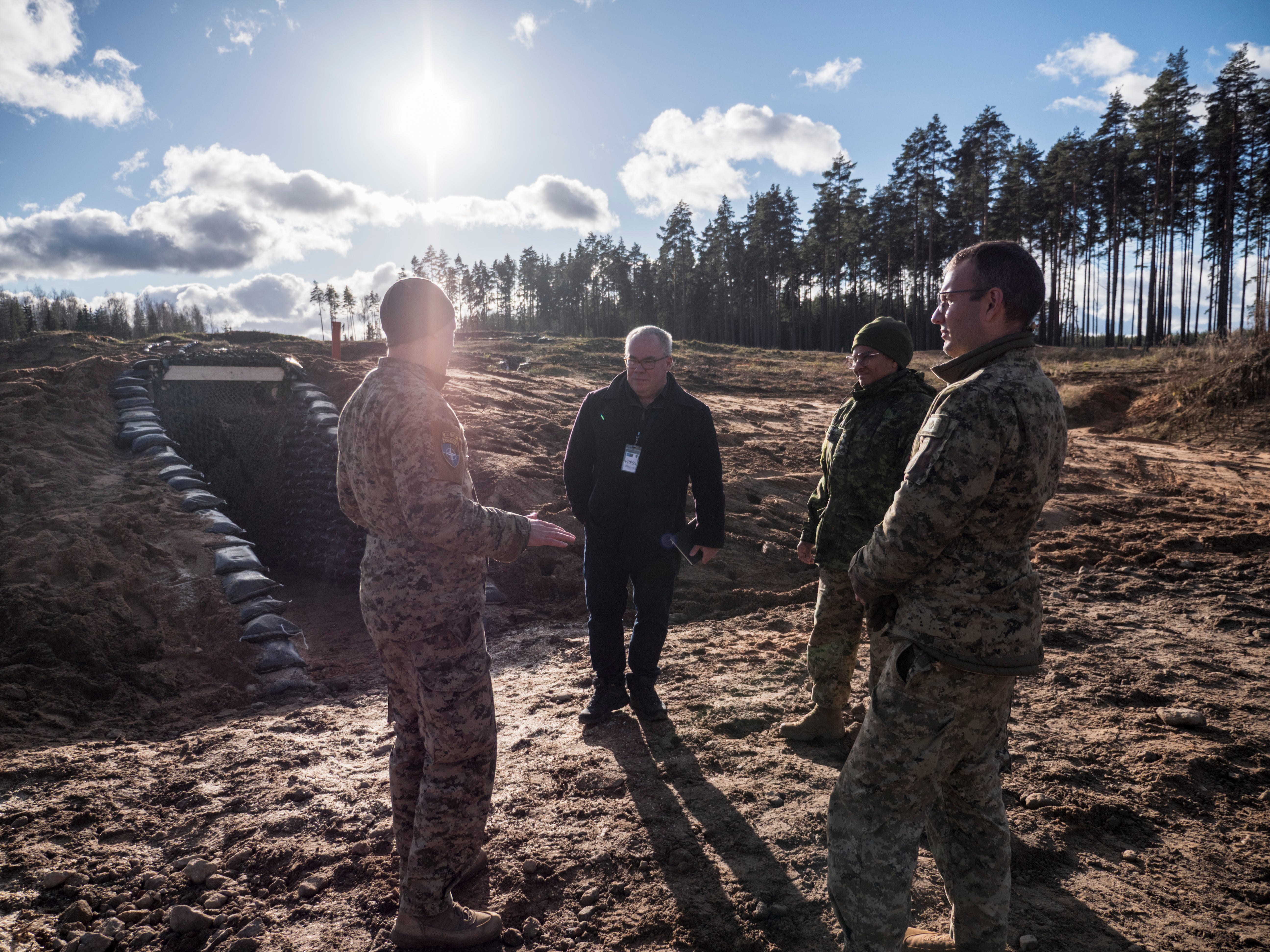
I’ll publish a few posts over the coming days from my recent trip to Latvia, where more than 2,000 Canadian Armed Forces troops lead a multinational brigade to defend NATO’s eastern flank.
Today: Accelerating business on the battlefield.
Next: The changing nature of combat itself.
Then: Sabotage, arson, drone alerts and misinformation: Welcome to Russia’s neighbourhood.
And somewhere in there, a separate post with extraordinary photos of Canadian and allied soldiers, from Mikolaj Nowacki, an award-winning Polish photographer I hired to document their work.
Today, a look at the changing relationship between soldiers and the businesses that hope to supply them. — pw
I can do journalism like this because paying subscribers allow me to have a travel budget, and a larger pool of subscribers constitute an audience newsmakers want to reach. If somebody sent you this post, consider becoming a free or paid subscriber.
I learned a long time ago, in Afghanistan, that if somebody is travelling with soldiers but not dressed like them, they’re probably interesting and might be important. So I should have paid more attention to the people at the briefing who weren’t dressed like soldiers.
The briefing took place in a mobile command post outside Jēkabpils, a city of 20,000 about two hours’ drive southeast of Riga. The guy being briefed was Timothy Edwards, Canada’s new ambassador to Latvia. He was being updated on the progress of Mission Rehearsal Activity Resolute Reforger, which sent 3,000 troops across the country on various assignments.
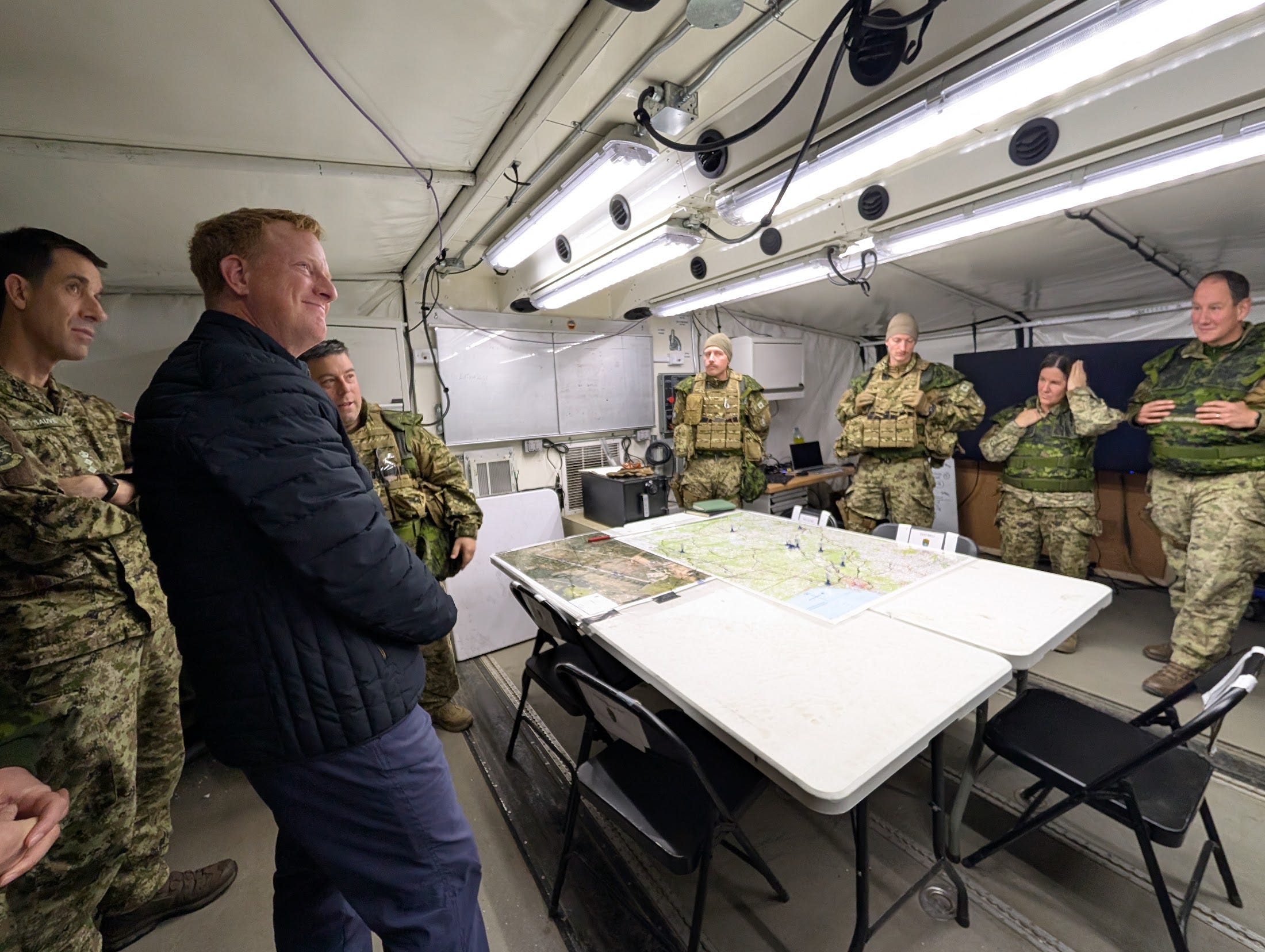
Canada has led a substantial NATO military contingent alongside allies from several other countries in Latvia. That contingent has grown steadily since 2017. Great Britain leads a comparable multinational force in Estonia to the north, and Germany in Lithuania to the south. I covered the establishment of this “enhanced forward presence” in 2017, and came back this month to see what’s new now that it’s a full brigade.
Back to the briefing. As several Canadian soldiers took turns describing the day’s plans to Edwards and putting those plans into the broader context of a country a little larger than Nova Scotia, I listened along. Behind me stood a guy dressed head-to-toe in black and carrying a matching ballistic helmet. Next to him was another fellow in a toque and ordinary street clothes. Tech support? Who knew. I ignored them until the briefing was over. Sometimes I can be slow on the uptake. Everyone filed outside to the tarmac and I began to realize the morning’s big event was largely about the two civilians’ work.
Here’s Ambassador Timothy Edwards, on the right, with the man in black. The latter wasn’t making the slightest effort to be mysterious. It’s just that I never did get a photo of his face. In this photo I was concentrating on the little dot in the air between their two heads: a drone.
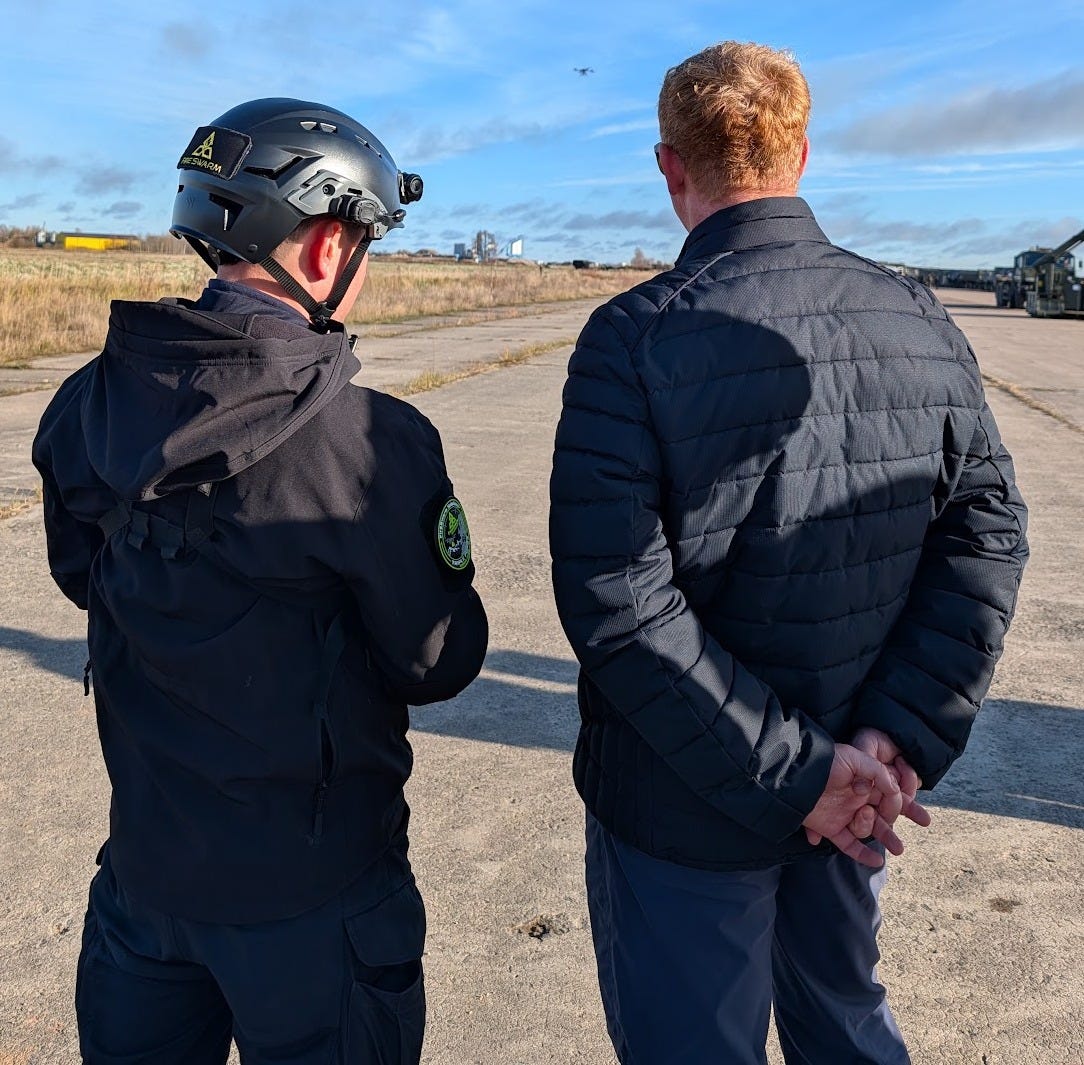
Soon the drone flew low enough so a crew could connect a stretcher carrying a dummy to a line the drone was trailing. The flying machine picked up the stretcher and its humanoid cargo, carried them a few hundred metres, and lowered them to the ground again:
Only a few weeks earlier, Ukraine had announced the world’s first drone evacuation of a wounded soldier. Canadians aren’t there yet, but they’re working to close the gap. The man in black handed me his business card and told me what his equipment and crews are up to.
He turned out to be David Thanh, a co-founder and COO of FireSwarm Solutions. The company launched three years ago in Squamish, BC with the goal of automating search and safety operations during wildfires. Animations on the website show heavy-duty drones dropping water on a West Coast forest wildfire. The company doesn’t make the drones, it buys them from established firms, mostly in Europe. Its expertise is in command-and-control systems that permit a bunch of drones to work together. Hence the Swarm in FireSwarm. The upstart company hasn’t deployed its equipment against any out-of-control fires yet, though it’s quickly building out a range of capabilities and equipment. It seeks to be “drone-agnostic”: it could work with equipment from a bunch of different manufacturers, and indeed with vehicles on the ground as well as in the air.
Nor are wildfires the only setting where FireSwarm plans to operate. The company says it’s developing “dual-use applications across disaster response, remote operations, defence support, and critical infrastructure.” Basically anywhere loads need to be transported in or out of inhospitable environments.
And so to Latvia. Thanh and his colleagues had a busy month across Central and Eastern Europe: besides Resolute Reforger in Latvia, FireSwarm participated in a 22-nation digital-communications field test in the same country several days earlier, and a large drone-fighting exercise in Bulgaria a few days before that.
In each case, the company isn’t just looking for sales. It’s looking for information it can use to improve its product range in a tight cycle of product development and field-testing. At the beginning of this year, FireSwarm got its ticket into that cycle of gruelling tests and vast commercial opportunity when FireSwarm was selected to participate in NATO’s DIANA program.
DIANA stands for Defence Innovation Accelerator for the North Atlantic. Launched in 2023, it puts potential industrial suppliers in close and sustained contact with the military forces that might wind up using their products, in hope of finding the equipment that can help in a fast-changing world.
For Thanh and his colleagues, learning quickly what works and what doesn’t is key. “Being able to get in front of defence and integrating into real-world needs is super-important. Not just, ‘We’ve developed a box in Canada without really knowing what is needed.’ It’s actually getting out there and getting boots on the ground and saying, ‘Yes, this part works; no, this part doesn’t. This was stupid — this is what you need to do.’”
What’s the scale of the business opportunity? Thanh considered how frank to be in his answer, and settled on pretty frank. “I hate to say the world is our oyster, but there are so many opportunities,” he said. “There’s so many untapped areas that we haven’t even explored yet. Technology, innovation and uncrewed vehicles in defence? It’s huge.”
But the arena FireSwarm Solutions is operating in is also very far from one where you can just hook yourself up to the money hose and enjoy the ride. For the NATO DIANA eligibility round that got FireSwarm into the program, 150 companies from around the world qualified — out of 3,680 that applied. That’s a brutal funnel. And nobody’s obliged to buy anything from any of those companies. I’ve covered business innovation for much of my career, and as far as I can see, the surest driver of innovation is vast opportunity crossed with high risk. Canada often prefers modest opportunity and near-zero risk. Less so on a tarmac in Latvia.
I mentioned two civilians (besides Ambassador Edwards) in Jēkabpils that morning. The other was Elliot Barry, Deputy General Manager at Barry Cordage, a family business of 45 years’ standing in Montreal. They make ropes and nets. Mundane, you might say, and it’s true that Barry Cordage isn’t in the NATO DIANA program. But go back up and look at that drone carrying a stretcher, and ask yourself how well that works without the rope.
Barry Cordage has been making things that hang from helicopters for many years, so making things that hang from drones was a logical next step. But a net can do other things too, like stopping an enemy’s attacking drones at the last second if other technologies haven’t worked. On my second day in Latvia I visited Canadian Army engineers helping the Latvian Army upgrade a base closer to the Russian border. One thing the Canadians pointed out to me was their widespread use of netting.
Barry said he’s working to develop netting that could stop Shahed-scale drones, bigger than a king-sized bed and incomparably deadlier. What would anti-Shahed netting look like? “We’re keeping that to ourselves for now,” he said. Opportunity crossed with high risk.
Like FireSwarm, Barry Cordage puts considerable resources into product development on a scale few Canadian businesses ever have to match. They even rent out their testing facility to other companies. Barry said it’s easier to sell new products, and new classes of products, to armed forces in NATO countries than it is to break into an established market. If somebody has been buying British or American rope forever, it’s hard to get them to switch. But when everything’s new, much is possible.
There’s more drama in the later instalments of this series, but I wanted to start with the first thing that struck me, which was the increasingly tight relationship between militaries and innovative businesses.
The crucible of a terrible war kicked innovation in Ukraine into high gear, as war has so often done through history. Today’s Western democracies have had to become nimbler to have any hope of keeping pace. Of course private business has worked with armies for as long as there have been armies, but the nature of this relationship — so close, fast and ever-new — feels different from anything I saw in Afghanistan.