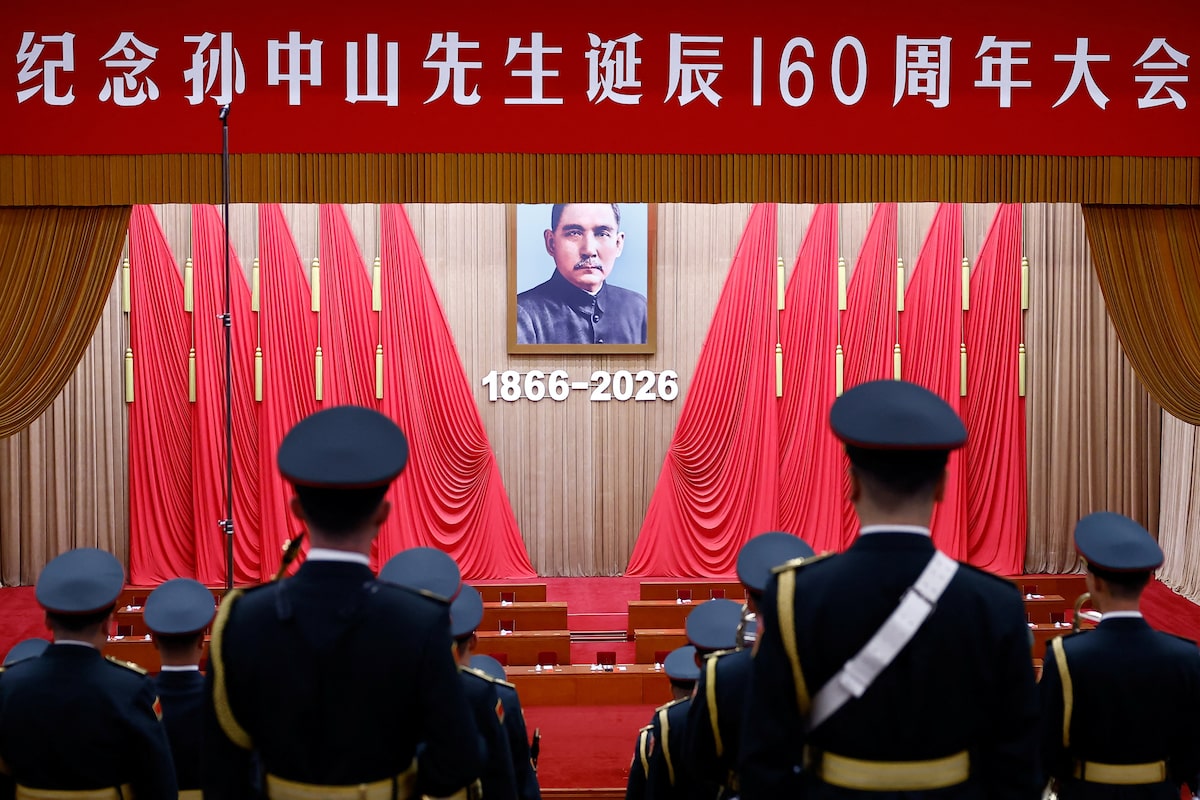
Military band members stand in front of a portrait of Sun Yat-sen ahead of a meeting commemorating his 160th birth anniversary at the Great Hall of the People in Beijing on Thursday.Maxim Shemetov/Reuters
Ceremonies were held in multiple Chinese cities Thursday to mark the 160th anniversary of the birth of Sun Yat-sen, credited with inspiring the revolution that overthrew the Qing dynasty, ending millennia of imperial rule in China, and considered by some as father of the nation.
Speaking at the Great Hall of the People in Beijing, Chinese leader Xi Jinping hailed Mr. Sun as a “great national hero, a great patriot and a great pioneer of China’s democratic revolution.”
In the weeks leading up to Thursday’s anniversary, China and Taiwan have been engaged in a war of words over Mr. Sun, a revered figure on both sides of the Taiwan Strait. China claims sovereignty over Taiwan and has not ruled out annexing the democratic island by force.
“Sun Yat-sen always firmly upheld national unity and ethnic solidarity, and resolutely opposed all words and deeds that sought to split the country or the nation,” Mr. Xi said. “Resolving the Taiwan question and realizing the complete reunification of the motherland is an unswerving historical task of the Communist Party of China.”
His speech was accompanied by a show of military force around Taiwan involving dozens of Chinese aircraft and warships, according to the island’s defence ministry.
China’s President Xi Jinping hailed Mr. Sun as a ‘great national hero.’Maxim Shemetov/Reuters
Born in Guangdong in 1866, Mr. Sun lived a peripatetic life even before he became a revolutionary, studying medicine in Hawaii and Hong Kong, and later spending years in exile in Britain, the U.S. and Japan.
As his country’s first elected president, Mr. Sun is akin to a Chinese George Washington, but his legacy has become contested in recent years, not least in Taiwan, which is officially called the Republic of China, or ROC, inheritor to the government Mr. Sun helped found in 1912.
While Mr. Sun is officially regarded as “father of the nation,” many in Taiwan today feel little connection to the revolutionary, who only ever visited the island when it was a Japanese colony, and whose political party, the Kuomintang, or KMT, established a brutal autocracy in Taiwan after retreating there after their 1949 defeat in the Chinese civil war.
“For a lot of people he’s just this abstract historical figure, the founder of the ROC and KMT,” said Lev Nachman, an associate professor at National Taiwan University and author of Contested Taiwan: Sovereignty, Social Movements, and Party Formation.
That fraught legacy was on display this week, when neither Taiwanese President William Lai nor leaders of the KMT, now the main opposition party, made much of Thursday’s anniversary, which comes two weeks before local elections on the island.
“No local candidates want to talk too much about national stuff,” Prof. Nachman said.
While the KMT historically performs well in local and municipal races, it has struggled to break the hold Mr. Lai’s Democratic Progressive Party has on the presidency. It is in the national political arena where debates over Taiwan’s relationship with China have much more sway.
The KMT regards Taiwan as part of China and advocates for eventual unification. The pro-independence DPP argues Taiwan is already a sovereign country, the ROC. Polls show an overwhelming majority of voters on the island reject annexation by Beijing and see themselves as Taiwanese first rather than Chinese (or both Taiwanese and Chinese).
Inside Taiwan’s budding civil defence movement, where ordinary citizens are preparing for disaster
Compared to the hagiographic view of Mr. Sun advanced in China, many in Taiwan take a more realistic assessment of his actual achievements and contribution to overthrowing the Qing, Prof. Nachman said.
“It’s a midterm exam question here: where was Sun Yat-sen during the [1911] Xinhai Revolution,” he said. “The answer is Denver, Colorado.”
Nor was Mr. Sun a particularly successful postrevolutionary leader. He only served just over two months as president, before giving way to former Qing general Yuan Shikai, who became increasingly dictatorial before his death in 1916 plunged China into civil war. The country was not unified again until 1928, by KMT leader Chiang Kai-shek, who would go on to fight the Japanese and Mao Zedong’s Communists, who eventually defeated him in 1949.
In a statement Thursday, Taiwan’s Mainland Affairs Council said Mr. Xi’s speech “distorted historical narratives” in the name of promoting Taiwan’s annexation.
“If the CCP truly wants to commemorate Sun Yat-sen it should acknowledge the objective fact that the Republic of China he founded still stands, respect Taiwan’s free and democratic way of life, and strive to implement Sun Yat-sen’s lifelong pursuit of democracy and civil rights, while boldly promoting political reform and democratization in mainland China.”