
Within a radius of approximately 14 km from the site where H. pluvialis was recorded, no major industrial facilities potentially emitting substantial amounts of nutrients were identified. The surrounding area was dominated by agricultural and forested land, whereas intensive livestock production represented the main identifiable local source of environmental pressure. The F1 area is located near a legally protected landscape area comprising forests, lakes, and the Brda River valley.
At the village in F1, large-scale livestock production is present, which may influence the quality of both precipitation and groundwater. The farm is divided into two sections—A and B, separated by 232 m (Fig. 1). The farm specializes in pig breeding and rearing. Intensive pig production was conducted at locations A and B in F1. The livestock facilities, located within a built-up area, included pig breeding and fattening operations, feed infrastructure, and uncovered manure storage areas. Section B, covering 0.66 ha, contained two livestock buildings and an open manure plate of approximately 220 m2. About 70 m west of section B, there was a village pond with an area of approximately 0.38 ha, corresponding to the control sampling point WG. The maximum livestock load reached 613 LSU (livestock units), including breeding gilts, boars, and piglets. The calculated annual ammonia emission from both sections was 14,493.9 kg, with annual production of 4,092 t of manure and 2,312 m3 of slurry.
The F2 area is located in the Greater Poland Voivodeship (Fig. 2). Approximately 4.7 km southeast of the precipitation recording site, there is a small town with a population of 13,854. Within a radius of approximately 3 km from the site where Haematococcus pluvialis was observed in precipitation, there are eight industrial livestock farms. The surrounding farms primarily rear American minks, broiler chickens, and pigs.
The F2 area was characterized by a high density of intensive livestock production, including mink, poultry, and pig farms. Annual manure production from mink farms ranged from 669 to 7,895 t, poultry farms generated between 947 and 13,855 t of litter annually, and pig production generated up to 13,627 m3 of slurry per year. These facilities represented major local sources of environmental pressure. Detailed livestock production and ammonia emission data are presented in Table S7.
Approximately 1.6 km east of the site where Haematococcus pluvialis was detected, a facility producing ready-made feed for livestock operates. The presence of H. pluvialis was recorded in the downstream section adjacent to this facility, at sampling point P1. Prior to this, despite repeated surveys conducted up to the source of the Pogona River, this alga had not been observed.
The available data suggest that livestock farms are the most likely local sources of pollution in the studied areas. However, the contribution of other diffuse or unrecognized sources cannot be entirely excluded. The impact of such facilities may involve short-term (episodic) exposure to high concentrations of pollutants or long-term (chronic) exposure to lower concentrations. In the case of large-scale industrial farms, simultaneous exposure to multiple air pollutants is commonly observed (synergistic effects)31. Airborne pollutants originating from intensive livestock production may contribute to the contamination of surface waters, groundwater, and precipitation32,33.
Surface water quality
Due to the lack of water in the streams flowing through location F1 caused by hydrological drought in Poland, water was collected from a pond situated in the central part of the village as a component of surface waters (point WG). Until recently, such water bodies were often treated as recipients of wastewater. The studied village in F1 is connected to a sewage system, and therefore no domestic wastewater is discharged directly into the pond. Despite this, the pond showed elevated nutrient concentrations and physicochemical characteristics indicating substantial anthropogenic pressure. High pH and very high conductivity classified these waters as beyond-class (non-classified). According to Polish standards22, this water body can be classified as a calcareous-based, low Schindler coefficient, polymictic reservoir (WSm_b).
Maximum conductivity at point WG for occasionally exceeded the threshold for good ecological status (Class II) by up to 4.9 times (Table 2). The corresponding thresholds were exceeded by up to 26.4-fold for total nitrogen and 40.9-fold for total phosphorus. High concentrations of total nitrogen and total phosphorus suggest significant anthropogenic pressure on this water body. The nearby pig farm likely represents an important local source of nitrogen and phosphorus, as there are no other industrial facilities in the vicinity that could adversely affect the pond. The slope of the terrain from farm B to the pond determines the direction of pollutant runoff. Studies conducted by the Regional Municipal Management Plant detected E. coli bacteria in the basement of a residential building located between farm B and the pond in 2018, resulting from manure seepage. Rainwater also flows into the pond, which, as indicated by preliminary analyses, is highly nutrient-rich.
Analysis of individual water quality parameters in the pond (point WG) revealed elevated conductivity (1.339 mS/cm⁻1) and high concentrations of ammonium nitrogen (2.13 mg/L⁻1), total nitrogen (10.4 mg/L⁻1), and total phosphorus (0.67 mg/L⁻1), as well as K, Ca, and Na, compared with values reported for many small and medium retention water bodies in Poland (Tables 2 and S234;). These physicochemical characteristics are consistent with substantial anthropogenic transformation of the pond environment.
To assess the degree of degradation of the studied riverine habitats, the values of the analysed parameters at points PN1, DP1, PN2, and DP2 on the Pogona River were compared with results obtained for a wide gradient of rivers in Poland. Analysis of mean values for ammonium nitrogen, total nitrogen, total phosphorus, nitrate nitrogen, and phosphates (except for point PN1) shows that they fall within the ranges of maximum concentrations recorded in Poland corresponding to class X of the established scale (Tables 2 and S3). pH values fall within class VI for all points, whereas conductivity falls within class VIII (points PN1, DP1, and PN2) and class IX (point DP2, where H. pluvialis was not detected). Water quality results for the Pogona River suggest substantial deviations from the mean water quality of rivers in Poland (Tables 2 and S4), supporting that habitats where H. pluvialis was recorded are extremely polluted.
It is also worth noting that for almost all parameters at point DP2, values were repeatedly higher than those previously recorded along a broad gradient of rivers in Poland (Tables 2 and S3). Total nitrogen, in all studied points along the Pogona River, showed concentrations exceeding the maximum values reported for other river stretches in Poland (Table S4). All analysed parameters exceeded permissible standards for good status (Class II) when considering mean values. It is also important to mention that the Pogona River is particularly vulnerable to nitrate pollution from agriculture, and nitrogen emissions should be reduced in accordance with the EU Nitrates Directive35. However, water quality in tributaries DP1 and DP2 indicates severe nitrate contamination. Recorded maximum values of the analysed parameters significantly exceeded permissible standards for good ecological status, particularly for phosphates, total phosphorus, ammonium nitrogen, and total nitrogen (Table S8). These values indicate very high levels of pollution and suggest strong anthropogenic pressure on the studied water bodies.
The frequency of Haematococcus pluvialis occurrence in surface waters depended on the sampling point (Table 2). At point PN1, the alga was recorded in 100% of samples, making this location key for identifying conditions linked to its occurrence. At points DP1 and WG, the frequency of algal occurrence was 50%. At PN2, the alga was observed less frequently (25% occurrence). No H. pluvialis was recorded at point DP2, despite its proximity to the R4 rainfall sampling site, where the alga frequently appeared. Point DP2 served as a control to illustrate differences compared to other surface water sampling locations and to assess whether selected physicochemical conditions were associated with algal occurrence.
Comparison of mean parameter values revealed differences between samples where the alga was present (PN1, DP1, PN2, WG) and those where it was absent (DP2). Several parameters showed clear contrasts between these groups. In PN1 (100% occurrence), moderate concentrations of phosphates (PO4) and nitrates (NO3) were observed, but ammonium nitrogen (NH4) concentrations were high. At DP2 (0% occurrence), concentrations of phosphates, nitrates, and ammonium nitrogen were the highest, suggesting that extremely high nutrient concentrations may be less favourable for algal occurrence. This pattern suggests that H. pluvialis is associated with moderately enriched conditions rather than with extreme nutrient concentrations. Similar observations have been reported previously, as H. pluvialis is commonly found in small aquatic habitats characterized by fluctuating environmental conditions rather than in highly polluted waters1,2. At WG (pond, 50% occurrence), parameter values were similar to those at PN1, but pH was higher (Table 2).
Spearman correlation analyses suggested weak associations between selected physicochemical parameters and H. pluvialis occurrence frequency in surface waters (Table S9). Positive relationships were observed for pH, whereas negative relationships were observed for conductivity, phosphate, nitrate, and ammonium nitrogen concentrations. Mann–Whitney U tests comparing sites with and without H. pluvialis occurrence indicated trends toward differences in nitrate and ammonium nitrogen concentrations; however, these differences did not reach statistical significance (Table S10).
H. pluvialis occurrence was associated with nutrient-enriched waters affected by intensive livestock production. The highest frequency of occurrence was observed at moderate rather than extremely high nutrient concentrations. At PN1 and WG, where the alga occurred most frequently, phosphate concentrations ranged from 0.76 to 1.05 mg/L⁻1 and nitrate nitrogen concentrations from 0.41 to 7.6 mg/L⁻1. In contrast, at DP2, where the alga was absent, phosphate and nitrate nitrogen concentrations reached 9.01 and 20.4 mg/L⁻1, respectively. The distribution of phosphate concentrations (PO4) in the analysed samples is presented in Fig. S3.
H. pluvialis occurrence was associated with slightly alkaline waters (pH 7.5–8.5) and conductivity values in the range of 1.0–1.5 mS/cm⁻1 (Fig. 3). Similar environmental conditions have been reported in previous studies of H. pluvialis. The species is commonly associated with small water bodies characterized by neutral to slightly alkaline pH and variable environmental conditions1,2,36. The pH range observed in the present study is therefore consistent with previously reported ecological preferences of this species.
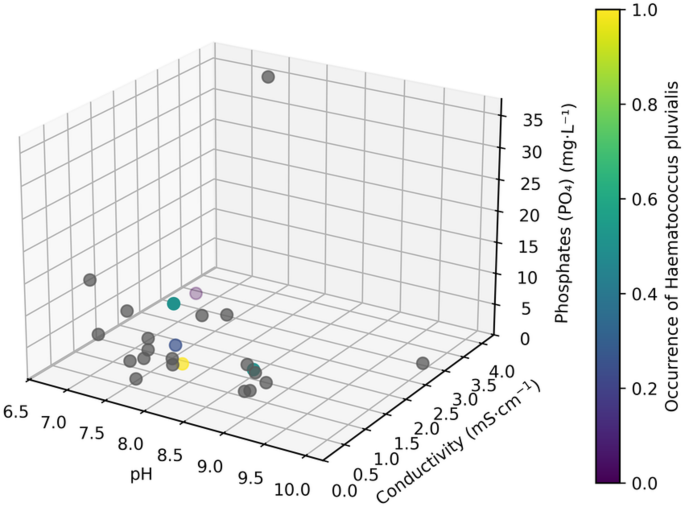
The influence of pH, conductivity and phosphates in surface waters on the occurrence of H. pluvialis.
Groundwater quality
The quality of shallow subsurface waters may reflect the influence of agricultural activities, including livestock production, fertilization, and manure storage. Although no occurrence of Haematococcus pluvialis was recorded in groundwater or well water at the studied locations, these waters were analysed to characterize physicochemical conditions under agricultural pressure and to compare them with surface waters. The absence of the alga in groundwater and well water may be associated with limited light availability, filtration processes in soil, and physicochemical conditions differing from those in surface waters. Waters occurring at the Q0 level are particularly susceptible to contamination from anthropogenic sources. Waters occurring at the Q0 level are particularly susceptible to contamination from anthropogenic sources.
Analysing the results of groundwater from piezometers in location F1, the highest values of most parameters were recorded at point P1, located near the fattening pig farm (Table 3). Due to the absence of other potential pollution sources in this area, the livestock farm likely represented an important local source of contamination. The recorded values differed substantially from groundwater quality ranges reported in national monitoring and literature data. The highest maximum values for several parameters were also recorded at points P1 and P2 (Table S11). In contrast, at point P4, the lowest mean values were recorded for most parameters (pH, conductivity, alkalinity, nitrite nitrogen, nitrate nitrogen, total nitrogen, and calcium).
Elevated nitrate concentrations were observed in the studied groundwater. Elevated concentrations of total phosphorus, total nitrogen, and potassium were observed particularly at points P1 and P2 compared with national monitoring data (Tables 3 and S12), suggesting substantial anthropogenic pressure.
Among the analysed wells, the highest mean values of the studied parameters were observed in well S1 (Table 4). The majority of parameters in S1 deviated from the results obtained in other wells, except for calcium, whose concentrations were significantly higher in wells S2–S5. The highest mean concentrations of total phosphorus and total nitrogen were observed in well S2. The terrain slope promotes the migration of biogenic compounds, and well S2 is located just downstream of this slope from the farm. Potassium concentrations in well S1 were sometimes up to 18 times higher than in the other wells and also exceeded the mean values reported in the national literature and monitoring data (Tables 4 and S13). Elevated potassium concentrations may reflect the influence of livestock production and manure storage.
Conductivity, phosphorus compounds, and ammonium nitrogen concentrations in several wells exceeded values reported in national monitoring data and selected literature reports (Tables 4 and S1337;). The physicochemical characteristics of wells S1 and S2 may indicate long-term infiltration of pollutants into deeper groundwater layers.
Compared with surface waters, groundwater and well waters generally showed lower concentrations of phosphates, nitrates, and ammonium nitrogen. The minimum and maximum values of the analysed parameters in well waters are presented in Table S14.
The absence of H. pluvialis in both groundwater and well water may be associated with limited light availability, filtration processes in soil, and physicochemical conditions differing from those in surface waters.
Rainwater quality
The quality of precipitation may reflect local environmental conditions and atmospheric deposition of pollutants. Intensive livestock production is associated with the emission of numerous compounds, particularly nitrogen compounds, which may influence ecosystem functioning and water quality.
The presence of algae in both rainwater and surface water suggests a potential local source of contamination. The observations suggest the possible influence of local emission sources. The presence of algae in rainwater is unusual but not unprecedented. It may result from the transport of algal cells or cysts via atmospheric processes, including wind dispersal and aerosolization. However, the relatively high frequency of occurrence observed in this study suggests the presence of local sources contributing to this phenomenon. Algae are used as a component of animal dietary supplements, as an additive to fish feed, and, to a lesser extent, poultry feed38,39. A nearby feed production facility may represent one potential source of the algae. However, the exact source of H. pluvialis could not be unequivocally confirmed and requires further investigation.
Comparing the studied points, some differences can be observed. The highest values for almost all analysed parameters were recorded at point R2. At point R1, on the other hand, the highest concentrations of potassium and calcium were observed. Ammonium nitrogen (N-NH4) concentrations were at similar levels at points R1–R3. At point R4, ammonium nitrogen concentrations in precipitation were about half as high. The highest phosphate concentrations in rainwater were recorded at points R2 and R3 (Table 5).
Comparison with national precipitation monitoring data for clean and moderately transformed areas in Poland showed that several analysed parameters exceeded the reported values (Tabs. S5 and S15), indicating substantial nutrient enrichment of precipitation waters in the studied locations.
Rainwater in locations F1 and F2 was characterized by high concentrations of ammonium nitrogen, potassium, calcium, sodium, and phosphorus compounds compared with national monitoring data for less transformed areas in Poland (Tables 5, S5, S6, and S15). The obtained results suggest substantial nutrient enrichment of precipitation waters and possible influence of local agricultural emission sources.
Conductivity values were also higher than those reported in national monitoring data, while maximum values of selected parameters were high for this type of water (Table S15). Overall, the results indicate substantial transformation of precipitation quality in the studied locations.
Occurrence of H. pluvialis and precipitation coloration
Rainfall analysis included both physicochemical and biological parameters. The coloration of precipitation also suggests water contamination. Due to the observed red-colored precipitation in the area, collected samples were analysed for the presence of algae. The precipitation color ranged from gray (sewage-like odor and color—R2) to pink (R1), red (R1, R4), yellow (R3), greenish-yellow (R3), and green (R1, R2, R3, R4) (Fig. 4). Analysis of the conditions (e.g., absence of industry) and the fact that the precipitation turned green after a few days suggested a biological origin of the coloration. The color change may reflect algal development under nutrient-rich conditions, as such nutrient-rich habitats are ideal for their development.
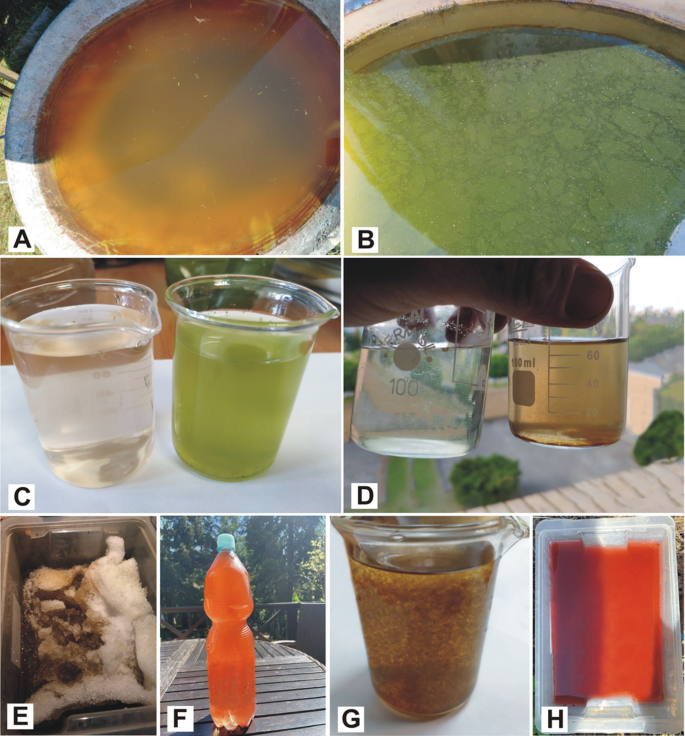
Water color under the influence of Haematococcus pluvialis: A—one-day precipitation in location F2; B—one-week precipitation in location F2; C—pink-colored precipitation at point R1 and green-colored surface water from pond W in location F1; D—pink-colored precipitation at point R1; E–H—color of rain and snow precipitation at point R1 in location F1.
Biological analysis were also conducted on water from the pond (WG) in location F1 and water from points on the Pogona River (PN1, PN2, D1, and D2). At point PN1, a red color of sediments and supernatant water was observed, with the crimson-red color persisting throughout the study period. Water samples revealed the presence of the rare alga Haematococcus pluvialis, a freshwater green microalga that produces the red carotenoid astaxanthin under stress (Fig. 5). The red coloration observed in precipitation and surface waters is likely associated with the accumulation of astaxanthin under stress conditions.

H. pluvialis in precipitation in area F1: A—R1; B—R2; C—R3.
Although Haematococcus pluvialis is not commonly reported in aquatic environments in Poland, its occurrence may be under-documented, particularly in ephemeral or small water bodies. Occurrences of red-colored precipitation associated with algae are rarely reported worldwide. Cases involving H. pluvialis were described in Spain in 2014, whereas other “blood rain” events reported from India and Sri Lanka were associated with algae of the genus Trentepohlia. In Poland, red precipitation has previously been linked mainly to Saharan dust transport.