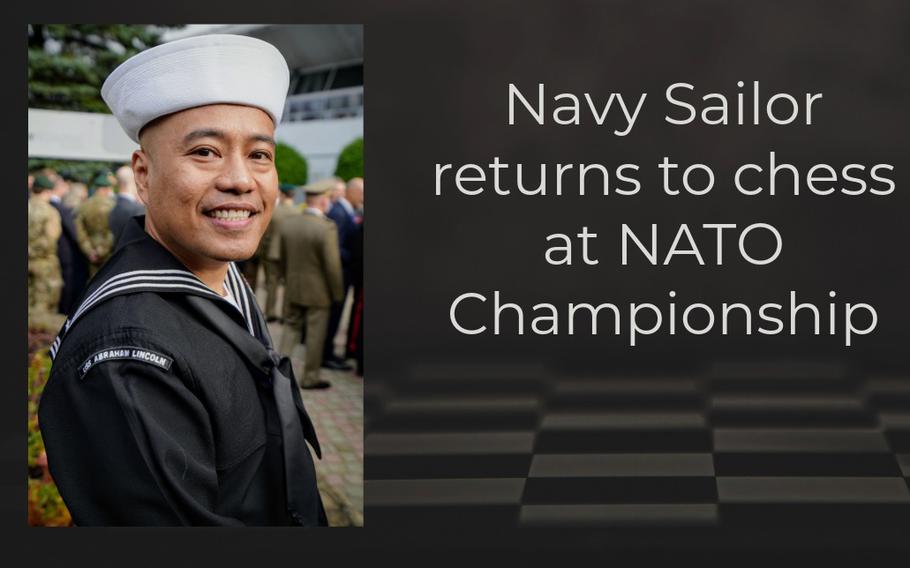
The rematch was a highlight for Balmaceda at the 2026 NATO Chess Championship in Latvia, where he represented the U.S. Armed Forces after returning from nearly 11 months aboard the aircraft carrier USS Abraham Lincoln. (Designed by Stripes Staff | Photo by Vladimir Lionter)
Six years after losing a chess game to the same opponent at an international military championship in Germany, U.S. Navy Petty Officer First Class Enrico Balmaceda got another chance at the board in Latvia. This time, he won.
The rematch was a highlight for Balmaceda at the 2026 NATO Chess Championship in Latvia, where he represented the U.S. Armed Forces after returning from nearly 11 months aboard the aircraft carrier USS Abraham Lincoln.
“I said, ‘I’ll play you again and do my best,’” Balmaceda recalled of his earlier encounter.

Six years after losing a chess game to the same opponent at an international military championship in Germany, U.S. Navy Petty Officer First Class Enrico Balmaceda got another chance at the board in Latvia. (Vladimir Lionter)
Months of demanding naval duties had left him with little time to practice. However, the competition offered an opportunity to return to a game he has played since childhood and to help his team against military players from other NATO nations.
“I will do my best here,” he said.
Balmaceda first learned chess from his father in the Philippines in 1989. He was also interested in billiards, but when his family was preparing to buy an acoustic instrument, he had another idea.
“Buy me a chess set.”
— Officer First Class Enrico Balmaceda to his father
His father encouraged the interest, sending him to a chess club and arranging lessons with a coach. What began as a childhood pastime eventually became a lifelong pursuit, taking Balmaceda to international competitions alongside his career in the Navy.
Today, he serves as an aviation boatswain’s mate (equipment), responsible for equipment used to launch and recover aircraft aboard carriers. The job requires precision and concentration in an environment where mistakes can have serious consequences.
Chess demands a different set of skills, but it also requires discipline, careful decisions and the ability to perform under pressure.
Finding time to play during his latest deployment, however, was difficult.
“It was stressful,” Balmaceda said of the deployment, which he described as a combat deployment. His primary responsibilities left little room for regular chess practice.
Although other sailors aboard the carrier knew how to play, they worked in different departments, making it difficult to arrange games.

Although other sailors aboard the carrier knew how to play, they worked in different departments, making it difficult to arrange games. (Leo Lintang (Adobe Stock))
“Practicing chess there is hard. I don’t have any opponent,” he said.
By the time he arrived in Latvia, Balmaceda was returning to competition after an extended break from regular play. Rather than setting high expectations, he planned to rely on his experience and take each game as it came.
“If I get lucky, why not, right?” he said.
The 2026 championship marked his ninth NATO chess competition. His first was held in Brest, France, in 2012. Since then, he has competed in military chess events in Canada, the Netherlands, England, the United States, Germany, Belgium and Estonia.
The COVID-19 pandemic interrupted the competition schedule in 2020, but Balmaceda continued participating in subsequent years. After the 2022 championship in Estonia, he received a lifetime membership.
“It’s an honor, of course.”
— Balmaceda said of competing internationally
Taking part requires more than a strong tournament record. Military personnel must also secure support from their commands to attend competitions away from their regular duties.
Balmaceda applied to join the U.S. team and submitted documentation of his previous tournament accomplishments to his command. Despite his lengthy deployment, he said, his command aboard the USS Abraham Lincoln supported his participation.

Balmaceda applied to join the U.S. team and submitted documentation of his previous tournament accomplishments to his command. (Vladimir Lionter)
“They fully supported me,” he said.
That backing gave him the opportunity to return to international competition and represent his country in a setting far removed from his daily responsibilities at sea.
In Latvia, Balmaceda’s focus was not solely on his individual results. He wanted to help the U.S. team perform well, approaching each game with the same emphasis on preparation and discipline that his Navy work demands.
His victory against the opponent he had faced in Germany in 2019 offered a personal reward after months away from regular chess. A single game does not decide a team championship, but the rematch gave him a chance to reverse an old result.
For Balmaceda, the purpose of competing remained straightforward: play well, contribute to his team and make the most of the opportunity to return to the board.
After nearly 11 months at sea, he was playing chess internationally again – and this time, against one familiar opponent, he came away with the win.