
The oil and gas crisis that the Iran war has triggered may have long-lasting effects, not least cementing a new wave of Chinese automotive investment abroad. EAI senior research fellow Bo Chen analyses the situation.
Add ThinkChina as a preferred source

The US aircraft carrier USS Abraham Lincoln returns home following an extended deployment in the Middle East to Naval Base Coronado in San Diego, California, US, on 8 October 2026. (Mike Blake/Reuters)
The war that began with the US-Israeli strikes on Iran on 28 February has dragged on for more than eight months through collapsed truces, a US naval blockade of Iranian ports and repeated Iranian attacks on shipping in the Strait of Hormuz. On the eve of the US midterms, explosions were reported on Qeshm and Hengam islands and near Bandar Abbas, and another US aircraft carrier is heading to the region. The risk of further escalation is growing.
The midterms, however, have changed the political calculus. The Republicans’ heavy losses on 3 November reflected mounting voter frustration with the administration, with the costs of an increasingly unpopular war and rising fuel and food prices adding to the backlash. The incoming Democratic majorities have pledged to wind the conflict down quickly. Though the new Congress will not convene until January, control of both chambers gives them power over war funding, oversight and war-powers resolutions, raising the political cost of escalation. Back-channel talks continue.
Financial markets have already responded: Brent crude fell more than 9% on 4 November, to about US$94 a barrel, and slipped below US$90 on 10 November. But Tehran insists American politics will change nothing, and the damage done to the region’s energy system cannot be undone by an election. Whether the war escalates or ends, its economic consequences will outlast the headlines.
Most commentary treats this as an oil shock. That understates the problem. Before the war, oil flows through Hormuz equalled about a fifth of global petroleum consumption, and about a fifth of global liquefied natural gas (LNG) trade, mostly from Qatar, took the same route. The effective closure of the strait has choked both. When Iran struck Qatar’s Ras Laffan complex, an oil crisis became a gas crisis too. QatarEnergy has extended force majeure month by month, with some buyers told that cancellations would run into December.
LNG is harder to replace than oil. Although some economies hold substantial gas inventories, storage capacity is geographically concentrated, and LNG requires specialised liquefaction, shipping and regasification infrastructure. The next large wave of LNG supply, much of it under construction in the US and Qatar, will mainly arrive from 2027. Until then, importers face spot purchases, rationing and a return to coal.

QatarEnergy’s Ras Laffan Industrial City LNG production facilities in Qatar on 2 March 2026. (Reuters)
Asia bears the brunt. About 83% of the LNG passing through Hormuz in 2024 went to Asian buyers. Japan and South Korea import almost all their energy; India is exposed through both crude and LNG, and Southeast Asia is a patchwork, with gas producers such as Malaysia and Indonesia partly insulated while import-dependent power systems in Singapore, Thailand and the Philippines are not. China, with abundant coal and a diversified energy mix, is the outlier.
Demand is making things worse. Winter heating demand is rising, while the rapid expansion of artificial intelligence (AI) has created a fast-growing and relatively inflexible source of electricity demand. Where renewable and nuclear capacity cannot expand quickly enough, gas-fired generation is increasingly called upon to power data centres. A leftward shift in supply is meeting a rightward shift in demand.
Every supply shock creates winners. Oil producers outside the Middle East, from the US and Canada to Brazil and Norway, benefit from higher prices and, where they have spare capacity, can increase production without facing the same risks to their shipping routes. US LNG exporters have also found eager buyers in Asia and Europe as countries seek alternative energy supplies.
Refiners can benefit too. When crude oil supplies are disrupted, supplies of refined fuels such as diesel and jet fuel can become even tighter, pushing up prices and allowing refiners with secure feedstock to earn bigger profits. For oil-importing countries, businesses and households, however, these gains come at a cost. Higher energy prices transfer income from those who buy energy to those who produce it, making the shock feel like a tax on everyone else. The actual impact also depends on who owns the energy assets, how governments tax or subsidise the gains, and how exchange rates move.
China, the world’s largest crude importer, has so far been hit less severely than many other economies. Its resilience is partly structural and partly cyclical.

Wind turbines at a wind farm operated by Beijing Energy Group, also known as Jingneng Group, in Zhangjiakou, Hebei province, China, on 8 May 2026. (Maxim Shemetov/Reuters)
The structural part begins with preparation. China entered the crisis with substantial crude inventories after significant stockbuilding through 2025 and early 2026. Although the scale of its strategic and commercial reserves remains opaque, these stocks have provided an important buffer. Decades of investment in substitution work through two channels. China installed about half of the world’s new wind and solar capacity in 2025, reducing its exposure to imported fuels in power generation, while rapid electric vehicle (EV) adoption is gradually weakening the link between growth and oil consumption, since transport is where most oil is burned. Abundant coal and large domestic refining capacity add further insulation.

The cyclical part is less flattering: weak domestic demand. After 2008, China’s four-trillion-RMB stimulus sent its energy appetite and world commodity prices soaring. Today, a property slump and subdued consumption have kept industrial energy demand in check. This is a problem for China’s growth, but it has inadvertently made China a stabiliser of global oil prices. Unlike its structural advantages, however, this is not a cushion Beijing should wish to keep.
As oil and gas prices soared, countries and consumers looked for alternatives and found them in China. Chinese exports of EVs, batteries and solar products rose about 70% year on year in March. Part of that surge was front-loading ahead of an export tax rebate change in April, and solar module shipments have since fallen below last year’s levels. But EVs and batteries have kept going: in August, EV exports rose 65% by value and lithium-battery exports 33%, and in September EV exports roughly doubled, though again flattered by shipments ahead of a further rebate cut next April. All this despite rising trade barriers.
When fuel becomes scarce, the case for a cheap battery electric vehicle (BEV) becomes a matter of household budgets, not ideology. Beyond cars and panels, the crisis could also accelerate demand for Chinese battery storage, power electronics and grid technologies, particularly in emerging Asian economies seeking greater energy security.

A drone view shows electric vehicles for export sitting at a port in Shanghai, China, on 13 April 2025. (China Daily, via Reuters)
History offers a parallel. The two Middle East oil crises of the 1970s were a turning point for Japanese carmakers, as American consumers who had dismissed small Japanese cars as cheap and flimsy suddenly wanted fuel-efficient Corollas and Civics. Once drivers experienced Japanese reliability, a crisis-driven purchase became a lasting preference. When trade frictions followed, Japanese automakers built factories in the US and Europe.
Chinese BEVs could follow a similar path. Many consumers buy them defensively, to escape fuel prices, but driving one is the real persuader: low running costs, instant acceleration and software that rivals far pricier brands. First-hand experience may overturn the stereotype of low-quality Chinese products, which is what would make demand outlast the crisis. And just as Japanese firms jumped tariff walls, BYD already assembles cars in Thailand and Brazil and is due to begin production in Hungary around the end of this year. A new wave of Chinese automotive investment abroad may be one of the war’s lasting legacies.
A credible reopening of Hormuz would bring prices down fast: Brent fell more than 10% in a single day when Iran briefly declared the strait open back in April. But market prices and physical capacity recover at different speeds, and two forces will keep energy prices above pre-war levels for some time.
The first is stocks. The longer the conflict lasts, the more inventories are drawn down and must later be rebuilt. China’s reserves are not bottomless; if the strait stays shut through winter, China too will eventually compete for scarce cargoes, removing the very stabiliser that has kept prices in check.
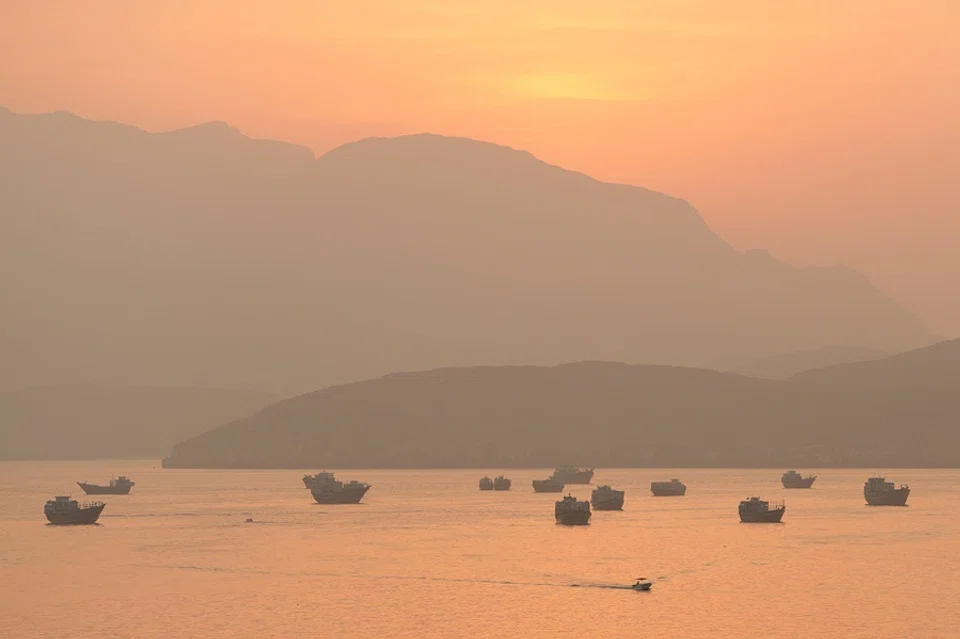
Vessels at the Strait of Hormuz, as seen from Musandam, Oman, on 12 October 2026. (Reuters)
The second is physical damage. Strikes on gas fields, liquefaction trains, terminals and shipping have destroyed capacity that takes months, sometimes years, to repair. A ceasefire would not restore lost supply overnight, especially for LNG, where spare capacity barely exists.
If disruptions persist through the winter, the world economy may experience the worst of this energy shock before it gets better. For central banks, that means another winter of cost-push inflation as growth slows: the uncomfortable trade-off of stagflation.
The US midterms have raised hopes that the war may soon end, but the economic damage has its own momentum: gas is at the heart of the shock, Asia is most exposed, and broken infrastructure will keep prices elevated after any ceasefire. For now, China’s stockpiles, green investments and weak demand have helped steady the world market. In the longer run, the deeper effect may be structural: just as the oil crises of the 1970s made Japanese cars a global standard, this crisis may make Chinese EVs and clean energy technologies the default choice for a world tired of paying for other people’s wars.