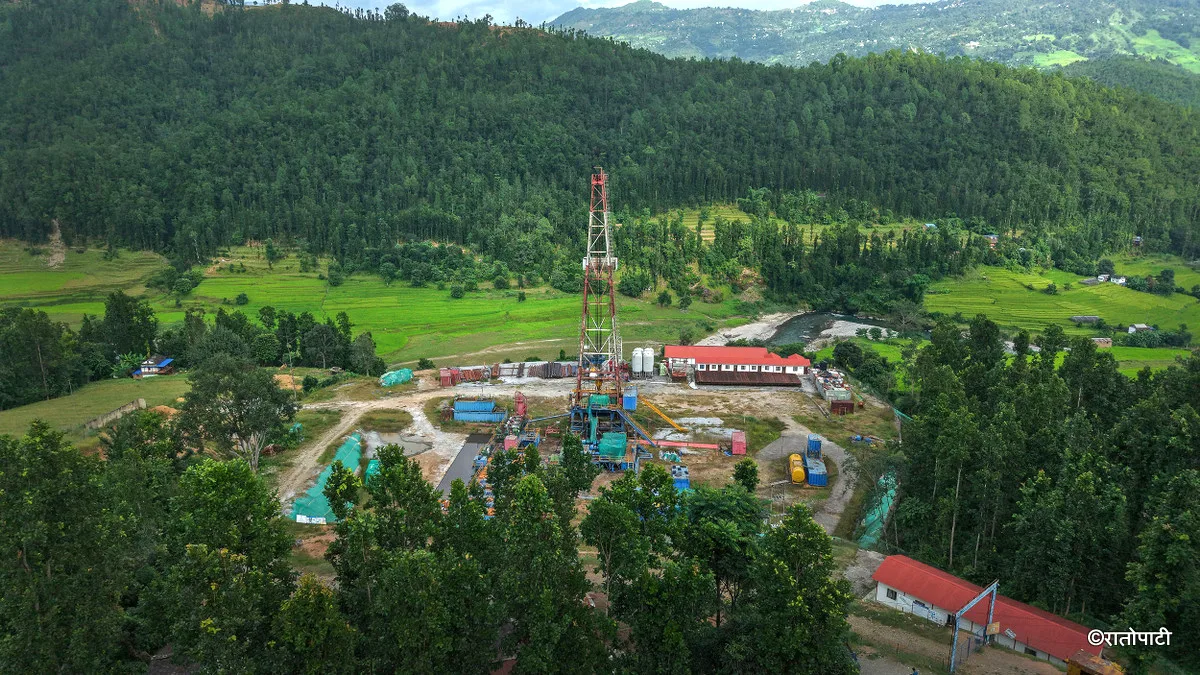
Kathmandu. Dailekh’s petroleum exploration project, seen as a potential reserve of petroleum products and natural gas in Nepal, has completed the first phase of work and is awaiting commercial excavation.
Under this project, operated with the economic and technical assistance of the Chinese government, a large reserve of natural gas has been confirmed through drilling in Jaljale, Bhairabi Rural Municipality-1, Dailekh.

The exploration of petroleum products in Dailekh began in 2019 under the collaboration between the Department of Mines and Geology and China’s ‘China Geological Survey’ (CGS). This project, based on the understanding reached between Nepal and China in 2016, is considered a historic and significant project in Nepal’s energy sector.
A formal agreement on petroleum exploration and excavation was signed between the two countries on February 28, 2019 (Falgun 16, 2075 BS). The project has been moving forward with the Chinese government providing approximately NPR 2.5 billion in grant assistance. Although the initial target was to complete the exploration within three years, the work was delayed due to obstacles such as the COVID pandemic, geographical difficulties, lack of road infrastructure, transportation of heavy equipment, and land acquisition.

In the first phase of the project, the Chinese technical team conducted studies including geological surveys, seismic surveys, magnetotelluric surveys, and geochemical sampling. Based on these studies, potential areas for petroleum products and natural gas were identified, and a drilling location was decided in Jaljale.
For this, approximately 45 ropanis of land were acquired in Bhairabi Rural Municipality-1, Jaljale, and necessary infrastructure was constructed. Subsequently, drilling began in May 2024, reaching a depth of 4,013 meters below ground. Soil and rock samples collected during drilling were sent to China for detailed testing.

80.70 Billion Cubic Meters of Natural Gas Reserve
According to the study report from the Chinese technical team, it has been confirmed that there is approximately 80.70 billion cubic meters of natural gas in the Jaljale area. Earlier preliminary studies had estimated the gas potential to be up to 112 billion cubic meters.

However, even with the identification of gas reserves, commercial production cannot begin immediately. The Department of Mines and Geology has stated that further technical testing is required to determine the quality, pressure, flow rate, and commercial extractability of the gas. Specifically, the actual potential for production and the necessary technology will only be finalized after ‘well testing’ is completed.
Preparation for Agreement for Second Phase of Work
Although the first phase of drilling and preliminary exploration is complete, the second phase of work has not yet progressed. The project’s pace has slowed due to delays in the necessary technical procedures for testing and further agreements with China.

According to the Nepal-China understanding reached in 2016 (2073 BS) and the agreement signed in 2019 (2075 BS), the Department of Mines and Geology had internally prepared to sign a second phase agreement with the ‘China Geological Survey’ in May 2026 (2083 BS) to move the project towards commercial production.
However, according to reports published in August 2026 (2083 BS), the expensive drilling machines and equipment installed in Jaljale have been left unused due to the inability to start the second phase of work. Local businessmen say that some equipment has even started to rust. A clear timeline for when the second phase of work will begin has not yet been made public.

What Impact Would Commercial Production Have on Nepal’s Economy?
If commercial production of natural gas is possible in Dailekh, it is expected that Nepal can save a significant amount of foreign currency spent annually on importing fuel and gas. The excavated natural gas can be used as cooking fuel (an alternative to LPG), for operating industries, for electricity generation, and for other industrial purposes.

Similarly, if commercial production begins, it is highly probable that economic activities in the entire Karnali Province, including Dailekh, will become dynamic, creating employment opportunities, developing local infrastructure, and attracting foreign investment. However, this requires the construction of large infrastructures such as gas processing plants, storage, transportation, and distribution systems.
Although studies so far indicate a significant reserve of natural gas in Dailekh, its commercial production feasibility still needs to be confirmed through further testing.

Therefore, the main challenges for the Dailekh petroleum project at present are completing the additional technical tests required for excavation, materializing the second phase agreement between Nepal and China, and determining a clear action plan for commercial production. This project, which has been limited to exploration for years, is now awaiting the government’s high political initiative and necessary investment to enter the actual production phase.

Photo: Prakash Chandra Timilsena/Nepal Photo Library