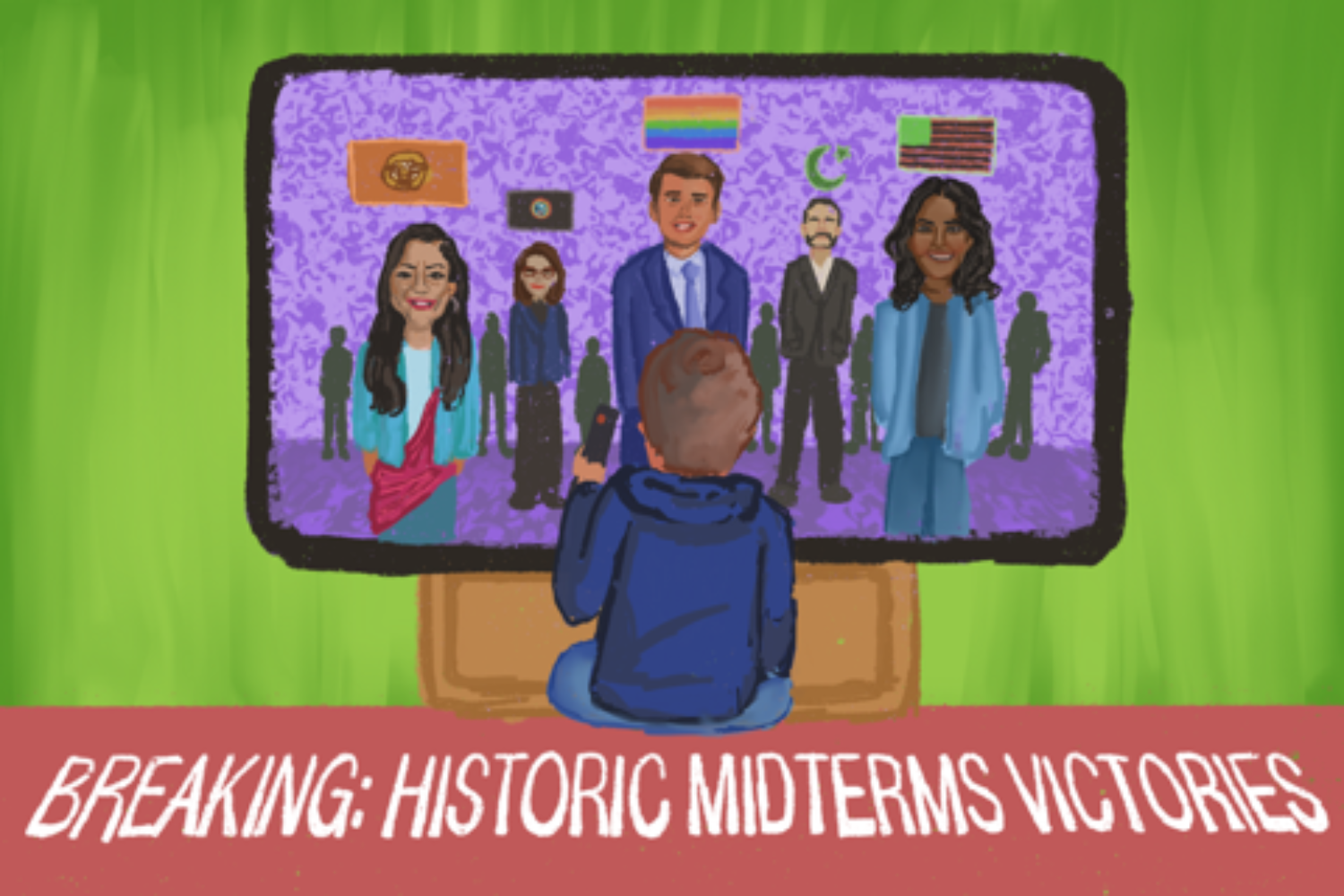

A young viewer watches news coverage of historic victories in the 2026 midterm elections, seeing people from historically underrepresented communities take positions of political leadership. Greater representation in government can help young people recognize that their voices and backgrounds belong in politics.
The 2026 midterm elections marked a series of historic firsts in American politics, with candidates from historically underrepresented backgrounds winning seats across the nation. For communities long excluded from positions of power, this new wave of political diversity could influence not only government decisions but also how minority groups view their place in American politics.
Currently, only 26% of Americans agree that the government includes people with backgrounds and experiences similar to their own, according to a Kettering Foundation study. As record numbers of women and candidates of color prepare to take office, students, educators, and researchers say representation can shape whose experiences are considered in political decisions — and who feels empowered to participate.
Historic firsts
Among the victories, Georgia elected Keisha Lance Bottoms as the first Black woman governor in the United States, while New Mexico elected Deb Haaland as the first female Native American governor. In the Senate, Michigan’s Abdul El-Sayed became the first Muslim elected to the chamber, and Minnesota’s Peggy Flanagan became the first Native American woman elected to the Senate.
Overall, the election brought record levels of representation. According to the Center for American Women and Politics at Rutgers University, at least 160 women, including 31 Black women and 26 Latinas, will serve in the 120th Congress, each a new record. These victories, among others, brought people from historically underrepresented communities into some of the country’s highest political offices.
For Carlmont juniors Alina Robinson and Lea Harris, the results carried significance beyond the historical milestones themselves.
Robinson, a Black and Mexican student involved in Speech and Debate and Mock Trial, said the election of leaders such as Bottoms and California Gov.-elect Xavier Becerra gave Robinson role models whose backgrounds reflected her own.
“It shows that even as a minority, you can still thrive in areas where you haven’t historically been accepted and make space for yourself there,” Robinson said.
For Harris, a Navajo student, the election of Native American women to prominent political positions was especially meaningful. Seeing women like Haaland and Flanagan reach positions of political influence represented progress for a community that has long been underrepresented in government.
“Native Americans having a voice in politics is beautiful because we’ve been silenced for so long,” Harris said. “Our land has been taken, and our people have been disrespected for hundreds of years.”
Barriers to representation
Although the election results marked progress in who holds political office, they also highlighted the barriers that have historically limited political participation among minority communities.
Mindy Romero, founder and executive director of the Center for Inclusive Democracy, a research organization focused on political participation, said disparities in voter turnout and political outreach contribute to whose voices are represented in government.
“Campaigns often focus their outreach on people who are already more likely to vote, leaving younger voters and voters of color with fewer opportunities to engage,” Romero said.
The voting process itself can also be difficult for young people to navigate, particularly when schools do not consistently teach students the practical steps involved in registering and voting.
“Young people, when they turn 18, don’t oftentimes know how to vote and don’t think voting matters,” Romero said. “This often earns young people the label of ‘apathetic,’ further suppressing the youth vote. In reality, youth just haven’t been properly educated on voting.”
Similar disparities affect voters of color, who can face unequal access to political outreach and engagement opportunities.
“Currently, the U.S. has an inequitable outreach landscape, which means the voter outreach models, like emails and campaign messages, target similar types of people and generally ignore younger voters and voters of color, since they are statistically less likely to vote,” Romero said.

These gaps can affect more than election outcomes. When certain communities are less likely to participate in the political process, their concerns and experiences may be less visible to policymakers and politicians.
Greer Stone, a Carlmont Advanced Placement Government teacher and current vice mayor of Palo Alto, said representation depends not only on who is elected, but also on who has the opportunity to participate in political decision-making.
“Being a good leader means not just listening to those who show up. It’s important to listen to those who don’t feel comfortable voicing their concerns or interests,” Stone said.
When certain groups are underrepresented in the electorate, it can be difficult for them to overcome existing barriers to political participation.
“Representation and diversity can be challenging because ultimately, it’s a lot harder for minority people to hold high offices,” Stone said. “It’s important that we create pathways for people from diverse backgrounds to seek these jobs and elected positions.”
Beyond barriers to voting and political outreach, underrepresentation and alienation can influence whether people from minority communities see politics as a space where they belong.
“I’ve seen many in my and other minority communities believe that getting into politics is unrealistic; maybe they’re scared that they wouldn’t be respected if they stepped into politics because of their voice, skin tone, or features — so having a space where differences are celebrated will help promote engagement in politics,” Robinson said.
The power of representation
For younger generations, increased diversity in political leadership can also change how they view their own opportunities to participate in government.
According to a UNICEF poll, while 82% of young people believe their generation can make a difference in politics, only 30% feel included in the political process.
“Seeing people with similar backgrounds in positions of political leadership has made me recognize my own potential in politics and government, showing me that there is a space for minorities like me,” Robinson said.
“
Seeing people with similar backgrounds in positions of political leadership has made me recognize my own potential in politics and government, showing me that there is a space for minorities like me.
— Alina Robinson
Harris also emphasized the importance of representation, describing the election results as inspiring for young Native Americans who may not often see people from their communities in positions of national leadership.
“When you see someone who looks like you and shares your background out there doing amazing things, it’s really motivating,” Harris said. “Not to be dramatic, but when I found out about the results, I almost started crying. It’s amazing to see all the progress being made for minorities.”
Beyond the impact on individual students, diverse representation can bring a wider range of perspectives and experiences into government.
“It’s important to have a diverse group of elected officials because they bring a myriad of perspectives, interests, and experiences to the table,” Romero said.
However, Romero emphasized the importance of not letting someone’s identity fully influence a decision.
“Voters should still evaluate candidates as individuals, considering their qualifications, knowledge, and ability to serve their constituents rather than relying solely on their backgrounds,” Romero said.
“
Voters should still evaluate candidates as individuals, considering their qualifications, knowledge, and ability to serve their constituents rather than relying solely on their backgrounds.
— Mindy Romero
Overall, representation can influence how young people like Harris and Robinson imagine their futures, both in politics and beyond.
“The diversity brought by the 2026 midterms will be really powerful,” Stone said. “These results show that in the United States, anything is possible regardless of your background, as long as you embrace and celebrate your identity.”
Beyond its impact on individual communities, the election milestones represent an important step for American democracy.
“Regardless of your political affiliation, the recent milestones in the 2026 midterms are very exciting and a great thing for democracy. It’s equally amazing and important to have elected leaders be more representative of the population,” Romero said.