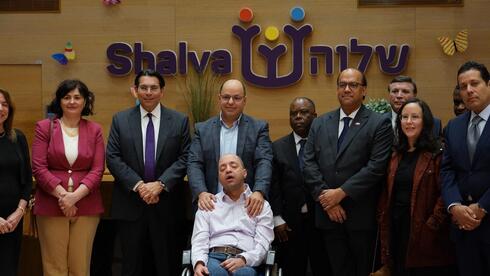
A delegation of 26 ambassadors to the United Nations visited the Shalva National Center in Jerusalem on Sunday, meeting people with disabilities and learning about the Israeli organization’s work to promote independence and inclusion. The visit, organized by the Foreign Ministry and led by Israel’s UN Ambassador Danny Danon, formed part of a five-day tour intended to introduce foreign diplomats to different aspects of Israeli society.
The delegation included ambassadors from Albania, Argentina, Armenia, Botswana, Bulgaria, Costa Rica, the Czech Republic, the Dominican Republic, Ecuador, Georgia, Paraguay, Samoa, Slovenia, Tanzania, Trinidad and Tobago, and Tuvalu, among other countries. For several participants, it was their first visit to Israel.

26 UN ambassadors visit Shalva with CEO Yohanan Samuels and Yossi Samuels
During their stay, the diplomats are scheduled to meet President Isaac Herzog, Prime Minister Benjamin Netanyahu and other senior figures from Israel’s political, economic and public sectors. Their itinerary also includes communities near the Gaza border, the site of the Nova music festival massacre on October 7, 2023, and religious and historical sites in Jerusalem.
The visit to Shalva offered a different perspective from the delegation’s diplomatic and security-focused engagements. The ambassadors toured the organization’s facilities and learned how its programs help children and adults with disabilities develop skills, achieve greater independence and participate more fully in society.
Founded in 1990 by Kalman and Malki Samuels, Shalva has grown from a small family initiative into a national organization serving thousands of people with disabilities and their families. Its Jerusalem center provides therapeutic and rehabilitative services, educational programs, sports and recreational activities, vocational training and support for independent living.
One of the visit’s most personal moments came when the ambassadors met Yossi Samuels, whose life inspired his parents to establish the organization. Samuels lost his sight and hearing following a medical incident during childhood, an experience that led his family to recognize the need for more comprehensive services and support for children with disabilities. What began as their response to his needs eventually developed into one of Israel’s leading organizations in the field.
The Foreign Ministry has increasingly incorporated visits to Shalva into its programs for international delegations. According to the organization, more than 100 delegations from around the world have visited the center over the past year, as part of efforts to encourage cooperation and the exchange of knowledge on disability care and inclusion.
Yohanan Samuels, Shalva’s CEO, said the ambassadors’ visit was an opportunity to present an aspect of Israeli society that receives less attention in international diplomatic discussions.
“At a time when Israel is at the center of international attention, it is especially important for us to introduce leaders and representatives from around the world to another side of our country: Israeli society at its best, its spirit of mutual responsibility and generosity, and its conviction that every person, regardless of disability, has a place and the opportunity and right to live a full and meaningful life,” he said.
Samuels emphasized that the center’s mission extends beyond providing treatment and rehabilitation.
“SHALVA is far more than a therapeutic center. It represents the kind of society we aspire to build: one that embraces everyone, provides equal opportunities and, above all, sees the person before the disability,” he said.
He expressed hope that the ambassadors would leave with a deeper understanding not only of Shalva’s work but also of Israel’s efforts to expand opportunities for people with disabilities.
The organization said the visit was intended to encourage further international cooperation in disability services and demonstrate how programs developed in Israel could contribute to improving the lives of people with disabilities and their families elsewhere.