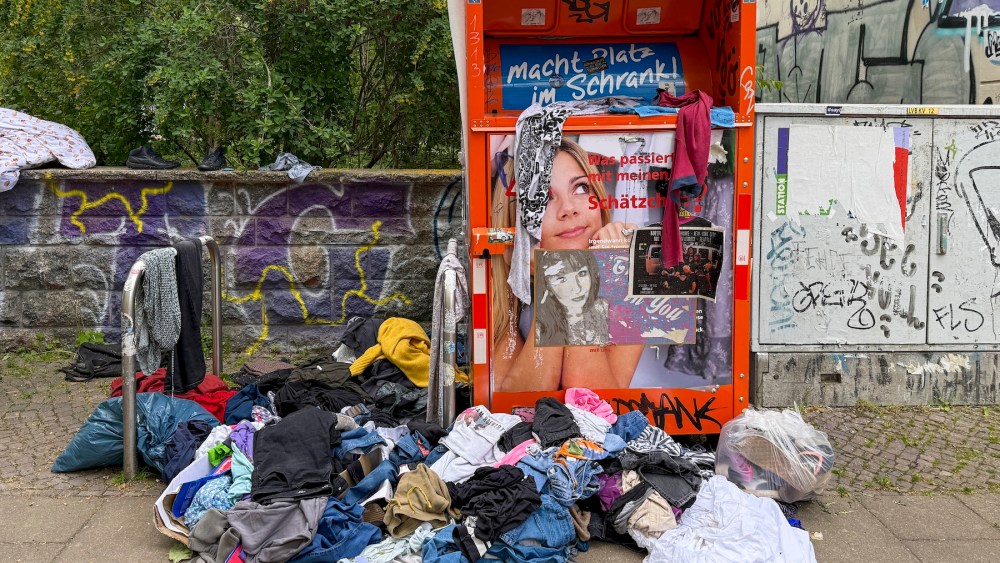
The European Union recorded 2.3 million metric tons of textile waste in 2024, with households accounting for more than half, according to figures released by Eurostat.
The bloc reported treating 1.4 million metric tons during the same year, a volume equivalent to 63 percent of reported generation, per the EU statistics agency. Recycling accounted for 78 percent of the treated total.
The reporting year predates the EU-wide requirement for separate textile waste collection, which took effect last year. Countries are also preparing extended producer responsibility (EPR) systems that will require textile and footwear producers to help finance the management of discarded products.

Textile waste generated and treated in the EU, 2024.
Eurostat
The figures come with an important limitation: Generation and treatment totals do not track the same waste from disposal to its final destination. Eurostat’s methodology counts waste generated within each country and waste treated within its borders, including imports and excluding exports. Handling delays, weight losses and changes in waste classification can also affect the comparison.
That means the difference between the two cannot establish how much textile waste went untreated.
Italy reported the largest volume generated, at 441,736 metric tons, followed by France at 339,965 and Germany at 212,107.
Among treated textiles, incineration with energy recovery accounted for 13 percent, landfilling for 8 percent and incineration without energy recovery for 1 percent. Together, recycling and energy recovery accounted for 91 percent of treatment.
Italy and France each reported recycling 98 percent of the textile waste they treated. Eurostat noted that Swedish and Maltese treatment data were confidential and that Romania’s figures referred to 2022.
The tally also provides a partial picture of discarded textiles. Eurostat’s textile waste category includes used clothing, textile packaging and waste from fiber and leather processing. Textiles discarded in mixed household waste are recorded under broader mixed-waste categories.
Textile waste treatment by type of recovery and disposal, 2024.
Eurostat
In May 2024, the European Environment Agency (EEA) estimated that the EU generated 6.95 million metric tons of textile waste in 2020, including textiles discarded in mixed household waste; however, that broader estimate cannot be used alongside the new figure to calculate a change in total textile waste.
Nor does the recycling share establish how much material became new clothing or fabric. Eurostat defines recycling as reprocessing waste into products, materials or substances for its original purpose or other uses.
The revised Waste Framework Directive, which entered into force in October 2025, requires member countries to establish producer responsibility schemes for textiles and footwear. Producers’ fees will fund collection and subsequent management, including preparation for reuse, recycling and disposal, with charges adjusted according to criteria such as durability and recyclability.
Member countries must transpose the revised directive into national law by June 17, 2027, and establish the schemes by April 17, 2028.