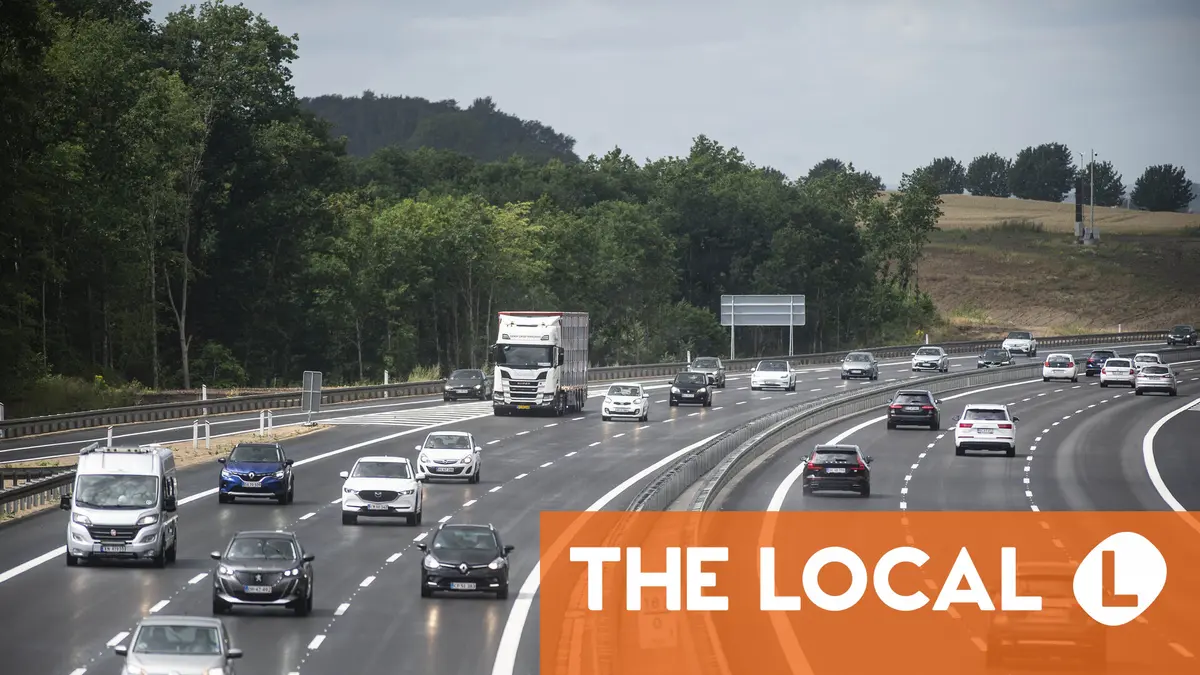
Denmark has agreed on a new ‘rescue corridor’ rule on motorways when traffic is moving slowly, designed to make it easier for emergency vehicles to arrive at the scene of an accident.
Under the new rule, when traffic slows to below 10 kilometres an hour, drivers must move to one side to create a “rescue corridor” for emergency vehicles to pass.
What exactly should I do?
Once traffic slows to 10km/h, you should start thinking about creating the “rescue corridor”, according to Denmark’s Road Directorate.
Note that this is only if traffic slows down on the whole motorway, not just in one lane.
This means that if you’re in the leftmost lane, you should keep left. Otherwise, keep right, so that you create a ‘corridor’ for emergency vehicles to pass through.
You don’t need to actually change lane, just move to the edge of your lane so that there’s a gap between the leftmost lane and the lane in the centre. It’s ok to cross over a line into the central reservation or the hard shoulder (emergency lane) if needed.
See the graphic below for an idea of how it works.

A graphic from the Road Directorate on how the rescue corridor works. The text reads ‘rescue corridor on the motorway: let assistance pass”. Graphic: Road Directorate
You should stay in your car, even if traffic stops completely, and keep the “corridor” open until traffic starts to speed up again.
These rules apply no matter how many lanes there are on the motorway.
If you’re near a sliproad or motorway entrance/exit it’s a good idea to make sure you aren’t obstructing the entrance to the motorway, if emergency vehicles need to use the sliproad to access. Leave some space between your car and the car in front if needed.
You can also tune into P4 Trafikradio for more information, although this will be in Danish.
Should I do this every time I see an emergency vehicle on the motorway?
Firstly, you should create a “rescue corridor” whether you can see an emergency vehicle or not as soon as traffic slows down to a crawl or stops – this is so emergency services can reach the scene of an accident immediately if needed.
If, however, traffic is moving at a normal speed and you spot an emergency vehicle approaching, then you should just give way to the emergency vehicle as you usually would – slow down, move to the right, if you can, and let the vehicle pass on the left.
What happens if I don’t follow this rule?
The worst-case scenario is that you are issued with a fine, although according to Danish police it seems like there will be some leeway for people who genuinely were not aware of the rule.
“Obviously there could be a driver who doesn’t understand the rule,” Steen Harpsøe, police inspector with the national police told the Ritzau news wire. He did, however, add that there is “no doubt” that a driver who is clearly trying to skip the queue by cutting through the ‘corridor’ would be fined.
It’s likely that other drivers on the road will start to create a corridor for emergency vehicles if traffic slows down enough, so if in doubt, follow their lead.