
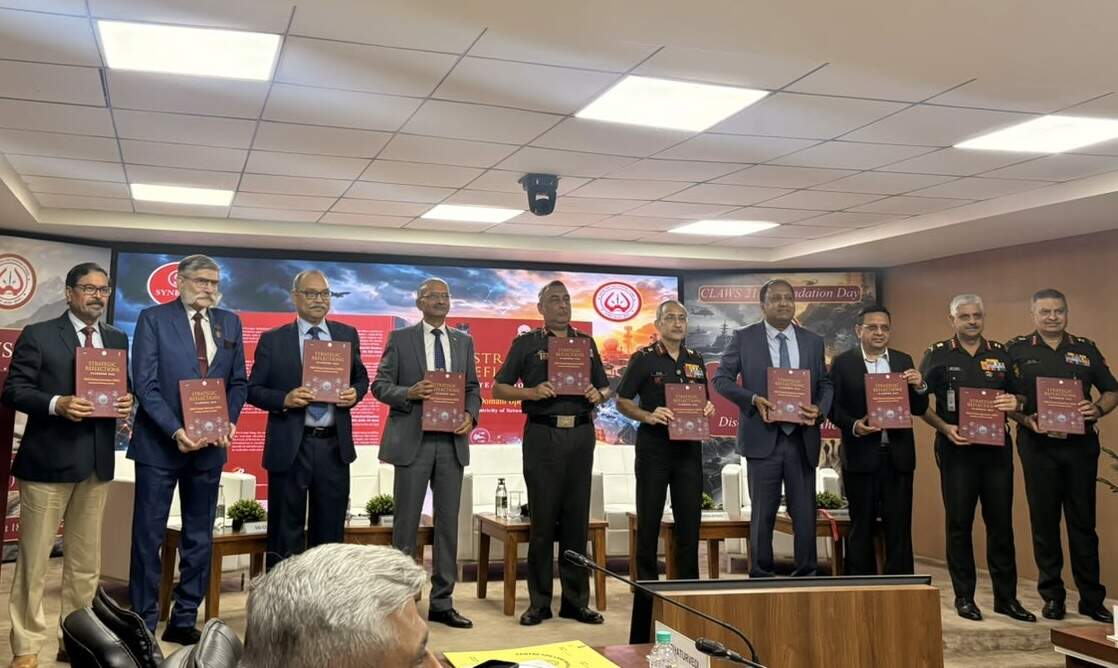
 Dignitaries at the 21st Foundation Day celebration of CLAWS
India must focus on developing enduring strategic capabilities rather than relying on temporary opportunities created by geopolitical conflicts, as intensifying competition over critical technologies, industrial supply chains and strategic resources reshapes the global security and economic environment.This was among the central themes discussed at a high-level roundtable titled “Resilience in Disorder: The Way Ahead,” jointly organised by the Centre for Land Warfare Studies (CLAWS) and Synergia Foundation in New Delhi on November 18. The event brought together senior defence veterans, diplomats and strategic affairs experts to examine India’s preparedness for an increasingly fragmented international order and the policy choices required to strengthen national resilience.The discussions addressed the implications of geopolitical competition, technological disruption, economic fragmentation and emerging security challenges for India’s long-term strategic interests. Participants examined how India could reduce vulnerabilities in critical sectors while maintaining the economic competitiveness and diplomatic flexibility necessary to navigate changing global power equations.
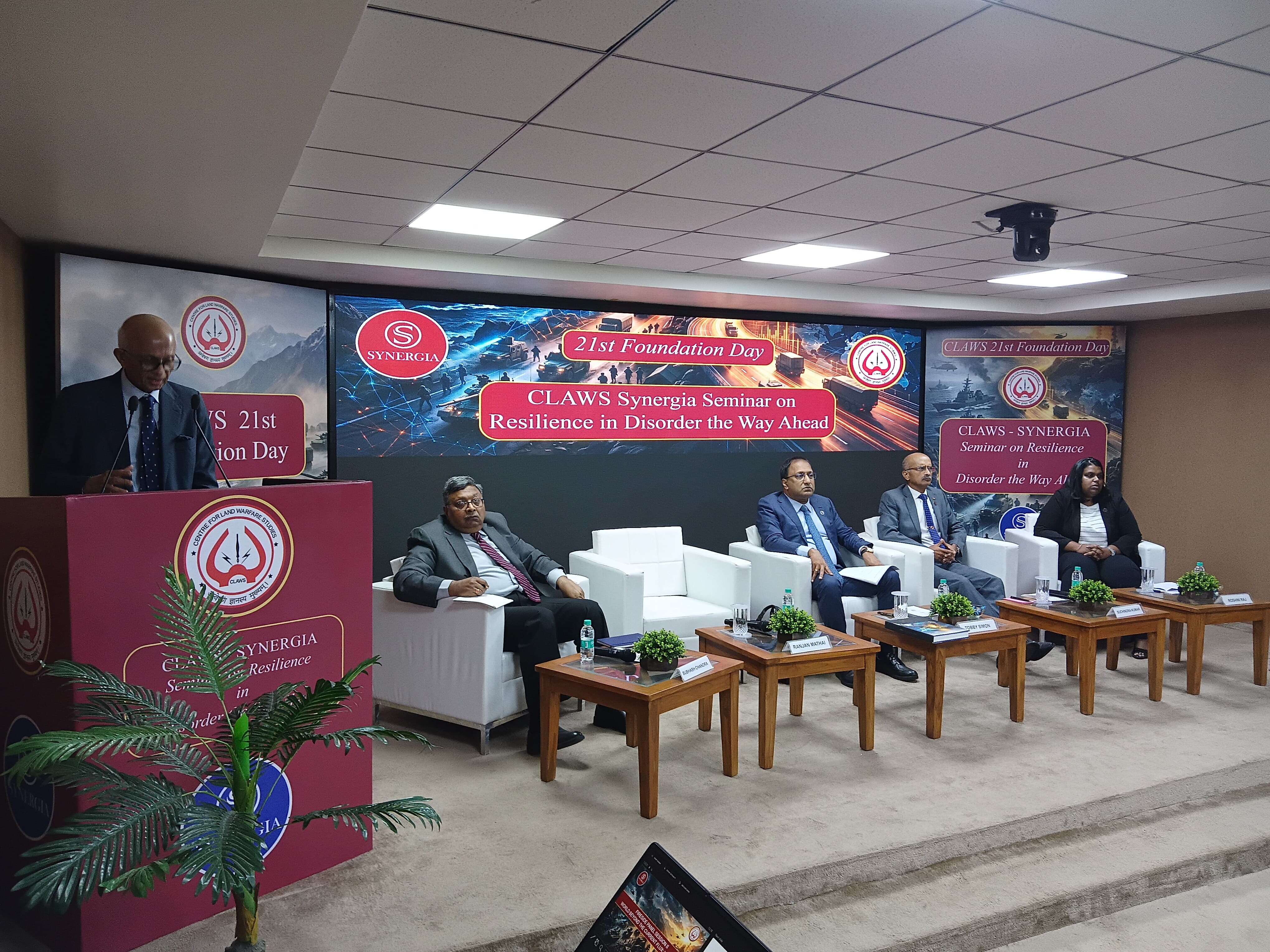 Senior military leaders, diplomats and strategic experts at the Synergia Foundation–CLAWS roundtable in New Delhi, where discussions focused on India’s strategic resilience, technological capabilities and economic security amid growing global uncertainty.
The roundtable featured two thematic sessions, “Living with Disorder: Resilience for a World That Won’t Reorder” and “World Beyond the Current Flux: Way Ahead.” The keynote address was delivered by Lt Gen Sandeep Jain, AVSM, SM, Vice Chief of the Army Staff.The second session was chaired by Subhash Chandra, IAS, former Secretary, Department of Defence Production. The panel included Ambassador Ranjan Mathai (Retd), former Foreign Secretary; Lt Gen Suchindra Kumar (Retd), former Vice Chief of the Army Staff and Army Commander; Tobby Simon, Founder and President, Synergia Foundation; and Roshini Raj, Senior Research Associate, Synergia Foundation.Addressing the discussion, Tobby Simon emphasised that India’s strategic planning must distinguish between opportunities arising from temporary geopolitical disruptions and capabilities that deliver lasting economic and security advantages.“India should sell dependable capability and buy selective freedom of action,” Simon said, outlining an approach that prioritises domestic technological strengths, reliable industrial capabilities and strategic partnerships that enhance India’s ability to make independent policy choices.His observations came against the backdrop of growing international competition in semiconductors, critical minerals, advanced technologies and alternative supply chains. Governments across major economies are investing heavily in strategic industries to reduce external dependencies and protect themselves against disruptions arising from geopolitical tensions.Simon argued that India must ensure that investments in these sectors create capabilities that remain commercially and strategically relevant even when international tensions subside. Building domestic expertise, protecting critical technologies and developing competitive industrial ecosystems would be essential to strengthening India’s long-term strategic position.The discussion also examined the economic risks associated with policies designed to achieve greater strategic self-reliance.Roshini Raj cautioned that efforts by individual countries to reduce external dependencies could generate new economic vulnerabilities if they resulted in excess industrial capacity, prolonged government subsidies or investments that lacked commercial viability.“What if the next instability comes from our solutions to this one?” Raj asked, drawing attention to the possibility that measures intended to address current geopolitical risks could themselves become sources of future economic disruption.She observed that geopolitical competition could create opportunities for countries to attract investments, develop alternative supply chains and strengthen domestic manufacturing. However, such opportunities needed to be assessed against long-term economic fundamentals rather than the immediate advantages created by international tensions.“The real test of India’s strategic investments is whether they remain valuable through confrontation, competition and accommodation,” Raj said.Her remarks highlighted a central challenge confronting policymakers: balancing national security requirements with economic efficiency. While strategic industries may require government support to overcome technological and supply-chain dependencies, their long-term sustainability depends on innovation, productivity and the ability to compete in international markets.The participation of former Foreign Secretary Ambassador Ranjan Mathai and former Vice Chief of the Army Staff Lt Gen Suchindra Kumar brought diplomatic and military perspectives to the wider discussion on India’s strategic choices. The panel examined how changing geopolitical alignments, emerging security threats and economic interdependence are influencing national security planning.The discussions also drew attention to the increasingly close relationship between economic competitiveness and national security. Access to advanced technologies, critical raw materials, manufacturing capabilities and resilient supply chains has become an important determinant of strategic influence, alongside conventional military strength and diplomatic engagement.For India, the challenge is to strengthen domestic capabilities without compromising its ability to participate in international markets and technology partnerships. Reducing critical dependencies, diversifying supply chains and building competitive industrial capacity are therefore emerging as interconnected economic and security priorities.The roundtable concluded with an emphasis on long-term strategic planning, stronger institutional preparedness and closer alignment between India’s defence requirements, technological development and economic policies.The discussions reinforced the argument that India’s resilience in an uncertain international environment will depend not simply on its ability to respond to immediate geopolitical disruptions, but on developing sustainable capabilities that preserve its strategic autonomy and economic competitiveness across changing global circumstances.