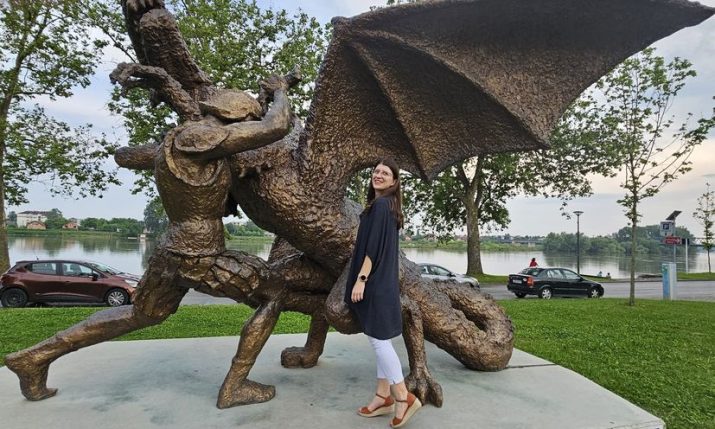

Anamarija in her hometown of Slavonski Brod with sculpture of knight Relja with dragon from Ivana Brlic Mazuranic’s fairytale (Photo: Private album)
Anamarija Mraz, a Croatian-Australian author living in Perth who writes under the pen name Mary-Anne Frost, is drawing on childhood memories, family traditions and the stories of her grandmothers to introduce international readers to the world of Slavic folklore.
Born in Slavonski Brod in eastern Croatia, Mraz grew up surrounded by traditional fairytales and oral storytelling. Her grandmothers were passionate storytellers, passing down tales that had been shared through generations but never written down.
Her debut novel, Pepelina, The Slavic Cinderella, is a reflection of that upbringing and an attempt to preserve the storytelling traditions that shaped her childhood.
The folkloric fairytale reimagines the familiar Cinderella story through Slavic mythology, village traditions and folklore, following a creative young woman who discovers the power of storytelling and finding her own voice.
We spoke to Anamarija about her childhood in Slavonski Brod, the stories passed down by her grandmothers, her journey from Croatia to Australia, and her inspirations.
What are your strongest memories of growing up in Slavonski Brod?
I have so many beautiful memories of growing up in my hometown. I wish I could write down every single one! My favourite has always been Christmas. My surname, Mraz, means “frost” or “ice” in English, so snow and December hold a very special place in my heart.
Winter itself was pure magic. Dad pulled us on the sleigh, we built snowmen and had snowball fights, and we wore socks over our boots so we wouldn’t slip on the icy roads to school. I remember going with Dad and my brother to choose our pine tree, later decorating it together, and having a little sip of mulled wine on Christmas Eve. The house smelled of roast pork, the table was full of green cabbage salad and French salad, Christmas music played, and we were surrounded by cousins, uncles, aunties and grandparents.

With her grandmother, great grandmother, grandfather and older brother (Photo: Private album)
I was blessed to grow up celebrating both Catholic and Orthodox Christmas. My maternal grandfather was Orthodox, so I have many happy memories of celebrating Slava and Orthodox Christmas: the flame of the homemade braided candles, the sweet, boiled wheat, the coin hidden in the homemade bread, finding lollies and walnuts in the hay beneath the Christmas tree, and my grandmothers telling stories by the warm stove where cats usually slept on the firewood.
What stories did your grandmothers tell you, and do you remember a particular one?
It has been a very long time, and I don’t remember the exact titles, but three stories were always my favourites.
The first was the fairy tale of the fisherman and the golden fish. My grandparents’ house is in the village of Poljanci, near Slavonski Brod, close to the River Sava, where there were plenty of river fish. My cousins and I would play by the river, and every time I saw a fish of any kind, I would make a secret wish. As a child, I think the story fascinated me because you could only watch the fish, never keep it, because it would never survive away from the water. It was a great lesson about greed, and about how much you can take before you pay the cost.
The second was Hansel and Gretel, though my grandma called it Ivica i Marica. It’s still one of my favourites, because I have one older brother, Darko. We are incredibly close and always support each other, and that story reminds me that having a brother you can rely on through thick and thin is one of my life’s biggest blessings. To this day, I remember that when Darko went out with our parents as a little boy, he would never take a sweet, a lolly or a chocolate unless he could take one for me too. He would politely ask, “May I have one for my sister?” We both loved Zvečevo’s Seka i Braco chocolate. I guess that’s why my brother and I love sweets so much, just like Hansel and Gretel!
The third is probably my favourite, although I don’t remember its name. It was about a three-headed, fire-breathing dragon who demanded young, beautiful maidens from the villagers as offerings to keep the village safe. He hoarded gold in his tall tower and sacrificed many maidens. Finally, he captured a princess who was kept prisoner until a brave prince came to save her. When I searched for it later, I found it comes from Russian folklore and has many names, because it was always passed down orally. What fascinates me about it is the classic idea of a princess waiting for her true love to rescue her, when, as most girls know nowadays, we must save ourselves, even if we do have the prince!

Confirmation day – with her late father (Photo: Private album)
How old were you when you moved to Australia? What were your first impressions?
I was 22 when I moved to Western Australia with my mum, dad and older brother. My first impression? Enchantment. That’s the only word for it!
We stayed in the port city of Fremantle for a short time when we first arrived. As a huge lover of history, I loved Fremantle’s heritage feel, especially the many buildings built from limestone. Fremantle is artsy and creative, full of soul and vibrant colour, and I felt drawn to it, even though it was all a bit overwhelming.
I also fell in love with the coast. I still remember my first coastal drive: walking down the wooden staircase to the beach, stepping onto the warm sand, and dipping my fingers in the ocean for the very first time. The water was freezing, and I thought, “This is definitely not the Adriatic, this is the Indian Ocean!” Then I laughed and thought, “Who would have imagined that a girl from Eastern Slavonia, who saw the Adriatic only once a year, would one day feel the Indian Ocean on her hands?”
But what impressed me most about Perth was Kings Park, overlooking the Swan River. When I saw the giant boab tree, I thought, “WOW, this is what magic looks like!” I’m a girl from Slavonski Brod, and I truly love our birch and oak trees (I’m a big tree hugger!), but I fell in love with the boab at first sight. It reminded me of The Lion King, which I watched over and over with my brother and cousins. The boab, Gija Jumulu, was a gift from the Gija people of the East Kimberley and was moved to Perth because of roadworks. For me, it has become an enduring symbol of my own migration journey, and it was the first thing I truly connected with when I arrived in Perth.
Looking at its bare branches, I couldn’t tell whether the tree was sick or healthy. I think I saw a part of myself in it. I had migrated from Croatia carrying my roots with me, and the boab gave me hope that I could grow new roots in Western Australia and make it my home, without ever forgetting where I come from.
What did you miss the most about home?
I missed, and still miss, so much about home. Most of all, my family and friends, and hearing my own language spoken around me every day. I miss the hospitality, too. In Croatia, the door is always open, there’s always room at the table that overflows with food and drinks, and no one lets you leave hungry! I remember that if someone sent you home after a celebration with a plastic container full of leftovers, you could never return it empty. It always went back filled with cake or something homemade.
I also miss the laid-back lifestyle, where nobody rushes so much and a coffee with friends can easily last a whole afternoon. My coffees with my best friend lasted for hours, sitting in her house with a massive mug in my hand, we would never stop talking! I never once thought it was wasting time. It was pure joy!
And of course, I miss the traditional food and drinks. Growing up in Slavonia, I loved our dried meats (kulen, šunka, kobasica and kulenova seka), homemade cheeses and fresh milk, and delicacies like chevapi with onion, burek, čvarci and all our wonderful breads, cakes and pastries. I remember drinking Cedevita and eating Kandit’s rum chocolate bars and Bajadera as a child. Those flavours taste like home to me, and even now, finding them at a Croatian or European shop in Perth, or online, feels like a little piece of my childhood.
Does the fact that they never wrote their stories down give you a responsibility to preserve them?
Good question! For a long time, I didn’t think of writing as preservation, because my first big breakthrough wasn’t as a writer but as an oral storyteller at Perth Festival. Afterwards, I expected to seek out more storytelling and performance opportunities. I love Shakespeare and theatre, but my heart wasn’t in performing. I was drawn instead to preserving stories in written form. So yes, I do feel a responsibility, but a gentle one: to make sure their voices aren’t lost.
After the festival, I went “quiet” and thought deeply about my writing and the direction I wanted to take. Over the years, I experimented a lot with my style, trying to master the techniques traditional publishers look for in writers. With Pepelina, I decided to self-publish and create my own style, inspired by the oral storytelling of my grandmothers. They were ordinary village women who told stories in simple, grounded and direct language. To honour them, I embraced what I call “printed voice”: prose in which you can still hear my grandmothers speaking, even though it’s on the page. It’s a style with roots in the Victorian era, when novels were often read aloud to the whole family.
Because my grandmothers never wrote their stories down, I think I also learned to hold stories very tightly. With Pepelina, I’m learning to let them go. I let them bloom and share them when they’re ready, with the hope in my heart that they’ll land where they’re meant to be. But some stories I’m letting grow deep roots, keeping them secret until they’re ready to bloom one day.
How did the idea for Pepelina come about?
The idea for Pepelina first came when I was searching for stories to help me through my grief after losing my father to cancer. Cinderella resonated with me most, because it shows a gentle but strong love between a father and daughter, the same deep connection I shared with my father before he passed away.
It took me some time to develop Pepelina from that first draft, because I was undecided about the heroine and her role in the story. I knew straight away that I wanted her to be creative, but the real insight came later, quite intuitively. An image came to my mind of a peasant girl who loved stories, making cabbage rolls and writing on the cabbage leaves. I immediately thought, “Why not make Pepelina a storyteller who writes on cabbage leaves, and even makes her own writing tools?”
Only much later did I realise that inspiration for Pepelina comes from every woman, in Slavic lands and beyond, who lived as an oral storyteller but, like my great-grandmother, could not read or write and so could never write her stories down.

Book cover
What makes your Slavic Cinderella different from the familiar fairytale?
I think Pepelina is different because it takes the famous elements of the fairy tale and turns them upside down!
First, my Cinderella isn’t waiting to be rescued. Pepelina is a storyteller, a lover of fairy tales and a humble girl who writes her stories on cabbage leaves and even makes her own writing tools. Her creativity is her magic, and her voice is what changes her life. Even her domestic work is enriched by the household spirits of Slavic folklore, like the Domovoi, who guards the hearth, and the Lapotnik, who makes and cleans shoes.
The glass slipper is transformed, too: in Pepelina, it’s an icy, frosted slipper made from green and purple cabbage leaves. The whole story is rooted in Slavic folklore, village life and the traditions I grew up with, so readers step into a very different world from the one they know. They’ll find traditional food like cabbage rolls, kompot, and bread spread with pork lard and sprinkled with paprika, and they’ll step inside a banya, the traditional Slavic bathhouse, full of steam and old rituals, where the mischievous Banik lives. Other elements are part of the world I created. While Cinderella stories often feel like springtime, winter plays a very important role in Pepelina. Readers will feel the eerie presence of the god Weles and the mystery of Baba Jaga, alongside traditional winter festivals like Maslenitsa and Kolyada.
The stepmother and stepsisters aren’t the villainesses readers might expect, either. They’re not purely evil but carry their own hardships: the stepsisters are creatively unfulfilled, and the stepmother carries a literary wound from her younger years.
And the ending isn’t the classic “happily ever after”, but something much more bittersweet. In the traditional tale, Cinderella marries the prince. Pepelina is in love, but she has a very complicated relationship with the man she loves.
At its heart, Pepelina is also a story about a father’s love for his daughter, written in memory of my own father.
How has living in Australia influenced your connection to Croatia and your writing?
Another excellent question! I don’t know if I would have pursued writing at all if I hadn’t migrated to Australia. When I lived in Croatia, I wrote short poems secretly and never shared them with anyone. Living so far from home made me realise that writing stories rooted in Slavic mythology and folklore is my way of keeping my bond with my home, my culture and my people strong and unbreakable. Distance has a way of awakening nostalgia and the cultural treasures buried deep within you.
Australia gave me the opportunity to share my voice. My first big breakthrough came here, as an oral storyteller at Perth Festival. And although Croatian is my first language, I wrote Pepelina and most of my short stories in English, which means I can share Slavic folklore with readers who may never have heard of the Domovoi, the Zhar-ptitsa (the Firebird) or Baba Jaga. I still write some stories in Croatian, too, so both languages live side by side in my writing. My mum often tells me I should write more in Croatian, because she says there’s so much more emotional power when I read my Croatian stories aloud, so I’m planning to do that more often in the future.

Home book celebration (Photo: Private album)
Over time, Australia has found its way into my stories as well. My second book, Australian Cinderella, planned for publication in 2027, brings my love of fairy tales into a world of bush fairies and Western Australian wildflowers. With it, I hope to complete a fairy-tale bridge or ‘beam’ of two Cinderella retellings, showing both my Croatian roots and my Australian branches. Just like the boab in Kings Park, I’ve grown new roots here, but my stories will always carry the old ones with them.
What was it like sharing your grandmothers’ influence on your storytelling journey at Perth Festival in 2025?
Two words: HUGE PRIDE! I felt incredibly honoured to share how much my grandmothers’ storytelling influenced my journey as a writer. My grandmothers never had the chance to tell their stories at a festival, so being able to honour them that way meant so much to me.
I must admit, though, it wasn’t easy to be seen so vulnerable for the very first time, without the protective armour most of us wear. I’m highly sensitive and introverted, so the festival helped me “step out of the shadows” and share parts of myself I usually keep hidden. Voicing my fears, and the challenges I had to overcome, especially after moving to Australia, felt scary. I was afraid people would judge me, but in the end, sharing my truth felt empowering and liberating.
After the festival, people came up to me and told me that my story about the ibis had changed the way they see this often-unloved bird. It’s the greatest compliment I have ever received, and I’ll always cherish that breakthrough.
I’d compare my festival performance to a chick hatching for the very first time. There’s the sound of the shell cracking and breaking, and then you open your eyes. You see new life all around you, and you chirp: peep! You step out of the eggshell, and you’re never the same again.
How do Australian and international readers respond to Croatian and Slavic folklore?
The response has been slow but steady. I’m a debut author, and in the writing world, things take a while to “take off”. Patience is a virtue if you’re a writer! I’m taking things one step at a time, learning how to market myself and bring my book to the right readers, particularly Australians who aren’t familiar with Slavic mythology. Books based on Slavic folklore are often seen as quite “niche”, so there isn’t a big fan base for Slavic fairy tales in Australia yet.
Still, some of my Australian readers have complimented me on the universality of the story, especially its themes of forgiveness, loss and following your dreams. It means so much that they recognise those themes in a Slavic retelling, because I worked very hard to capture the universal experience of losing a father, and how that wound can be healed through creativity and the power of storytelling.
Australia is also a wonderfully multicultural community, and I’m so happy that readers with roots in countries like India, Bhutan, the Philippines and Thailand have embraced my book warmly. It truly warms my heart when readers embrace the work of someone from another culture. So even though “The Slavic Cinderella” is in the title, it hasn’t stopped readers of other cultures from enjoying a story I wrote for readers of all cultures, not just Slavic ones.
Lastly, I’ve been told my book is well received in Germany! That doesn’t surprise me too much: the Brothers Grimm’s Cinderella is much loved there, and Germany has some beautiful castles that I’ve been lucky enough to visit. There’s also a large Croatian and Slavic community in Germany, so some of that support may be coming from our diaspora, who love Slavic fairy tales and can read in English.
What would you like readers, particularly younger generations of Croatian heritage, to take away from your book?
Pepelina can teach younger generations of Croatian heritage that empowerment comes from within, and that our roots are our greatest source of strength. If your roots are strong, so will be your branches, blooms or fruits! Just as Pepelina finds her voice through writing stories, you can use your own voice and creativity, whether through writing, music, art or dance, to grow, to heal and to carry our culture forward.
Because ancestral connection plays such a huge role in Pepelina’s journey to reclaim her voice, I’d also encourage young people of Croatian heritage to learn as many stories about their ancestors as they can. Ask your parents and grandparents while you still can. Their stories are treasure chests worth digging into. There’s a saying: “If you don’t know where you come from, you don’t know where you’re going.” But I always rephrase it: “If you truly know where and who you come from, very far you will go.”
For more information about the author and to learn where to buy Pepelina, The Slavic Cinderella, please visit www.maryannefrostauthor.com

Anamarija (Photo: Private album)