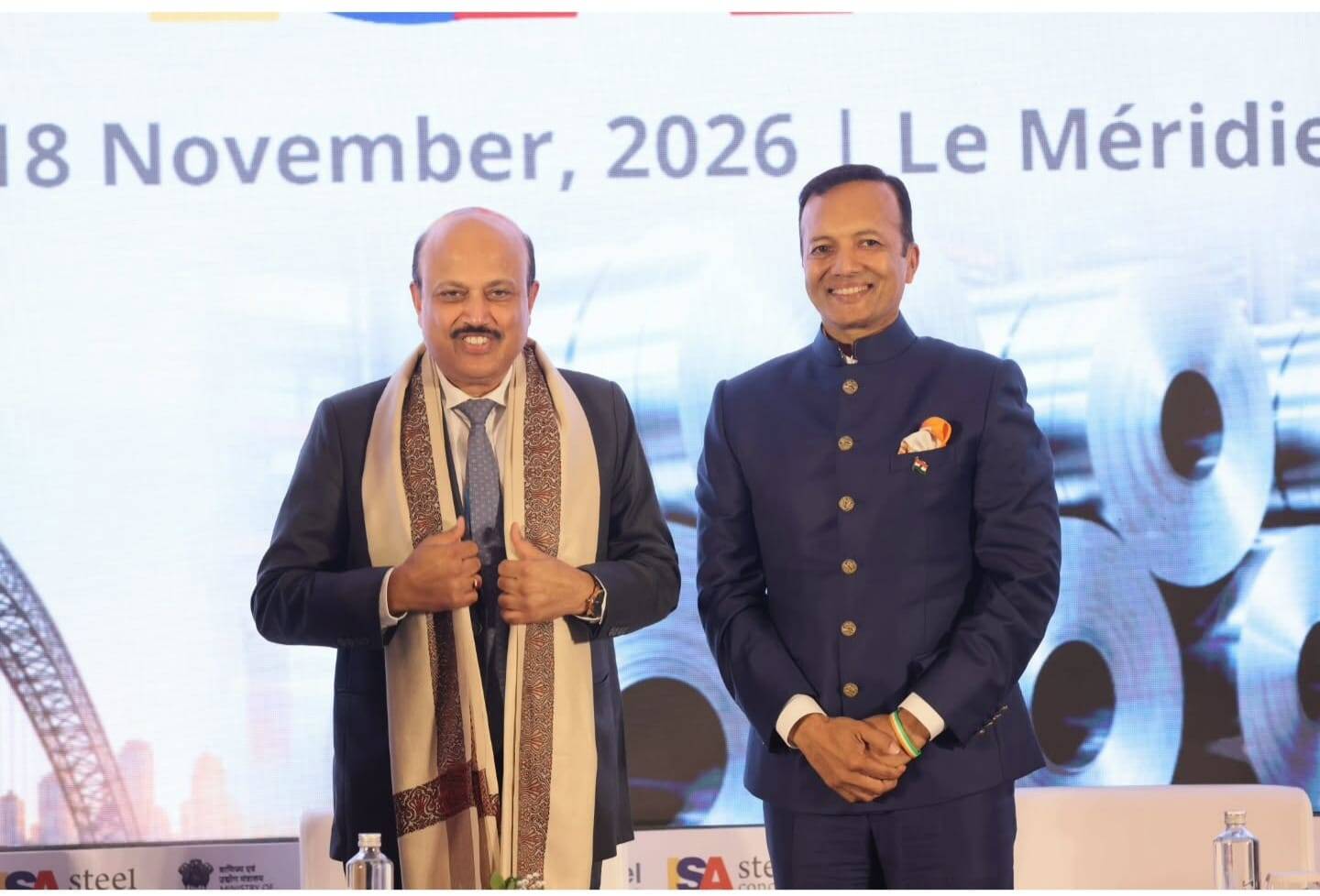
 Naveen Jindal, President of the Indian Steel Association, highlights the impact of high raw material costs and levies outside GST on the global competitiveness of Indian steelmakers.
The Union Government will examine the impact of taxes and levies outside the Goods and Services Tax (GST) framework on India’s steel industry, as domestic manufacturers seek greater cost competitiveness in international markets. The issue emerged as a major policy concern at the seventh ISA Steel Conclave 2026, organised by the Indian Steel Association (ISA) in New Delhi.The two-day conclave brought together policymakers, steel manufacturers and industry experts to examine India’s expanding steel production capacity, dependence on imported raw materials, international trade pressures and the technological changes required to support future growth.Addressing the concluding session through a video message, Union Commerce and Industry Minister Piyush Goyal said the industry’s next phase of development must be defined not only by higher production volumes but also by quality, reliability and value addition.“Our ambition must now extend beyond producing more steel to producing the world’s most trusted steel,” Goyal said. He called for a transition from supplying conventional steel products to delivering specialised solutions for shipbuilding, modern construction and advanced manufacturing.The Minister linked the industry’s prospects to India’s broader export ambitions, noting that the country’s exports had reached $863 billion in FY2025-26 and expressing confidence that they could touch $1 trillion in the current financial year. He also referred to the ₹25,000 crore Export Promotion Mission as an initiative intended to help smaller enterprises address export-related certification and compliance requirements.Goyal assured manufacturers that the Government would protect Indian steelmakers against unfair trade practices. However, balancing domestic industry protection with access to competitively priced raw materials and steel products remains an important consideration for policymakers, particularly as infrastructure and manufacturing demand continues to expand.One of the most significant issues raised at the conclave concerned the cumulative impact of taxes, royalties and other statutory charges that remain outside GST.Naveen Jindal, Member of Parliament, Chairman of Jindal Steel Limited and President of the Indian Steel Association, argued that these costs place Indian manufacturers at a disadvantage against international competitors.“Indian companies pay several levies that are not subsumed under GST, such as royalty on raw materials, high premiums on coal and iron ore auctions, and electricity duty,” Jindal said.According to estimates presented by Jindal, these charges account for approximately 10–12% of production costs in India, compared with 1–2% in certain competing markets. These figures represent the industry’s assessment and would require a comparable evaluation of taxation and production costs across countries.Jindal also pointed to high auction premiums on iron ore mining leases, saying that some companies had paid premiums exceeding 100%, substantially increasing their raw material costs. Since several of these charges fall outside GST, exporters cannot claim input tax credits against them.Commerce Secretary Rajesh Agrawal acknowledged the concern and indicated that the Government would examine possible solutions.“These are not easy solutions, as they involve both state and central levies, but I will work within the Government to see how the Indian steel industry can become the most cost efficient producer in the world,” Agrawal said.His remarks suggested a willingness to review the industry’s cost structure, although no specific tax changes, timelines or policy commitments were announced.Any reform would require coordination between the Centre and state governments, particularly because mining royalties, electricity duties and related charges constitute important sources of public revenue. The policy challenge would be to improve industrial competitiveness without creating disproportionate fiscal pressures on mineral-producing states.The discussions also highlighted the strategic importance of coking coal, an essential input in conventional blast-furnace steelmaking. Despite substantial domestic coal resources, India remains heavily dependent on imported metallurgical coal of the quality required by its integrated steel plants.This dependence exposes manufacturers to international price fluctuations, freight costs and supply disruptions. The fourth ISA Coking Coal Summit, held alongside the conclave, examined these vulnerabilities and the implications of carbon pricing for future steel production.The industry must also contend with the growing importance of low-carbon steel in international markets. Investments in energy efficiency, scrap-based production, cleaner technologies and alternative ironmaking processes will increasingly influence export competitiveness, particularly where importing countries introduce carbon-related trade requirements.India’s ambition to achieve 300 million tonnes of steelmaking capacity will therefore require more than investments in additional plants. It will also depend on reliable raw material supplies, affordable energy, transport infrastructure and the ability to produce specialised grades for high-value industrial applications.The conclave examined the emergence of steel manufacturing centres beyond the traditional industrial regions. A McKinsey presentation identified approximately 50 million tonnes of steel capacity associated with Vidarbha, 17.8 million tonnes in Andhra Pradesh and 10.5 million tonnes in Koppal, Karnataka. The figures were presented as part of the discussion on emerging steel hubs, rather than independently verified operational capacity.Alok Sahay, Secretary General and Executive Head of ISA, cited Gadchiroli in Maharashtra as an example of how mineral availability, infrastructure and policy support could encourage industrial investment.However, the expansion of steel production into new regions will also require careful assessment of environmental clearances, water availability, land requirements and local infrastructure. The commercial viability of proposed projects will depend on these factors as much as on mineral access.Commerce Secretary Agrawal also encouraged steelmakers to explore markets across Africa, Latin America, ASEAN and Oceania, reflecting the need to diversify export destinations amid changing global trade conditions.The Indian Steel Association, which represents approximately 90% of India’s crude steelmaking capacity, said it would submit the conclave’s recommendations to the Government. Two knowledge reports prepared by EY-Parthenon in consultation with ISA were also released, examining the steel industry’s economic contribution and the challenges associated with coking coal.The conclave underscored a central issue confronting India’s steel industry: expanding capacity is necessary to meet future demand, but higher production alone will not guarantee international competitiveness. The effectiveness of the Government’s response will depend on whether concerns over taxation, raw material security, trade practices and technological modernisation translate into measurable policy and industrial outcomes.
