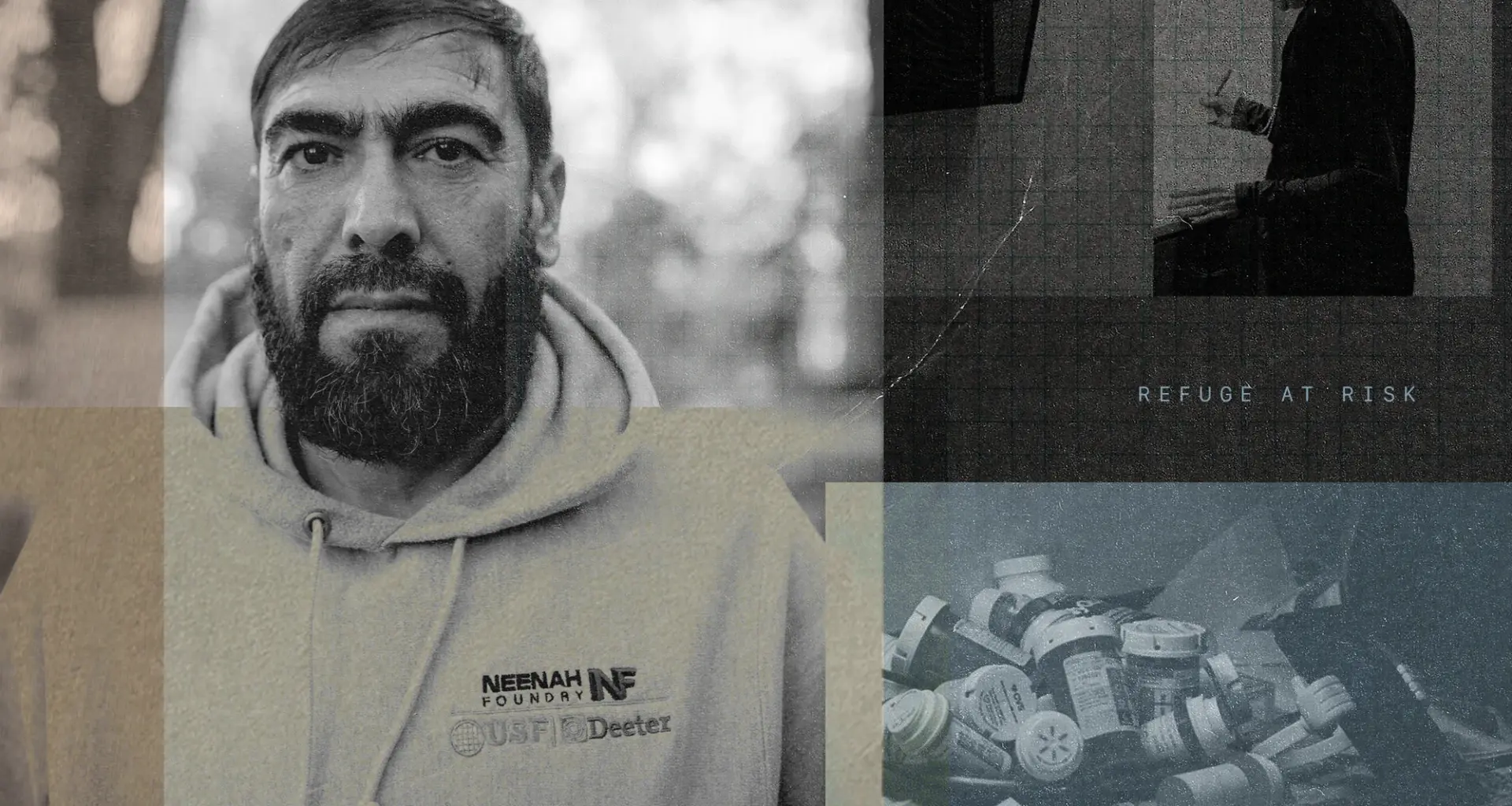
A man diagnosed with cancer. A woman in need of eye surgery. Refugees with post-traumatic stress disorder from their experiences in their home countries. Close to 1,000 legal immigrants have lost healthcare in Nebraska since Oct. 1.

Photo illustration by Hanscom Park Studio
Tooryalai Adil pushed through the pain. Until he couldn’t.
The 48-year-old lived in discomfort. Since coming to the U.S. from Afghanistan in 2021, he’d developed full-body aches, swelling in his lungs and occasional difficulty using the restroom. It wasn’t ideal, but he managed.
But that night, Adil’s pain grew so excruciating it woke him from his sleep. It was January 2026, and he lived a 45-minute walk from the closest emergency room. He called a friend, who drove him from his central Lincoln apartment to Bryan Health in the early hours of the morning.
As the year progressed, so did his condition. Adil walked those 45 minutes more than once, when friends working the night shift couldn’t give him a ride. He lost his job on the Kawasaki assembly line — he could no longer work through the pain.
With the help of Catholic Social Services, Adil applied for and received Medicaid coverage. In September, he underwent a biopsy. It confirmed what doctors already suspected: Adil had prostate cancer. They recommended a minimally invasive surgery.
Then he received a letter from the state: He was no longer eligible for Medicaid. Soon, he would lose coverage. Fearing lifelong debt, Adil canceled his next appointment.
“I don’t have a job, I don’t have money, I don’t have Medicaid. How can I go to the doctor?” he said in Pashto through an interpreter.
Adil is among the estimated 1,000 legal immigrants living in Nebraska who lost Medicaid starting Oct. 1, after federal legislation known as the One Big Beautiful Bill Act made sweeping changes to the health insurance program. The change bars refugees, asylees and other previously eligible immigrants from receiving Medicaid unless they have acquired a green card. The White House has stated that immigrants must be able to support themselves without taking from taxpayer-funded benefits programs.
 A pile of medications sits beside Tooryalai Adil at his home in Lincoln on Nov. 13. The meds were prescribed to help treat symptoms of prostate cancer. Photo by Allison Hess for the Flatwater Free Press
 Bottles of Tooryalai Adil’s medicine. Doctors prescribed Adil a number of medications to treat symptoms of prostate cancer. Photo by Allison Hess for the Flatwater Free Press
Healthcare workers say cutting Medicaid eligibility for refugees and asylees adds strain to an already taxed healthcare system. Free and low-cost clinics are left shouldering a heavier patient load with stagnant funding. Some patients, like Adil, are skipping vital care entirely, afraid of a large bill showing up in the mail.
Federal funds cover short-term medical care for refugees for only a year after entering the country, making many ineligible. Emergency rooms are legally required to treat medical emergencies, regardless of someone’s ability to pay — but that doesn’t mean hospitals won’t send a bill down the line.
“Anytime you mix healthcare with immigration policy, it gets awfully complex,” said Jeremy Nordquist, CEO of the Nebraska Hospital Association. “It creates a patchwork, Swiss cheese approach here to our coverage now for refugees and asylum seekers.”
***
After federal lawmakers approved President Donald Trump’s legislative package in summer 2025, advocates across Nebraska began bracing for major cuts to the social services their refugee clients relied on.
First came the SNAP cuts. Immigrant support groups and food banks rallied to keep food on the table for families. Still, advocates said many went hungry, forced to choose between eating or paying rent.
Then came the Medicaid cuts.
Advocates made lists of medically fragile patients who would be in immediate danger if they lost health insurance. There was the single mother undergoing chemotherapy and the man with severe multiple sclerosis. There were older refugees with Parkinson’s and others with psychosis and post-traumatic stress disorder from their experiences in war-torn home countries. Each was unlikely to survive without ongoing care, advocates argued to state officials.
“It’s not inappropriate to say, ‘We have to make some hard choices,’” said Kelly Lytle, who works with refugees through the CHI Health Clinic in Omaha. “But I think a lot of people, who are decent people, who may think differently than me, would not want people to suffer and die unnecessarily.”
Some states, including New York and New Mexico, have put state funds toward healthcare for the immigrant groups that lost Medicaid.
Lytle hoped that Nebraska’s Department of Health and Human Services would step in to assist that smaller group of medically fragile refugees. But as the department began sending out notices to families, it became clear that wasn’t going to happen.
DHHS launched an online advertising campaign to raise awareness of the change, including an FAQ and information on other programs that could help, said spokesperson Jeff Powell.
“DHHS has also provided updates at its advisory committee meetings and held multiple online sessions with community partners to go over the changes and provide additional resources,” Powell said in a statement.
 Nancy Johner at Clinic with a Heart in Lincoln. Johner serves as the executive director of the clinic. Photo by Allison Hess for the Flatwater Free Press
 Staff in the hallway of Clinic with a Heart in Lincoln. After checking in, patients are escorted to private exam rooms for care. Photo by Allison Hess for the Flatwater Free Press
The Center for Immigrant and Refugee Advancement created Medicaid flyers in eight languages to help refugees understand the changes. They encouraged refugees to see their doctors before losing coverage, schedule any needed procedures as quickly as possible and ask for a three-month supply of their prescribed medications.
The Center for Legal Immigration Assistance in Lincoln has seen small strokes of luck. Kewan Assad, a DOJ-accredited representative with the organization, said one of her clients had his green card application expedited after submitting a doctor’s letter describing his condition to federal immigration services, allowing him to keep coverage. They’re now encouraging their most fragile clients to do the same.
Not everyone could get last-minute care before losing benefits. Before the cutoff, Hannah Vlach’s nonprofit Restoring Dignity helped a client schedule eye surgery. The woman, a Rohingya refugee who fled Myanmar, had cataracts and glaucoma, making it impossible to work or drive.
Her surgery was scheduled for Oct. 1. Vlach said the hospital called days before the procedure with grim news: They had been informed the woman was no longer eligible for Medicaid. Her surgery was canceled.
“If she doesn’t get this surgery, she’s probably going to become permanently blind,” Vlach said. “She’s diabetic, her daughter’s diabetic, so it’s just … a whole crisis. They already lost SNAP. Now they’ve lost Medicaid.”
Mustafa Rfat, an assistant professor at the University of Nebraska at Omaha, knows the pain of being unable to access needed healthcare. Originally from Iraq, Rfat came to the U.S. as a refugee in 2011. He has a condition called ankylosing spondylitis, an inflammatory disease along the spine that causes severe pain.
 Mustafa Rfat, an assistant professor at UNO. Courtesy photo
Without Medicaid, he said, he wouldn’t have gotten treatment for his condition, which allowed him to pursue his studies and eventually get a doctorate in social work. He worries others, now cut off from medical services, won’t get the same opportunities.
He described a refugee family in Omaha whose child has severe health issues and relies on assistive devices to eat. The family lost Medicaid and subsequently lost access to their child’s doctor and medication — “like a death sentence,” Rfat said. The father is working, but because they lost home care services, he has to stay home more frequently to take care of his child. He’s now at risk of losing his job.
“So you’re seeing that ripple effect,” he said. “It’s not only just a medical issue. It’s not only just an assistive device issue. It’s not only home care services. It’s not only a human cost.”
***
By 5 p.m. on an early November night, the waiting room at Clinic with a Heart brimmed with patients.
Families spoke softly amongst each other, some in English, others in Spanish. Interpreters sat on call. The front desk buzzed with activity as patients checked in and workers answered any lingering questions before they saw a doctor.
The Lincoln clinic served 20 patients that night. Located in the Near South neighborhood, the clinic is well-situated to provide care to some of the city’s poorest residents.
It’s also well-equipped to help refugees. The clinic asks patients to call for an appointment so an interpreter will be available when they arrive. Last year, Clinic with a Heart served people speaking 29 different languages, said executive director Nancy Johner, including patients from Afghanistan, Bosnia and many other countries. The year before, it was 34.
 Shoes for patients are stacked on shelves of Clinic with a Heart in Lincoln. The clinic provides shoes to those in need as part of its services. Photo by Allison Hess for the Flatwater Free Press Sindy Alvarez in the waiting room of Clinic with a Heart in Lincoln. Alvarez cleans the room after patients leave for the evening. Photo by Allison Hess for the Flatwater Free Press
Now, they’re in a state of wait-and-see. The clinic plans to ask new patients whether they recently have lost Medicaid, Johner said. It’s not something they previously tracked, but in the wake of the cuts, she wants to know how many newcomers are walking through their doors because they lost access to their primary care provider.
The clinic can’t replace primary care, Johner said. Funding allows for patients to have three free medical appointments per year at Clinic with a Heart. Finding them a medical home — somewhere where they can get regular checkups and specialized care — is a priority.
“It’s not fair to them, because we brought them here,” Johner said. “You tell someone, ‘Yep, come on in, we’ll take care of you,’ and then this happens.”
Refugees with chronic conditions that require ongoing care aren’t well-suited to free clinics. Neither are those like Adil, with significant health concerns. They can get important care to stabilize them and start them on the right track, but then they need a dedicated provider, Johner said. The clinic can’t offer specialized services like chemotherapy.
Clinic with a Heart frequently refers patients to other providers, including Bluestem Health in Lincoln, which charges a sliding scale fee for patients without insurance.
Bluestem receives federal funding to provide primary care services regardless of a patient’s ability to pay. But that funding has remained stagnant since 2010, said CEO Brad Meyer. Over the same time frame, the organization has gone from serving 9,000 patients to 21,000.
It’s too early to quantify the impact of the Medicaid restrictions on Bluestem and its patients, he said. The health system doesn’t ask immigration status. For some refugees, even the sliding scale fee is too much to pay. And as more clients lose Medicaid, it becomes harder for the health system to recoup the cost of providing care.
“We’ve got about a $28 million budget, and only $2 million of that comes from grants from the federal and state government,” Meyer said. “So we rely heavily on patient encounters to help keep the lights on.”
***
After months of uncertainty, Adil knows what’s wrong with his body, knows about the cancer cells sitting like a ticking time bomb. Knows he needs treatment.
But he’s behind on rent. He has a family still in Afghanistan, relying on him to send money home. And he has been unable to find another job since he left Kawasaki.
The Afghan community in Lincoln knows about his plight, he said. His friends and his roommate help where they can. But they have their own families to look out for.
His roommate, another immigrant, has health insurance through his job at Smart Chicken. Adil worked there before Kawasaki, he said, but he’s in no condition to return to the plant.
So Adil sits, waits and wonders. He fiddles with his phone, trying to set up a DoorDash account. He can’t work an assembly line, but maybe he can deliver food using a car bought from a fellow immigrant.
Folded blankets and comforters act as a low bed in the corner of the living room in the apartment he shares. Beside it on the ground, lit by the dim yellow glow of a lamp, lay a pile of orange medicine bottles.
There’s tamsulosin, to help with urine flow; ondansetron, to prevent nausea and vomiting; meloxicam, to reduce pain and inflammation. Pop, swig, swallow.
Some of the bottles are already empty; others half full.
When Adil runs out, there are no guaranteed refills.
 Refuge at Risk: About this series
Halted refugee resettlement, rescinded SNAP benefits, fear of deportation – read along in the coming months as we go deeper into how the changes to immigration policy under the Trump administration have upended life for the thousands of refugees who now call Nebraska home.