A delegation of 250 young American leaders, elected officials and influencers from all 50 U.S. states visited Israel this week as part of a Foreign Ministry initiative aimed at strengthening ties with the next generation of American decision-makers, including those who could shape Washington’s policies toward Israel in the coming decade.
The visit was organized under “50 States One Israel,” the flagship project of the ministry’s North America Division. The delegation included politicians, journalists, religious figures and community leaders who met senior Israeli officials, toured communities devastated by the October 7 attacks and explored Israel’s technology sector.

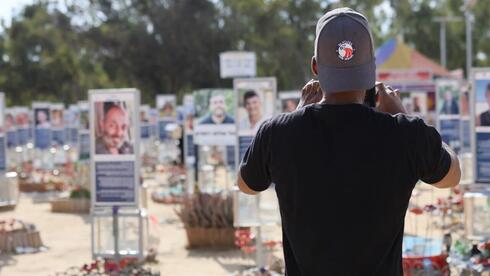
A member of the American delegation visits the Nova music festival massacre site
(Photo: Shlomi Amsalem and Arnon Busani, GPO)
For Lior Haiat, the Foreign Ministry’s deputy director-general for North America, the initiative marks the final major project of his tenure before taking up his next post as Israel’s ambassador to Italy. It is the third delegation organized under the program. In September 2025, Israel hosted 250 state legislators, five from each state, followed by another 250 American technology leaders in October 2026.
“Relations with the United States are not conducted solely along the Washington-Jerusalem axis,” Haiat said, explaining the strategy behind the initiative, which has an estimated budget of five million shekels and involves approximately 30 Foreign Ministry employees and representatives at Israeli diplomatic missions across the United States.
“Tomorrow’s Washington isn’t in Washington,” he said. “The people who will determine the level of American support for Israel in five to 10 years are currently in Florida, Montana and Hawaii. We need to reach them before they get to the capital.”
According to Haiat, a Foreign Ministry review found that 70% of sitting members of Congress previously served as state legislators, a political arena that generally pays little attention to foreign affairs. He also said the newly elected Congress includes approximately 100 newcomers, 90% of whom have never publicly expressed a position on Israel.

Foreign Ministry officials with members of the delegation of 250 young American leaders
(Photo: Shlomi Amsalem and Arnon Busani, GPO)
Haiat said earlier delegations had already produced tangible results, including efforts to advance pro-Israel legislation at the state level and the establishment of an organization bringing together state lawmakers who support Israel.
Asked whether investing in future American leaders was worthwhile at a time when Israel’s standing in U.S. public opinion faces growing challenges, Haiat argued that the benefits were not limited to the distant future.
“They are leaders and influencers today,” he said. “The investment is both immediate and long-term.”
He added that interest in the program had been strong, with one unusual exception during a previous delegation: A participant stepped off the plane at the last minute, saying she did not want to take part in a “propaganda tour.”
Dor Shapira, a senior official in the Foreign Ministry’s North America Division, said the initiative was designed to establish direct relationships with emerging American leaders before they reach positions of national influence. The goal, he explained, was to develop ambassadors of familiarity, understanding and friendship in each of the 50 states.
Participants were selected by Israeli diplomatic missions in the United States based on their influence in their home states. Eligibility criteria included having never previously visited Israel and not being classified by the ministry as anti-Israel.
About half the delegation consisted of women, and participants represented both the Democratic and Republican parties. The group included mayors, state legislators, political advisers, pastors, priests and rabbis, alongside social media influencers, journalists, bloggers and community leaders from Indian American, Black and Asian American communities.
The itinerary combined diplomatic meetings, historical tours and visits to security and technology sites. In Jerusalem, participants toured the Old City and Yad Vashem, Israel’s Holocaust memorial, and met President Isaac Herzog, Foreign Minister Gideon Sa’ar and members of the Knesset, Israel’s parliament.

American delegation members plant trees during their visit to Israel
(Photo: Shlomi Amsalem and Arnon Busani, GPO)
The delegation then traveled south to communities near the Gaza border, visiting the site of the Nova music festival massacre and kibbutzim attacked on October 7, 2023. Participants heard firsthand accounts from survivors of the Hamas-led attacks.
American lone soldiers serving in the Israel Defense Forces, some originally from the same states as members of the delegation, also joined the tour. In Ofakim, participants planted 50 trees, one representing each U.S. state, adding to the 100 trees planted by previous delegations.
The program also included a gala dinner in Jerusalem and a luncheon in Jaffa organized in cooperation with the U.S. Embassy in Israel. During the luncheon, participants spoke with Israeli Arab content creator Nas Daily about the complexities of life in Israel. Wednesday and Thursday were devoted to Israel’s innovation industry in Tel Aviv and briefings on the country’s geopolitical position in the Middle East.
Addressing the delegation, Foreign Minister Sa’ar emphasized Israel’s strategic importance to the United States.
“America has no more loyal ally than Israel,” Sa’ar said. “Israel is a strategic asset to the United States. It stands on the front line against Iran, its terrorist proxies and radical Islamist forces, which threaten not only Israel but also America and Western civilization as a whole.”
Several participants described what they saw as a gap between American media coverage of Israel and the reality they encountered during their visit.
Jonathan Choe, a journalist and senior fellow at the Seattle-based Discovery Institute, said he and other participants faced criticism on social media after a group photograph of the delegation was published. Rather than asking for the photograph to be removed, they decided to post additional pictures from the trip.
Choe said he was particularly struck by the determination and resilience of Israelis, which he believed enabled them to recover and rebuild after devastating events.

Young leaders representing all 50 U.S. states during their visit to Israel
(Photo: Shlomi Amsalem and Arnon Busani, GPO)
Emma Mason, an academic and social activist from Illinois, said she had expected Israelis to express more extreme views toward Palestinians following the October 7 attacks. Instead, she said she encountered many people who simply wanted to live in security and coexist peacefully.
Cesar Grajales, a political commentator from Miami, said the visit to the Nova festival site and the devastated kibbutzim had left a profound impression on him. He pledged to continue speaking about the importance of U.S.-Israel relations through television, radio and his public activities.
William Gallagher, deputy director of Americans for Prosperity in Kentucky, said American media coverage did not reflect the diversity he encountered in Jerusalem’s Old City.
“Arab Israelis are integrated into everyday life, they vote, and they care about the future of their country,” Gallagher said.

Emma Mason of Chicago during the delegation’s visit to Israel
(Photo: Shlomi Amsalem and Arnon Busani, GPO)
He added that visiting the communities near Gaza had helped him understand what he described as the existential nature of the threats facing Israel, something he said was difficult to grasp from 6,000 miles away.
Joshua Angel-Abad Solano, a political activist and organizational leader from Minnesota, said his views of Israel had been shaped in recent years by media coverage and social media. The visit, he said, exposed him to a more complex reality than the one he had previously known.
“I had the privilege of spending time here with Arab Israelis and Jewish Israelis, all of whom work, live and serve their country proudly side by side,” he said.
Chris Jensen, the mayor of Noblesville, Indiana, described the trip as “an emotional and eye-opening experience” and encouraged friends and neighbors back home to listen, learn and find common ground with Israel.
Hannah Fields, an educator and robotics mentor from Wyoming, similarly described the visit as a “perspective-changing experience” that challenged misconceptions and gave her a firsthand understanding of Israel and its people.
For the Foreign Ministry, these encounters represent the central premise of the initiative: building relationships with Americans who already influence their communities and may eventually help shape the direction of U.S. policy toward Israel.